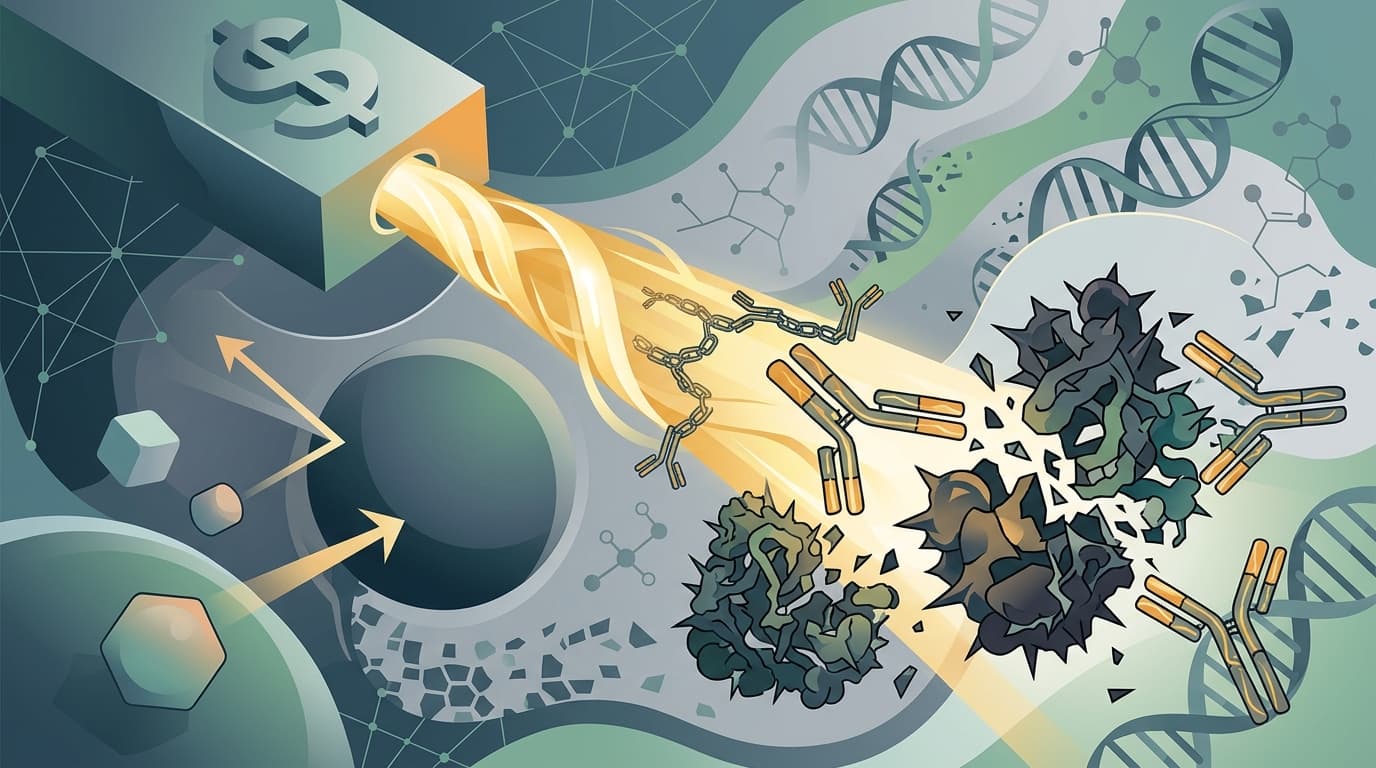

AstraZeneca just paid $25 million to license a cancer drug that doesn't block tumor proteins, it destroys them completely. The preclinical EGFR degrader from Pinetree Therapeutics could rescue patients who've run out of options on current treatments.
Imagine you're trying to stop an intruder from getting into your house. Traditional cancer drugs work like deadbolts: they block the door. But what happens when the intruder picks the lock? You're out of options.
That's essentially what happens with EGFR-driven lung cancers. Drugs like osimertinib block the EGFR protein from sending growth signals. They work brilliantly, until the cancer mutates and slips past the blockade. One key on-target resistance mechanism is a mutation called C797S that renders osimertinib ineffective. Patients who progress on osimertinib currently have no approved targeted options.
AstraZeneca just paid $25 million because a small Cambridge biotech might have found a way to stop playing defense entirely.
On April 29, 2026, AstraZeneca exercised its option to license PTX-299, a preclinical EGFR degrader developed by Pinetree Therapeutics. The $25 million option payment gives AstraZeneca full global development and commercialization rights. And the total deal could be worth over $500 million in milestones and royalties if everything pans out.
The concept behind PTX-299 is elegantly simple: instead of blocking EGFR's signaling (the deadbolt approach), you destroy the entire protein. No protein, no signal, no tumor growth. It doesn't matter if the cancer mutates its lock; there's no door left to pick.
Pinetree calls its technology the AbReptor™ platform, and it works differently from most protein degraders you've heard about. Traditional PROTACs (proteolysis-targeting chimeras) work inside the cell. Pinetree's approach uses bispecific antibodies that grab onto the target protein on the cell surface, then co-engage a special internalization receptor. This triggers the cell to swallow both proteins and route them to lysosomes, the cell's recycling centers, where they get broken down.
Think of it like tricking the cell into taking out its own trash.
This isn't a cold call. AstraZeneca and Pinetree first partnered in with an exclusive option and license agreement. That original deal included up to $45 million in upfront and near-term payments, giving AstraZeneca time to evaluate Pinetree's preclinical progress before committing further.

Chiesi just dropped $1.9 billion on KalVista to grab the only oral pill for acute hereditary angioedema attacks. In a week with five biotech acquisitions, this bet on needles going extinct in HAE might be the smartest of the bunch.


Join thousands of biotech professionals who start their day with our free, daily briefing.

Two years later, they're pulling the trigger. That tells you something important: whatever Pinetree showed them in preclinical studies was convincing enough to justify taking on full development costs. AstraZeneca now owns the program outright and will shepherd it toward the clinic.
For Pinetree, this validation came at a critical time. The company closed an oversubscribed $47 million Series B in October 2025 to push its lead programs toward Phase I trials. The AstraZeneca exercise essentially confirms that at least one major pharma player believes their platform works.
AstraZeneca isn't betting on degraders in a vacuum. The entire field is hitting an inflection point.
Arvinas and Pfizer's vepdegestrant became the first PROTAC to reach NDA submission in June 2025, targeting estrogen receptor-positive breast cancer. At least eight PROTAC assets have now reached Phase 2 or beyond. And in the EGFR space specifically, C4 Therapeutics is already running clinical trials with CFT-8919, a degrader targeting the L858R EGFR mutation in lung cancer.
The pharma giants are piling in. Gilead signed an option deal with Kymera for a CDK2-targeting molecular glue degrader in June 2025. Amgen acquired Dark Blue Therapeutics for targeted protein degradation assets in blood cancers. The message is clear: big pharma sees degradation as the next pillar of precision oncology, not just a niche experiment.
Most degraders in the clinic right now are small molecules that work inside cells. Pinetree is playing a different game. Their antibody-based approach targets proteins on the cell surface, a space that traditional PROTACs can't easily reach. EGFR sits on the outside of cells, making it a natural fit.
The AbReptor™ platform also offers a potential selectivity advantage. Because it uses antibodies for target recognition, you can engineer exquisite specificity for mutant EGFR while sparing the normal (wild-type) version. That matters enormously for toxicity; EGFR isn't just a cancer protein. It plays important roles in healthy skin and gut tissue. Kill too much wild-type EGFR, and you get brutal side effects.
Preclinical data on similar degrader approaches have shown they can eliminate even triple-mutant EGFR (the nastiest resistance variants, like Del19/T790M/C797S) while leaving wild-type EGFR alone. If PTX-299 can replicate that profile in humans, it would address an enormous unmet need.
Let's be real: PTX-299 is still preclinical. It hasn't been tested in a single human being yet. The path from promising preclinical data to an approved drug is littered with expensive failures. Most candidates don't make it.
But the logic here is sound. EGFR resistance is inevitable with current drugs. Degradation offers a mechanistically distinct solution. And AstraZeneca, which already sells osimertinib (branded as Tagrisso, one of the world's top cancer drugs), has every reason to own the next chapter of EGFR treatment.
The $25 million upfront is pocket change for AstraZeneca. The real investment comes later: the clinical trials, the manufacturing scale-up, the regulatory filings. If PTX-299 works, though, you're looking at a drug that could rescue the millions of NSCLC patients who eventually fail on current EGFR inhibitors.
For Pinetree, this deal is proof of concept for the entire AbReptor™ platform. They're expanding into trispecific degraders for inflammatory diseases and developing degrading antibody-drug conjugates. If AstraZeneca can advance PTX-299 successfully, it validates the whole approach and makes every other program in Pinetree's pipeline more valuable.
Sometimes the best defense isn't a better lock. It's removing the door entirely.
GSK and Alector just killed their second Alzheimer's trial in six months, effectively torching a $700 million partnership. The failure raises uncomfortable questions about whether targeting the brain's immune system can actually slow neurodegeneration.