AstraZeneca Just Bet $1.5 Billion That AI Can Crack the Liver
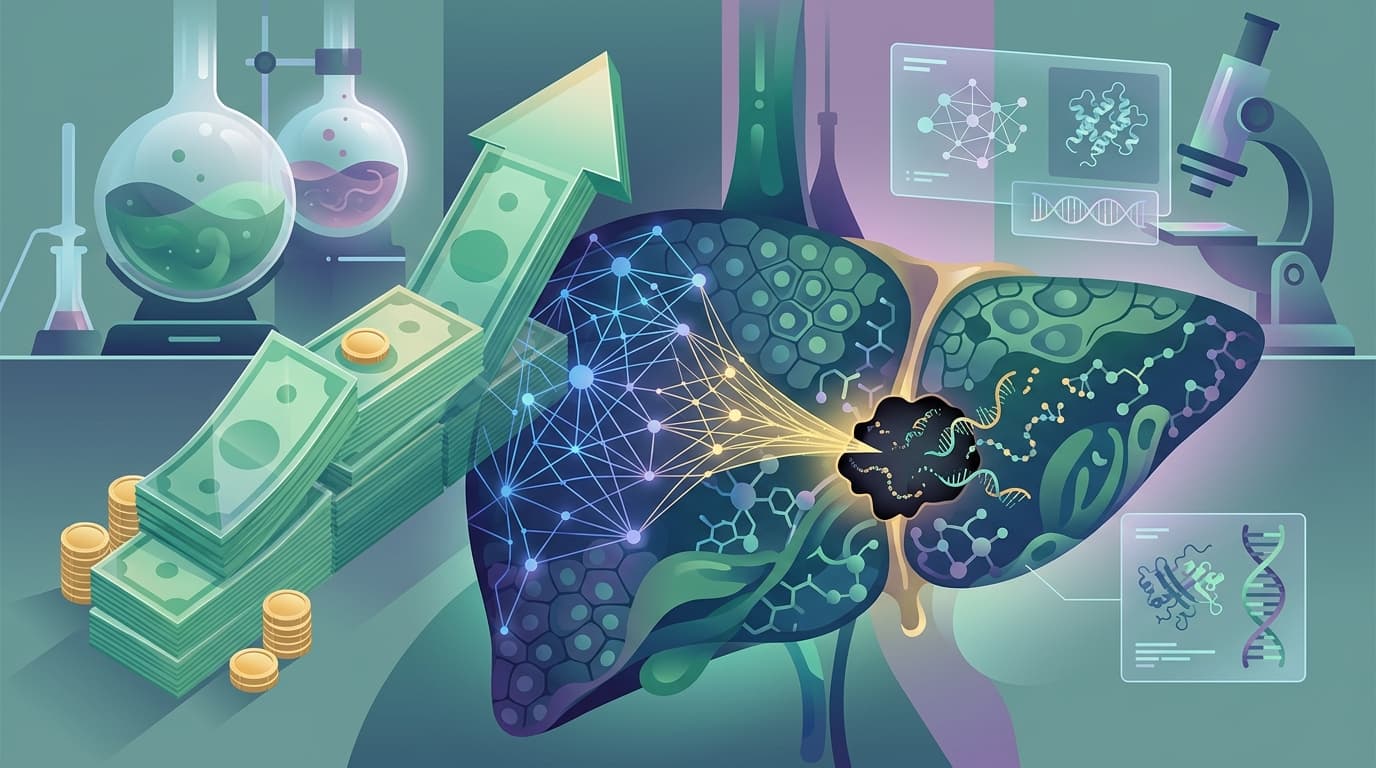
AstraZeneca just signed a $1.5 billion AI drug discovery deal with insitro to go after MASH and cardiomyopathies. It's one of the largest AI-pharma collaborations ever, and it tells you everything about where Big Pharma thinks the future of drug discovery is headed.
A Very Expensive Bet on a Very Hard Disease
MASH is the disease that eats drug pipelines for breakfast. Metabolic dysfunction-associated steatohepatitis (a fancy name for a liver disease driven by fat buildup and inflammation) has humbled some of the biggest names in pharma. Programs get killed. Trials disappoint. Billions vanish.
So when AstraZeneca writes a check to go after MASH using artificial intelligence, it's worth paying attention. Not because AI is magic, but because the check is $1.5 billion.
The pharma giant just inked a collaboration with insitro, the machine-learning drug discovery company founded by Stanford AI legend Daphne Koller. The deal covers both MASH and cardiomyopathies (diseases where the heart muscle doesn't pump properly), and it's one of the largest AI-driven drug discovery partnerships ever announced.
What $40 Million Buys You (and What $1.46 Billion Doesn't)
Let's talk about the money, because the structure tells you everything about how pharma really thinks about AI.
AstraZeneca is paying $40 million upfront. That's real cash, wired now. On top of that, insitro can earn up to roughly $1.46 billion in development and commercial milestones, plus single-digit royalties on future sales. Add it all up and you get the $1.5 billion headline number. (Bloomberg actually reported a figure as high as $1.86 billion, depending on how you count certain components, but most outlets and AstraZeneca's own materials land around $1.5 billion.)
The key word in that paragraph is "milestones." This isn't AstraZeneca handing over a suitcase full of cash. It's more like a performance bonus structure: insitro gets paid as candidates hit specific development goals. Think of it like buying a house with a small down payment and a very large mortgage that only kicks in if the house turns out to be made of gold.
That's classic pharma risk management. AstraZeneca limits its near-term exposure while locking in optionality on whatever insitro's platform discovers. If the AI finds nothing useful, AstraZeneca is out $40 million. If it produces a blockbuster drug, the milestone payments will look like a bargain.
Get tomorrow's biotech intelligence before your competitors.
Join thousands of biotech professionals who start their day with our free, daily briefing.
insitro's Secret Sauce
insitro isn't new to this game. Founded in 2018, the company has spent eight years building what it calls its Virtual Human platform: an AI system that combines massive-scale cellular experiments with population-level human genetics to find what actually causes a disease, not just what correlates with it.
The numbers behind the platform are staggering. insitro says it has accumulated over 20 petabytes of integrated cellular and clinical data (for context, that's roughly the storage equivalent of 20 million hours of HD video). The company runs its models on a 192 H100 GPU cluster, which is the kind of computing firepower usually reserved for training the large language models that power chatbots.
But insitro's real calling card is its pharma partner list. Gilead tapped the company for NASH target discovery. Bristol Myers Squibb partnered on ALS and frontotemporal dementia. Eli Lilly collaborated on predicting how small molecules behave in the body. This AstraZeneca deal is the biggest yet, and it validates the platform at a scale that's hard to ignore.
Why MASH Is Still Worth Fighting For
You might wonder why AstraZeneca is diving deeper into MASH when the field already has two approved drugs. Resmetirom got the green light in March 2024, and semaglutide followed in August 2025.
The answer: those approvals barely scratched the surface. The MASH treatment market could exceed $31 billion. The disease affects a huge population, and the biggest clinical challenge, actually reversing liver fibrosis (scarring), remains largely unsolved by current therapies.
AstraZeneca already has skin in this game. Its pipeline includes AZD2389, an anti-fibrotic candidate in Phase II, and early-stage work on a GLP-1-based program. But the company also recently axed AZD2693, an antisense therapy that flopped in a Phase 2b trial. That pattern of pruning losers and restocking the pipeline is exactly why the insitro deal makes strategic sense; it's a way to refill the funnel with AI-identified targets that might have a better shot.
The Bigger Picture: AI as a Standard Pharma Tool
Zoom out, and this deal fits into a seismic shift in how drug companies source their early pipelines. In 2024 alone, AI drug discovery deals totaled roughly $10 billion across the industry. Isomorphic Labs (Google DeepMind's drug discovery spinout) signed partnerships with both Eli Lilly and Novartis worth a combined $3 billion. Schrödinger landed a $2.3 billion deal with Novartis. Takeda partnered with Iambic in 2026 for up to $1.7 billion.
The AstraZeneca-insitro collaboration sits comfortably in this top tier. And the trend line is clear: pharma companies are treating AI platforms as a core sourcing channel for early discovery, not a side experiment or a PR stunt.
What's notable about the deal structure is what AstraZeneca didn't do. It didn't acquire insitro. It didn't license a late-stage asset. Instead, it's paying for access to a discovery engine and keeping all the clinical and commercial rights for itself. insitro does the early heavy lifting (finding targets, identifying disease biology, advancing candidates to the development stage), and AstraZeneca takes over from there.
It's the pharma equivalent of hiring a world-class scout instead of buying a team. You get the talent identification without the overhead of owning the whole operation.
The Bull Case and the Bear Case
The optimistic read: AI has matured enough that it can tackle diseases where traditional approaches have repeatedly failed. MASH biology is messy, involving metabolic, inflammatory, fibrotic, and genetic factors all tangled together. That complexity is exactly where machine learning should, in theory, outperform conventional target selection. If insitro's platform can identify the right targets in the right patient subgroups, this deal could look like a steal.
The skeptical read: milestone-heavy deals are easy to announce and hard to collect on. The $1.5 billion headline sounds impressive, but the vast majority of that money depends on drug candidates making it through clinical trials, which is where most drugs go to die regardless of how they were discovered. AI can accelerate early discovery, but it can't repeal the ~90% failure rate of clinical development.
Both sides have a point. The truth probably lands somewhere in between: AI is genuinely useful for finding better starting points, but it's not a shortcut past the brutal realities of human biology.
What to Watch
The real test won't come for years. insitro needs to deliver development candidates that AstraZeneca believes are worth advancing into clinical trials. Then those candidates need to actually work in patients.
In the meantime, keep an eye on the competitive landscape. FGF21 analogues like efruxifermin and pegozafermin are racing through late-stage MASH trials. Combination therapy strategies are gaining momentum. And the FDA's acceptance of a Letter of Intent to qualify liver stiffness measurements as a reasonably likely surrogate endpoint for MASH trials could shorten trial timelines for everyone, including whatever comes out of the insitro collaboration.
For now, the biggest takeaway is simple: big pharma isn't just flirting with AI anymore. It's writing billion-dollar checks and pointing the technology at some of medicine's hardest problems. Whether those bets pay off will define the next decade of drug development.
4 min read
The Bladder Cancer Drug That Just Got a Bigger Playground
The FDA just widened Anktiva's bladder cancer label to include high-grade papillary tumors, and it could reshape ImmunityBio's entire commercial story. Here's why a seemingly incremental regulatory update is actually a franchise-defining moment.