AstraZeneca Is Letting AI Design Its Next Cancer Drug From Scratch
AstraZeneca just signed a $247 million deal with Absci to let AI design a cancer antibody from scratch. It's the company's second major AI partnership in a single week, and it signals something bigger than one deal.
A Quarter-Billion-Dollar Bet on a Robot Chemist
Imagine asking a computer to invent a brand-new medicine, then watching it sketch out millions of possibilities in the time it takes you to order lunch. That's roughly what AstraZeneca just paid for.
The pharma giant signed a deal with Absci Corporation worth up to $247 million to discover a novel antibody for cancer. Not tweak an existing one. Not optimize something already in the pipeline. Design one from scratch, using generative AI. The deal includes an upfront payment, research funding, milestone payments, and royalties if a drug eventually reaches patients.
And this isn't even AstraZeneca's biggest AI bet this month. Just days earlier, the company inked a deal with insitro worth up to roughly $1.5 billion for AI-driven drug discovery in heart and liver diseases. Two massive AI partnerships in a single week? That's not dabbling. That's a strategy.
What Absci Actually Does
Absci calls itself a "generative AI drug creation company," which sounds like marketing fluff until you look at the tech underneath.
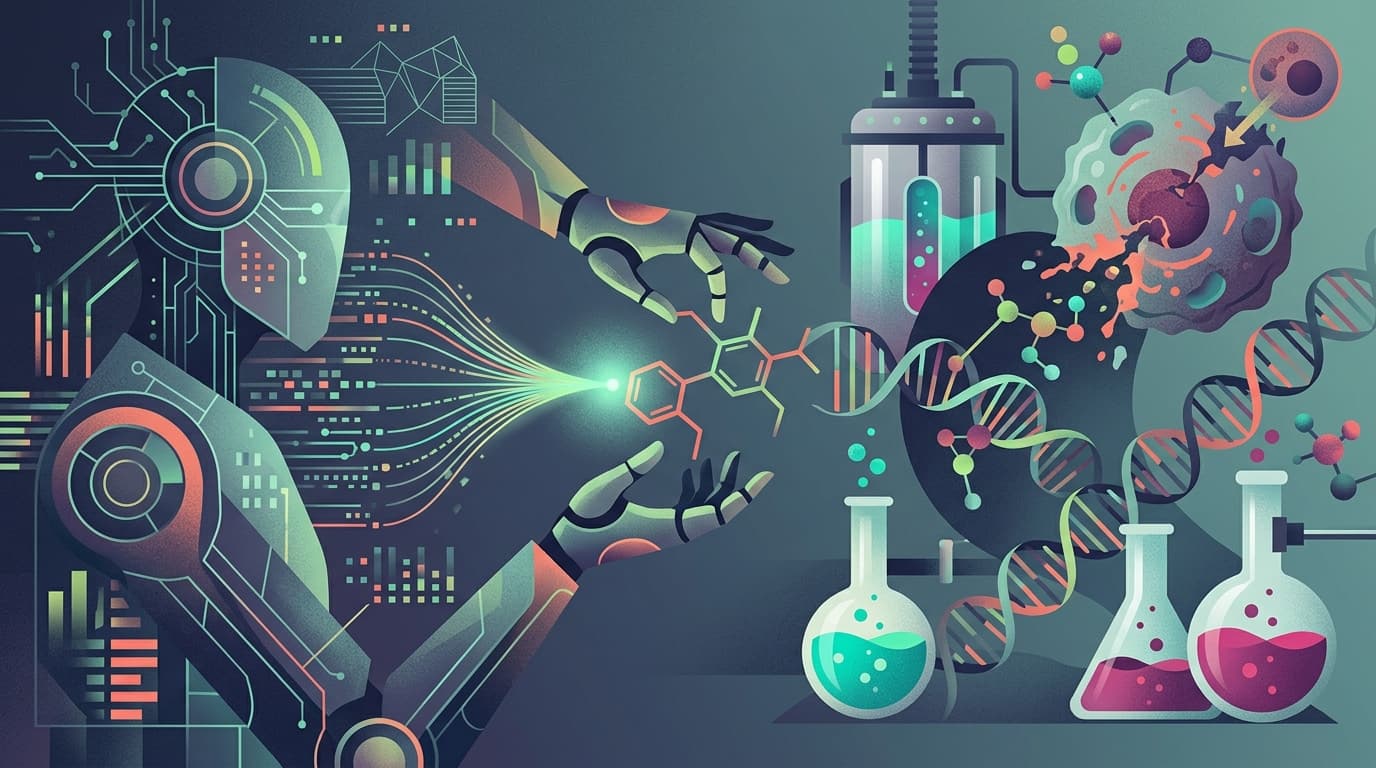
The company's platform works like a turbocharged design-and-test loop. Its AI engine (called Origin-1) generates millions of novel antibody designs computationally. Think of it like an architect drafting blueprints at superhuman speed, except instead of buildings, it's designing proteins that can latch onto cancer cells.
Then comes the part that separates Absci from a fancy chatbot: wet-lab validation at scale. The company says it can test nearly 3 million unique AI-generated designs per week in actual lab experiments. The whole cycle, from computer-generated concept to lab-confirmed antibody, can reportedly happen in about six weeks.
The key selling point is "zero-shot" design. That means Absci claims it can create antibodies against targets where no one has ever found a binder before. No training wheels, no reference antibodies to copy from. It's the molecular biology equivalent of writing a hit song in a genre that doesn't exist yet.
Get tomorrow's biotech intelligence before your competitors.
Join thousands of biotech professionals who start their day with our free, daily briefing.
Why AstraZeneca Keeps Swiping Right on AI
The Absci deal is part of a pattern that's hard to ignore. AstraZeneca has been on an AI dating spree in 2026, and it's not just casual.
Beyond Absci and insitro, the company has also partnered with Carterra on autonomous biologics discovery workflows, expanded an oncology AI collaboration with Immunai (eligible for up to $37.5 million), and previously worked with Tempus AI and Pathos. The company's CEO has publicly cited AI as a pillar of its broader strategy.
So what's driving this? The traditional way of discovering antibodies is slow, expensive, and often frustrating. You screen massive libraries of molecules, hoping something sticks to your target. It works, but it's a bit like finding a needle in a haystack by checking every piece of straw individually.
AI platforms promise to flip that equation: generate the needle first, then confirm it works. If the technology delivers, it could shave years and hundreds of millions of dollars off early discovery timelines. For a company like AstraZeneca, spreading bets across multiple AI partners is less risky than betting everything on one platform. It's a portfolio approach to a technology that's still proving itself.
The Fine Print Matters
Let's be clear about that $247 million headline number. Most of it is tied to milestones and royalties, meaning Absci only collects the full amount if the antibody makes it through clinical trials and generates real sales. The guaranteed money is the upfront payment and research funding, which weren't publicly broken down.
This is standard biotech deal math. The headline is designed to make investors excited, but the actual near-term economics are much smaller. Think of it like a real estate deal where the listing price is $247 million but the earnest money is a fraction of that.
For Absci, though, any validation from a top-five pharma company is huge. The company reported just $2.8 million in total revenue for all of 2025 and posted a net loss of $115.2 million that same year. Its accumulated deficit had swollen to $624.8 million by the end of 2025. This is a company that has been burning cash for years waiting for moments exactly like this one.
The stock tells the story of shifting sentiment. ABSI traded around $3.49 at the end of 2025 and dipped below $3 in March 2026. By mid-October, before this deal, it had climbed to roughly $9 per share. Investors were already sniffing something out.
Everyone Wants an AI Antibody Partner Now
AstraZeneca isn't alone in this shopping spree. The AI antibody discovery market in 2026 looks like the streaming wars of 2020: everyone is placing bets, deals are getting bigger, and nobody wants to be the last one without a platform partner.
Pfizer, Genentech, Jazz, and Takeda have all entered or expanded AI-enabled antibody collaborations this year. Genentech's deal with Earendil Labs carries potential value exceeding $1.5 billion. Takeda's expanded partnership with Nabla Bio includes over $1 billion in milestones. Jazz signed a $56 million upfront deal with AbCellera worth up to $876 million total.
The competitive landscape is crowded and getting more interesting by the quarter. Chai Discovery has landed platform-access deals with multiple top-ten pharmas. Antiverse focuses on notoriously difficult targets like GPCRs (receptors on cell surfaces that are critical drug targets but infamously hard to hit with antibodies). OpenProtein.AI deepened its work with Boehringer Ingelheim.
What separates the winners from the noise? The market increasingly values platforms that combine three things: generative AI design, proprietary biological data, and real-world lab validation. Pure software plays without wet-lab proof are falling behind.
The Bigger Picture
Two years ago, AI drug discovery felt like a science experiment. Today, it's becoming core infrastructure for the world's biggest pharmaceutical companies. AstraZeneca's willingness to sign two major AI deals in a single week tells you everything about where the industry is headed.
The $247 million Absci deal is, by itself, a mid-sized bet. But zoom out and it's one tile in a much larger mosaic. Pharma is no longer asking "should we use AI for drug discovery?" It's asking "which AI partners do we need, and how many?"
The real test comes next. Can Absci's AI-designed antibody actually make it through clinical trials and into patients? That journey will take years. But for now, the fact that AstraZeneca is willing to write checks this size says the industry believes AI-native biologics discovery has crossed from "interesting" to "essential."
And if it works? The way we discover medicines will never look the same.
4 min read
BMS Just Paid $1.5 Billion for a Company With Zero Approved Drugs
Bristol Myers Squibb is dropping $1.5 billion in cash on Orbital Therapeutics, a preclinical-stage startup with zero approved drugs and zero revenue. The bet says everything about Big Pharma's platform fever and the desperate race to fill patent cliffs.