The Three-Headed Antibody That Wants to Make Cold Tumors Hot
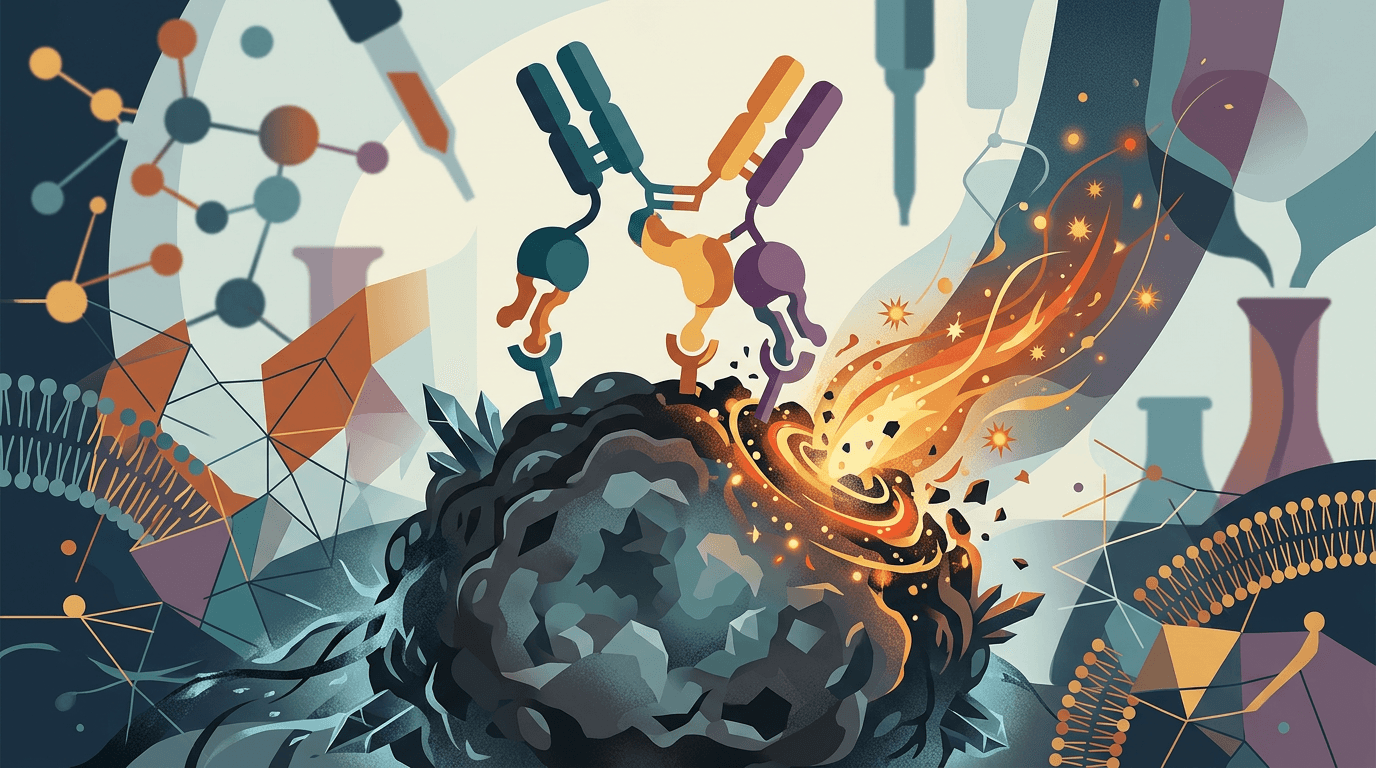
Akeso just sent the world's only trispecific antibody targeting ILT2, ILT4, and CSF1R into human trials. If one drug that hits three immune targets at once can turn cold tumors hot, it could rewrite the rules of cancer immunotherapy.
Most cancer immunotherapies work like a skeleton key: one drug, one lock. That approach has transformed oncology over the past decade. But for a huge chunk of patients, the lock doesn't budge. Their tumors are "cold," meaning the immune system barely notices them. These are the patients who don't respond to checkpoint inhibitors, and the biotech industry has been scrambling to figure out why.
Akeso thinks the answer isn't a better key. It's a key that opens three locks at once.
One Antibody, Three Targets
In March 2026, Akeso announced that its experimental drug AK150 received clearance from China's National Medical Products Administration (NMPA) to begin clinical trials in patients with advanced solid tumors. That's a routine regulatory milestone on the surface. What makes it unusual is what AK150 actually is: a trispecific antibody that simultaneously targets three proteins called ILT2, ILT4, and CSF1R.
If a bispecific antibody is like a Swiss Army knife with two blades, AK150 has three. According to Akeso, it's the only antibody in the world going after all three of these targets at once. And it's the company's first trispecific molecule to reach human testing.
To understand why this matters, you need to understand what these three targets actually do.
The Bodyguards That Protect Tumors
Inside many solid tumors, there's a cast of cellular villains that conspire to keep the immune system at bay. Among the worst offenders are tumor-associated macrophages (TAMs), a type of immune cell that's been corrupted by the tumor to switch sides. Think of them as security guards who got bribed. Instead of fighting the cancer, they actively suppress the immune cells trying to do their job.
CSF1R is a protein that keeps these traitorous macrophages alive and thriving. Block it, and you cut off their supply line.
But killing bad macrophages isn't enough on its own. That's where ILT2 and ILT4 come in. These two proteins act as "molecular brakes" on immune cells. ILT4 sits on myeloid cells (the broader family that includes macrophages) and tells them to stand down. ILT2 does double duty: it suppresses myeloid cells puts the brakes on killer T cells and natural killer (NK) cells, the very soldiers your immune system needs to destroy tumors.
Get tomorrow's biotech intelligence before your competitors.
Join thousands of biotech professionals who start their day with our free, daily briefing.
and
AK150's pitch is simple in concept, fiendishly complex in execution: block all three at once, and you simultaneously eliminate the corrupt guards, release the brakes on the good guys, and convert a cold tumor into a hot one.
Why Single-Target Drugs Haven't Cracked This
The biotech industry has been chipping away at these targets individually for years. Jounce Therapeutics has JTX-8064, an anti-ILT4 antibody in clinical trials that reprograms macrophages to a more helpful state. Multiple companies have tested CSF1R inhibitors. The results have been, in a word, underwhelming.
The problem is that the tumor microenvironment is more like a hydra than a snake. Cut off one head, and the suppressive network compensates through other pathways. Single-target drugs against ILT2, ILT4, or CSF1R alone have struggled to fully dismantle this web of immune evasion. Akeso is betting that hitting all three simultaneously will be qualitatively different, not just incrementally better.
There's some early evidence to support this idea. In animal models, AK150 showed dose-dependent tumor shrinkage across every dose group tested. That's encouraging, though preclinical results in oncology are famously unreliable predictors of human outcomes.
Engineering a Three-Headed Monster Is Really, Really Hard
Building a trispecific antibody isn't just "one more target than a bispecific." It's an exponential leap in manufacturing complexity. Bispecific antibody production is already significantly more expensive than making conventional antibodies. Trispecifics push that complexity further, requiring the precise coordination of three distinct binding domains into a single stable molecule.
Akeso built AK150 using its proprietary Tetrabody platform combined with AI-driven drug discovery. The company now has over two dozen candidates in clinical trials, including 15 bispecific or multispecific antibodies and bispecific antibody-drug conjugates. Seven of its drugs are already on the market. In other words, this isn't a startup taking a wild swing; it's a company with deep experience in multispecific engineering.
Globally, more than 50 trispecific antibodies are now in clinical trials across various companies. None have been approved yet. Industry projections suggest the first approval could come around 2028. The potency gains can be striking: one trispecific in the blood cancer space (ISB 2001, targeting BCMA/CD38/CD3) showed enhanced cancer-killing ability compared to established bispecific antibodies in lab studies.
The Bigger Picture: Immunotherapy's Next Chapter
The first generation of cancer immunotherapy was about flipping a single switch (PD-1/PD-L1 checkpoint inhibitors). The second generation added a second switch (bispecific antibodies like Akeso's own cadonilimab, which targets PD-1 and CTLA-4). The third generation, if trispecifics deliver on their promise, will be about rewiring the entire control panel.
For cold tumors in particular, this could be transformative. Cancers like pancreatic cancer, hepatocellular carcinoma, and certain breast cancers have been notoriously resistant to immunotherapy. ILT2, ILT4, and CSF1R are all highly expressed in these tumor types, making them logical targets for AK150's triple-threat approach.
What to Watch
Akeso hasn't disclosed the trial's phase designation, dosing plan, or specific endpoints. The cleared indication is broad: advanced solid tumors. The key questions going forward are straightforward but critical.
First, safety. Trispecifics, with their additional complexity, carry heightened immunogenicity risk. Second, manufacturing consistency. Getting three binding domains to behave reliably at commercial scale is a problem nobody has fully solved yet. Third, and most importantly, does the triple-target biology actually translate in humans?
Animal models looked good. The mechanism makes sense on paper. But immunotherapy has humbled many a promising preclinical story.
AK150 is a fascinating test case for whether the future of oncology lies in increasingly sophisticated multi-target weapons. If it works, it won't just validate one drug. It'll validate an entire next-generation platform. The stakes, in short, are bigger than one molecule.
Funding & Financings4 min read
The $381M Bet on Watching Proteins Move
Eikon Therapeutics just pulled off the largest biotech IPO in two years, raising $381 million on a platform that literally watches individual proteins move inside living cells. With Nobel Prize co-founder Eric Betzig and former Merck R&D chief Roger Perlmutter at the helm, the company is betting its cancer pipeline (and a billion-dollar war chest) on seeing biology differently.