
A new report warns that AI in clinical trials is amplifying biased datasets, reinforcing flawed site selection, and scaling bad decisions faster than ever. The $2.4 billion AI-in-trials market might be turbocharging the wrong things.
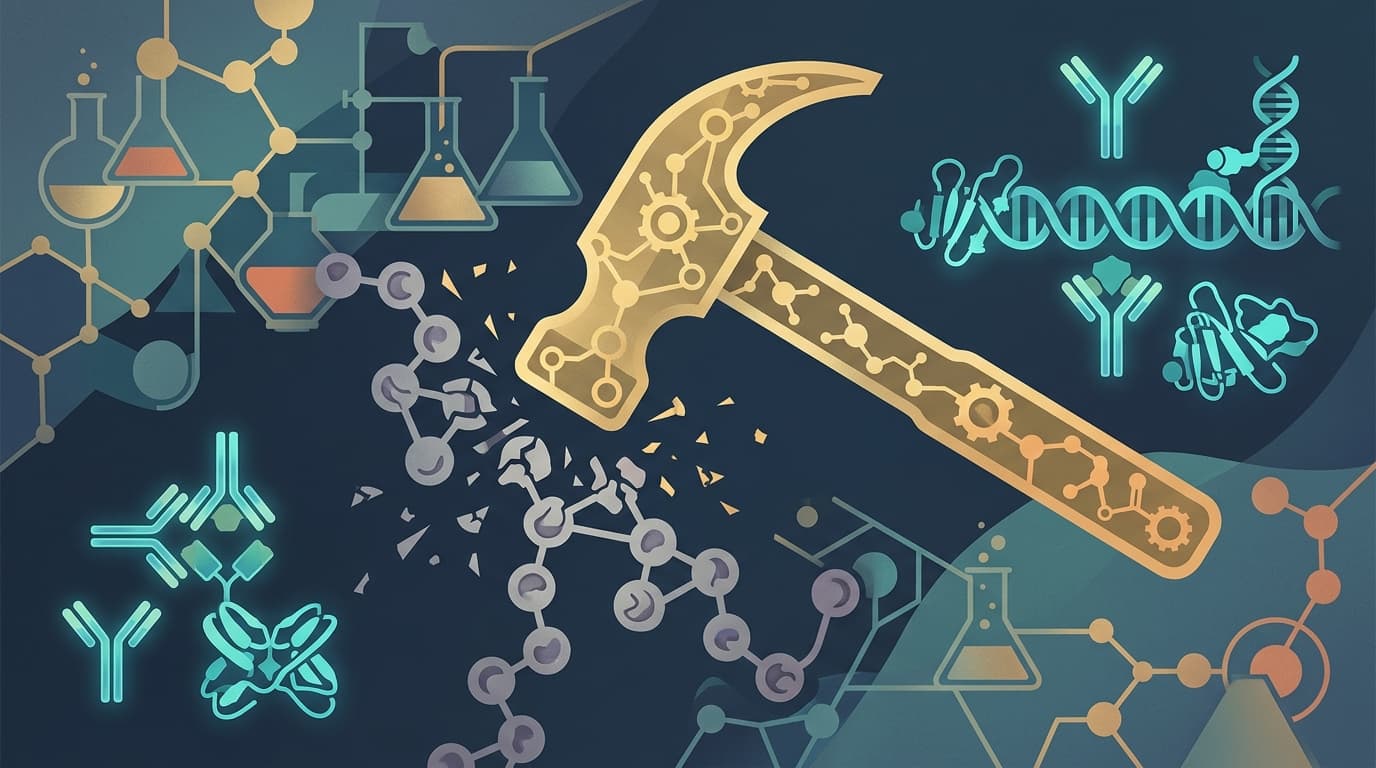
You know that old saying: "To a hammer, everything looks like a nail." A new report argues that's exactly what's happening with AI in clinical trials. The industry spent billions on shiny new tools, then pointed them at broken processes and hit "go."
The result? Faster mistakes. At scale.
A report published in May 2026 found that AI tools deployed across clinical trial design and operations are amplifying existing flaws rather than fixing them. Biased datasets, opaque algorithms, and uncritical automation are making old problems worse, not better.
The core argument is elegant in its simplicity: if your clinical trial process is broken, layering AI on top doesn't repair it. It just breaks things faster. Think of it like putting a turbocharger on a car with bald tires. You'll go quicker, sure. But the crash will be spectacular.
The report zeroes in on three areas where AI is doing the most damage: patient recruitment, site selection, and protocol design. In each case, the pattern is the same. Historical data with built-in biases gets fed into models that treat those biases as truth, then replicate them across dozens of trials simultaneously.
The recruitment problem is a perfect example. Over half of clinical trials fail to meet enrollment timelines. Only 4% of U.S. adults have ever joined a trial. These are systemic failures rooted in poor outreach, narrow eligibility criteria, and structural barriers like transportation and language access.
AI was supposed to fix this. Companies built tools that scan electronic health records and claims data to find eligible patients. Sounds great on a pitch deck. But most of that training data comes from large academic medical centers, skewing heavily toward white, male, and younger patients.
So the algorithm learns that the "ideal" trial participant looks a lot like the people who've always enrolled in trials. It ranks diverse candidates lower, flags smaller community clinics as underperformers, and optimizes for speed over representativeness. The report warns that AI recruitment tools can silently harden existing inequities in who gets access to experimental therapies.

A gene-edited pig kidney just kept a man alive and off dialysis for 271 days, shattering every record in xenotransplantation. With FDA approval for an expanded trial in hand, eGenesis is turning science fiction into a real answer for the 90,000 Americans stuck on the kidney transplant waiting list.


Join thousands of biotech professionals who start their day with our free, daily briefing.
This isn't hypothetical. An NIH Inspector General review found that a majority of NIH-funded trials failed to meet diversity requirements. If the AI is trained on that same skewed history, it's not solving the problem; it's institutionalizing it.
Site selection tells a similar story. Roughly 41% of activated clinical trial sites fail to meet enrollment targets, and about 11% enroll zero patients. These "ghost sites" are a massive waste of time and money.
AI-powered site selection was supposed to eliminate them. Models crunch historical performance data to predict which sites will deliver. The catch: those models tend to favor the same well-resourced academic centers that have always gotten the most trials. Community hospitals and clinics serving underrepresented populations get systematically deprioritized, not because they can't perform, but because they've had fewer chances to prove it.
It's like a hiring algorithm that only recommends candidates from Ivy League schools because that's who got hired before. The model isn't measuring potential. It's measuring privilege.
Perhaps the most unsettling finding involves what researchers call automation bias: the tendency for people to accept AI recommendations without pushing back. Under time pressure (and clinical trials are always under time pressure), study teams take the algorithm's word for it.
Site rankings? Accepted. Eligibility modifications? Rubber-stamped. Adaptive randomization schemes? Sure, the model said so.
The report notes that this dampens clinical judgment and makes it harder to catch when a model is drifting or just plain wrong. Many of these AI tools are black boxes, offering a score or recommendation with limited insight into which variables drove the decision. When nobody can explain why the algorithm made a choice, nobody can challenge it either.
The timing of this report matters. In January 2026, the FDA and EMA jointly published 10 guiding principles for AI in drug development, covering everything from data governance to lifecycle management. A new HHS rule (effective May 2025) now prohibits discrimination when using "patient care decision support tools," including AI used in clinical research recruitment. Covered entities have a duty to assess and mitigate bias risk.
The EU AI Act classifies certain healthcare AI as "high-risk," requiring conformity assessments, technical documentation, and human oversight.
In other words, the regulatory walls are closing in. Companies that deployed AI without robust validation, transparency, or bias auditing may find themselves on the wrong side of both the science and the law.
The AI-in-clinical-trials market is growing rapidly, with projections reaching several billion dollars by 2030. That's a lot of money flowing into tools that, according to this report, may be making trials more expensive and complex rather than less.
The report isn't anti-AI. Its recommendations are practical: fix the underlying trial design problems first, then use AI to stress-test and optimize. Keep humans in the loop for high-stakes decisions. Validate models across multiple sponsors, indications, and demographics. Monitor performance after deployment, not just before. And for the love of good science, make the algorithms explainable.
The expert consensus emerging in 2026 is sobering but clarifying. AI is excellent at scaling workflows. It's terrible at fixing bad strategy. The real methodological advances in trial design (Bayesian methods, adaptive designs, external control arms) are happening alongside AI, not because of it.
The most successful companies will be the ones that treat AI as a power tool, not a replacement for thinking. A circular saw is incredibly useful when you've measured twice. It's incredibly dangerous when you haven't measured at all.
Biotech spent the last few years buying hammers. Now it's time to figure out which things are actually nails.
UCB's Bimzelx just beat AbbVie's Skyrizi in a head-to-head psoriatic arthritis trial, posting the first-ever biologic superiority win on a major joint endpoint. The results could reshape how doctors pick treatments in a $13 billion market.