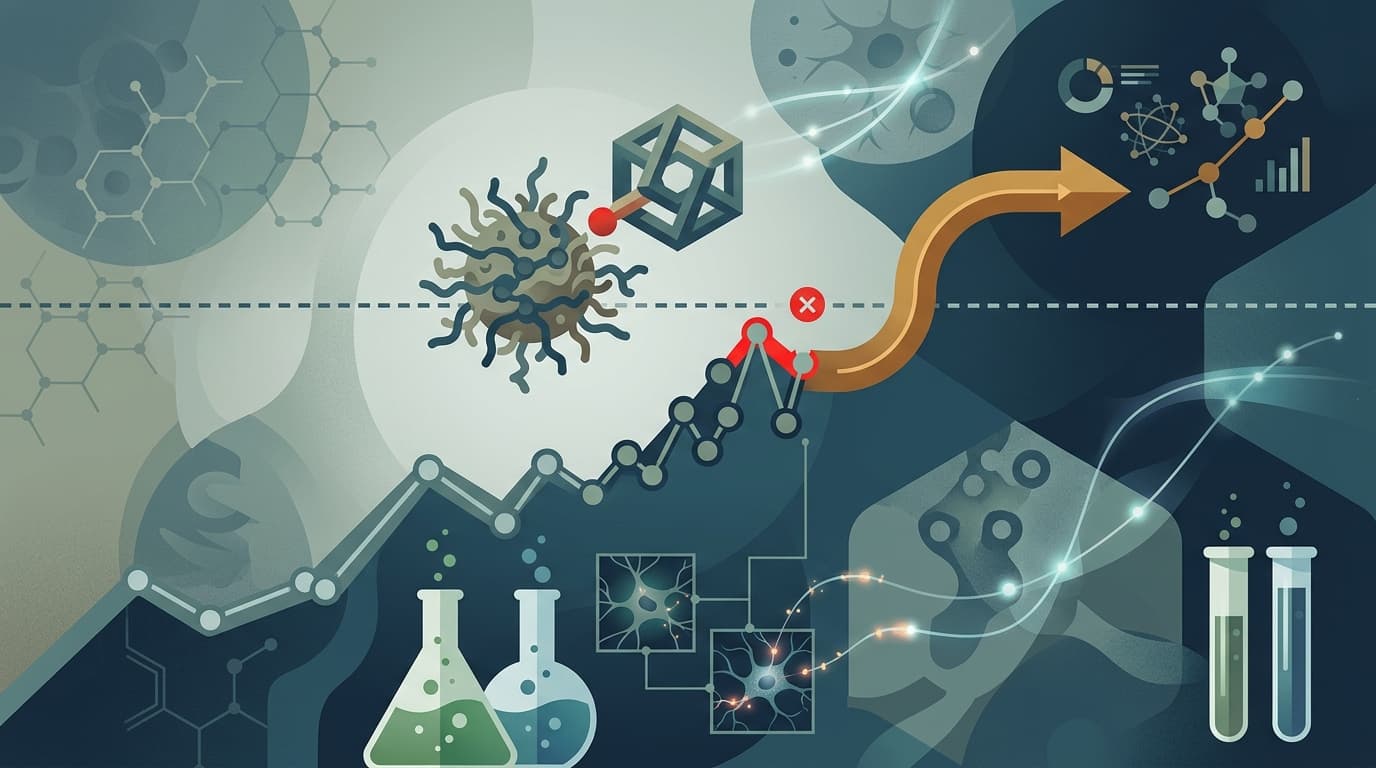

Acadia's Alzheimer's psychosis drug missed its key trial goal by the thinnest of margins. Instead of walking away, the company is charging into Phase 3. Is it a bold bet or a costly mistake?
Imagine training for a marathon, running 26.1 miles, and being told you didn't finish. That's roughly what happened to Acadia Pharmaceuticals last week.
Their experimental drug remlifanserin (previously called ACP-204) was being tested for psychosis in Alzheimer's patients: the hallucinations, the delusions, the symptoms that make an already devastating disease even crueler for patients and caregivers. The Phase 2 trial, called RADIANT, enrolled about 318 patients across multiple countries and tested two doses against a placebo.
The result? The higher dose improved symptoms more than placebo, but the difference just barely missed statistical significance. The p-value came in at 0.0603. In clinical trials, the magic number is 0.05 or below; anything above that, and the result is technically a fail. Acadia's drug missed the cutoff by a sliver.
Wall Street's reaction was swift and unforgiving. Shares dropped roughly 10–13% in the sessions following the announcement, one of the stock's worst stretches in years.
But here's the twist: Acadia says it's pressing forward into Phase 3 anyway.
Let's zoom in on what happened in the trial, because the headline "missed primary endpoint" doesn't tell the full story.
The primary measure was the SAPS-H+D score, a scale that tracks how severe a patient's hallucinations and delusions are. At the higher dose (60 mg once daily), patients improved by 12.6 points versus 10.4 points for placebo. That's a meaningful gap in absolute terms, with a standardized effect size of 0.26. But the p-value landed at 0.0603, just north of the 0.05 threshold that regulators and investors treat as gospel.
The lower dose of 30 mg? Pretty much a dud, showing minimal improvement over placebo.
On a secondary measure called CGI-S-ADP (a clinician's overall rating of how severe the psychosis is), the 60 mg dose actually did hit significance, with a p-value of 0.0077 and a larger effect size of 0.37. So the drug appeared to work on one measure but technically failed on the one that mattered most.

Half of relapsed multiple myeloma patients stayed cancer-free for five years after a single CAR-T infusion, with no maintenance therapy. Legend Biotech's latest CARVYKTI data is fueling talk of something oncologists rarely dare to whisper: a potential cure.


Join thousands of biotech professionals who start their day with our free, daily briefing.
Safety looked clean. Side effects were similar to placebo, with no deaths, no heart rhythm concerns, and no worsening of motor symptoms or cognition. For a drug aimed at elderly dementia patients, that's a genuinely important finding.
Most companies that miss a primary endpoint quietly shelve the program and move on. Acadia is doing the opposite, and their reasoning is worth examining.
First, the company is treating the Phase 2 trial as a design-learning exercise rather than a binary pass/fail. They plan to drop the 30 mg dose (which clearly wasn't doing much) and focus Phase 3 entirely on the 60 mg dose. That simplification could sharpen the signal.
Second, screening and enrollment for Phase 3 were already underway before the data dropped. They're not starting from scratch; they're adjusting a program that's already in motion.
Third, there's the unmet need argument, and it's a strong one. There are zero FDA-approved treatments specifically for Alzheimer's disease psychosis. Not one. Patients and doctors currently rely on off-label antipsychotics that carry serious side-effect baggage, including a black box warning about increased mortality risk in elderly dementia patients. If remlifanserin works, the market is wide open.
Acadia's leadership reportedly described the molecule as "absolutely worth our investment" given the combination of efficacy trends and clean safety data.
Before you get too optimistic, some historical context is in order. Developing drugs for psychosis in dementia patients is one of the hardest things in all of pharma. It's basically the final boss of clinical trials.
The reasons are well documented and depressing. Placebo response rates in these trials are notoriously high: patients improve just from getting attention and structured care, which makes it brutally hard for any drug to show a clear advantage. Symptoms fluctuate wildly from day to day, making consistent measurement a nightmare. Patient populations are inherently diverse; Alzheimer's psychosis looks different in every person.
Acadia knows this pain firsthand. Their older drug pimavanserin (brand name Nuplazid), which uses a similar mechanism and is approved for Parkinson's disease psychosis, was rejected by the FDA for dementia-related psychosis in 2021. Multiple antipsychotics have failed registration trials for this indication over the years, not because the drugs don't work in practice, but because the trials couldn't prove it with statistical rigor.
Remlifanserin is essentially Acadia's second attempt at this target using the same receptor class (5-HT2A, a serotonin receptor involved in psychosis). Skeptics will ask a fair question: if pimavanserin couldn't get across the finish line, why would a cousin molecule fare differently?
Acadia doesn't have the luxury of time. Bristol Myers Squibb is running a Phase 3 trial of Cobenfy (xanomeline plus trospium) for Alzheimer's psychosis, with data expected around early 2027. Cobenfy uses a completely different mechanism, targeting muscarinic receptors instead of serotonin, and it's already approved for schizophrenia. If BMS's trial succeeds, they could beat Acadia to the first-ever approval in this space.
Other early-stage programs are in the pipeline too, but the realistic race is between Acadia and BMS for what could be a blockbuster indication.
The analyst community didn't abandon Acadia, but they definitely got more cautious. Citigroup kept a Buy rating but slashed its price target from $40 to $33. BMO Capital lowered its target to $34 while maintaining an Outperform view. Needham held firm at $41, and TD Cowen kept a Buy with a $37 target.
The common thread: most analysts trimmed their probability-of-success estimates for remlifanserin. They still like Acadia as a company, but they're pricing in higher risk that this particular drug might never make it to market.
Acadia's decision to push remlifanserin into Phase 3 is a calculated gamble, not a reckless one. The data wasn't a disaster; it was a near-miss with some genuinely encouraging signals on secondary endpoints and safety. But "encouraging signals" have a long and tragic history of not translating into Phase 3 wins, especially in dementia psychosis.
The bull case writes itself: massive unmet need, clean safety profile, a refined Phase 3 design that drops the dead weight of the lower dose. The bear case is equally straightforward: the drug couldn't clear the bar in a smaller, more controlled Phase 2 setting, and Phase 3 trials are typically harder, not easier.
For Alzheimer's patients and their families dealing with terrifying hallucinations and delusions, the stakes couldn't be higher. Right now, they have nothing approved to help. Whether Acadia's gamble pays off or joins the growing list of dementia psychosis failures may come down to something painfully thin: a few hundredths of a p-value.
The FDA approved the first-ever combo pairing a HIF-2α inhibitor with a kinase inhibitor for kidney cancer, and the data suggest it outperforms the current go-to option. Merck's belzutifan empire now has five FDA approvals in five years, and Wall Street is paying attention.