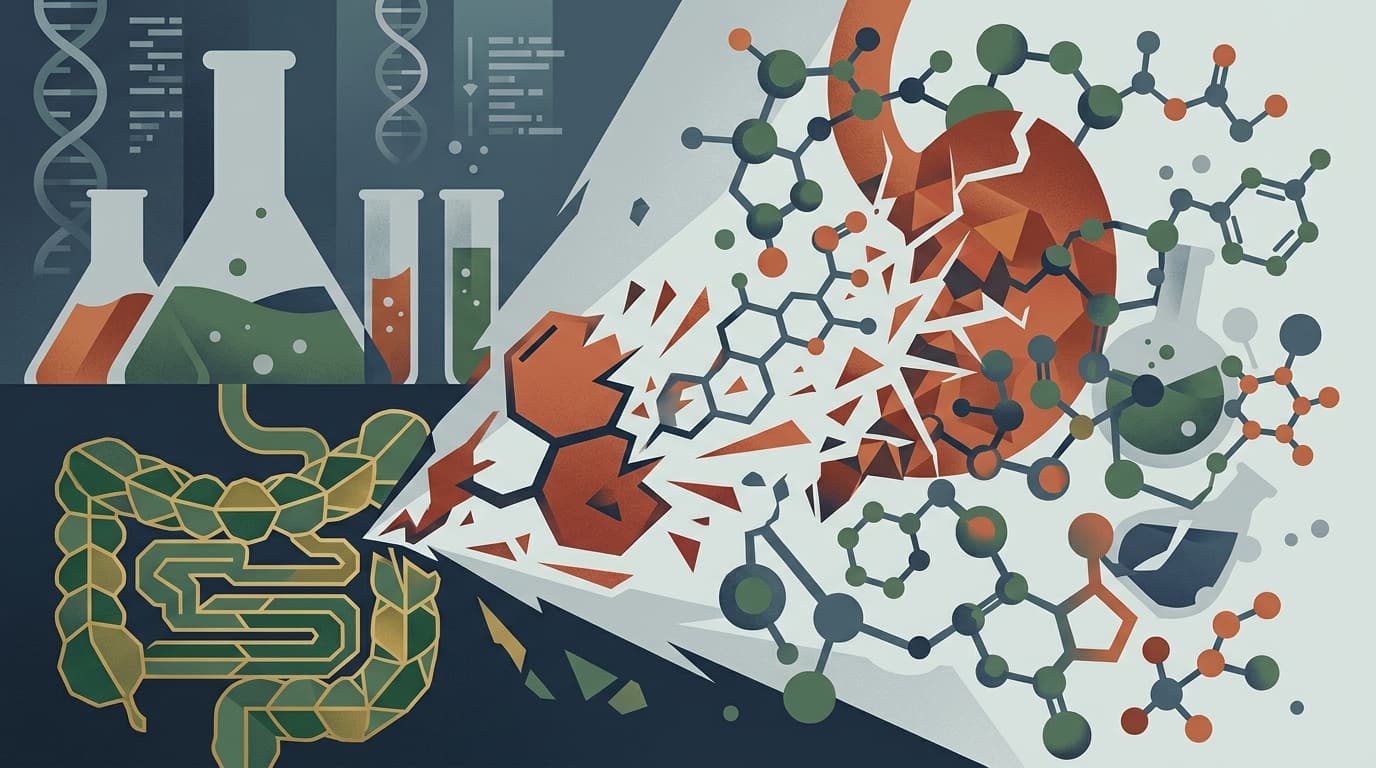
AbbVie's experimental combo therapy ABBV-466 just outperformed Skyrizi, its own blockbuster, in a Phase 2 Crohn's disease trial. Why would a company deliberately try to beat its best-selling drug? Because the alternative is letting someone else do it first.
Most companies spend years trying to dethrone a competitor's best drug. AbbVie decided to dethrone its own.
The company just dropped Phase 2a results for ABBV-466, a next-generation combination therapy for Crohn's disease, and it outperformed Skyrizi (risankizumab), AbbVie's own blockbuster that currently anchors its entire gastroenterology franchise. It's like Toyota building a car specifically designed to outsell the Camry. Weird move, until you realize it's genius.
The Numbers That Matter
The data came from the TARGET-CD study, a 300-patient Phase 2a trial in moderate-to-severe Crohn's disease, presented at UEG Week 2026 in Barcelona. The primary endpoint was endoscopic remission at Week 12, which basically means: did the inside of your gut look healed when a doctor scoped it?
ABBV-466 hit 30.2% endoscopic remission. That beat both of its individual components tested as standalone therapies: the IL-23 inhibitor arm (risankizumab alone) came in at 21.3%, and the α4β7 inhibitor arm (trosunilimab alone) landed at 18.0%.
But the Week 24 data is where things get really interesting. By that point, the gap didn't just hold; it widened. ABBV-466 climbed to 40.5% endoscopic remission, while risankizumab stayed at 22.4% and trosunilimab barely moved to 20.0%. The combination wasn't just a little better. It was nearly double.
Two Punches Are Better Than One
So what exactly is ABBV-466? Think of it as a tag team.
Crohn's disease is driven by inflammation in the gut, but that inflammation doesn't come from just one source. It's more like a fire being fed by two different fuel lines. IL-23 is a signaling molecule that cranks up inflammatory immune responses. α4β7 integrin is basically a GPS system that directs immune cells to travel into the gut lining, where they cause damage.
Most current therapies cut one fuel line. Skyrizi blocks IL-23. Entyvio (Takeda's drug) blocks α4β7. ABBV-466 cuts both at the same time by combining (the IL-23 blocker, a.k.a. Skyrizi's active ingredient) with (the α4β7 blocker).
Get tomorrow's biotech intelligence before your competitors.
Join thousands of biotech professionals who start their day with our free, daily briefing.
risankizumab
trosunilimab
The logic is intuitive: if you shut down two complementary pathways instead of one, you should get deeper disease control. The TARGET-CD data suggests that logic actually holds up in real patients, which is not something you can always count on in drug development.
Why Would AbbVie Cannibalize Its Own Star Player?
This is the question that makes the whole story interesting. Skyrizi is a monster. It's positioned as the leading IL-23 therapy in Crohn's disease and one of AbbVie's most important post-Humira growth products. So why build something designed to beat it?
Because if AbbVie doesn't do it, someone else will.
The IBD (inflammatory bowel disease) market in 2026 is a knife fight. Johnson & Johnson is pushing Tremfya (guselkumab) as a next-gen IL-23 option. Eli Lilly has Omvoh (mirikizumab) gaining traction. Multiple companies are racing to bring TL1A inhibitors, an entirely new mechanism, to market. And combination approaches are becoming the obvious next frontier.
AbbVie looked at the competitive landscape and essentially decided: we'd rather eat our own lunch than let someone else eat it for us. If combination therapy is the future of Crohn's treatment (and the data increasingly suggests it is), AbbVie wants to own that future with an asset built on top of its existing franchise.
It's the pharmaceutical equivalent of Apple releasing a new iPhone that makes last year's model obsolete. You'd rather your customers upgrade within your ecosystem than leave for a competitor.
The Safety Question (So Far, So Good)
Whenever you combine two biologic therapies, the first thing doctors worry about is safety. More immune suppression generally means more risk of infection and other side effects. It's the classic trade-off in immunology: hit harder, but watch out for friendly fire.
The good news from TARGET-CD is that serious adverse event rates were broadly similar across all three arms of the trial. The combination didn't appear to carry a meaningfully worse safety profile than either drug alone. That's a big deal at this stage, because safety concerns have torpedoed promising combination strategies in the past.
Of course, this is a 300-patient Phase 2a study. Safety signals can hide in small trials and emerge later in larger ones. AbbVie will need much bigger studies to prove the combination is safe enough for widespread use. But clearing this early hurdle matters.
AbbVie's Bigger Chess Game
ABBV-466 doesn't exist in isolation. It's one piece of a sprawling IBD strategy that AbbVie has been assembling over the past two years.
The company presented 18 abstracts at DDW 2026 across Crohn's disease and ulcerative colitis, mostly centered on Skyrizi and Rinvoq (its JAK inhibitor). It submitted regulatory applications in 2026 for a subcutaneous induction formulation of Skyrizi in Crohn's, which would make the drug easier to start patients on. And it has more than 30 ongoing or planned IBD trials across its portfolio.
Beyond ABBV-466, AbbVie is also building a TL1A portfolio. TL1A is the hottest new target in IBD: it's involved in both inflammation and fibrosis (scarring), and multiple competitors are chasing it. AbbVie has at least two TL1A programs in development, including ABBV-701 and a licensed asset called FG-M701 from FutureGen, which the company says could offer stronger efficacy and less frequent dosing than first-generation TL1A antibodies.
The strategy is layered. Skyrizi and Rinvoq hold the fort today. ABBV-466 represents the next upgrade. TL1A programs are the generation after that. AbbVie is essentially building a conveyor belt of IBD therapies, each designed to succeed (and eventually replace) the last.
What Wall Street Thinks
Analyst reaction to the TARGET-CD data was broadly positive. The combination outperformed both monotherapies at both timepoints, and safety didn't raise red flags. Importantly, many patients in the trial had already failed other advanced therapies, which makes the results more meaningful; these are harder-to-treat patients, not the easy wins.
Commentary also noted that AbbVie is already moving a larger Phase 2 program forward, signaling internal confidence in the asset. When a company accelerates its own timeline, it usually means the data looks even better behind closed doors than what's been shared publicly.
That said, the stock didn't move dramatically on the news. AbbVie is a roughly $500 billion company by market capitalization, and ABBV-466 is still years away from approval. The market is pricing in optionality, not revenue.
The Road Ahead
Phase 2a is encouraging, but it's still early. AbbVie needs to run a much larger Phase 3 program, prove durability beyond 24 weeks, and convince regulators that the combination's benefit-risk profile justifies approval. That's a multi-year, multi-billion-dollar bet.
The competitive clock is also ticking. J&J, Lilly, and a wave of TL1A-focused biotechs aren't standing still. The window for "best-in-class" in Crohn's disease is open, but it won't stay open forever.
Still, the TARGET-CD results represent something unusual in pharma: a company deliberately building the successor to its own blockbuster, and producing data that suggests the strategy is working. In an industry where most companies cling to their existing drugs until patent cliffs force their hand, AbbVie is playing offense.
Whether ABBV-466 ultimately makes it to market is an open question. But the willingness to bet against yourself, to acknowledge that your current best isn't good enough for tomorrow, is the kind of strategic thinking that separates companies that thrive from companies that coast.
AbbVie just showed its hand. Now the rest of the IBD market has to respond.
Deals & M&A
4 min read
Viatris Just Paid a 45% Premium to Break Up With Generics
Viatris is shelling out $1.65 billion (at a 45% premium) to buy Pacira BioSciences and its flagship non-opioid pain drug EXPAREL. It's the generics giant's biggest bet yet that it can reinvent itself as a specialty pharma player, and Wall Street has opinions.