What If Your Body Could Build Its Own Cancer-Killing Cells?
Vyriad just dosed the first patient in a trial that could turn the entire CAR-T manufacturing model inside out. Instead of building cancer-killing cells in a factory, VV169 tries to build them inside the patient's own body.
The $400,000 Problem Nobody Talks About
Imagine you're diagnosed with a blood cancer. Your doctor tells you there's a treatment that could save your life. The catch? Someone needs to extract your immune cells, ship them to a specialized factory, spend weeks genetically reprogramming them, then ship them back and infuse them into your body. The whole process takes three to five weeks. The price tag can exceed $400,000. And sometimes, the factory just can't make the product at all.
That's the reality of today's CAR-T therapy, one of the most celebrated breakthroughs in cancer treatment. Products like Kymriah, Yescarta, and Breyanzi have given patients with certain blood cancers a real shot at remission. But the manufacturing process is so complex, so expensive, and so slow that many patients never get access. Roughly 4 to 7% of patients who start the process don't receive a finished product because manufacturing fails along the way.
Now, a small company in Rochester, Minnesota, wants to flip the entire model on its head.
Vyriad Just Took the Biggest Swing in CAR-T History
Vyriad is preparing to run a Phase 1 trial of VV169, an in vivo CAR-T therapy for relapsed or refractory multiple myeloma. If those words don't immediately set off fireworks in your brain, let me translate: this is the first time a therapy like VV169 has been tested in a human with the goal of turning the patient's own body into the CAR-T factory.
Traditional CAR-T works like sending your car to a mechanic. You drop it off, they fix it up, and you pick it up weeks later. VV169 is more like the mechanic showing up at your house with all the tools and doing the work on the spot. One IV infusion. No cell collection. No factory. No waiting.
The trial, run in collaboration with Mayo Clinic, is a dose-escalation and expansion study. That means they'll start with low doses and gradually increase them, watching carefully for safety signals before expanding to more patients. The FDA accepted Vyriad's IND application (the regulatory green light to begin human testing) earlier this year.
Get tomorrow's biotech intelligence before your competitors.
Join thousands of biotech professionals who start their day with our free, daily briefing.
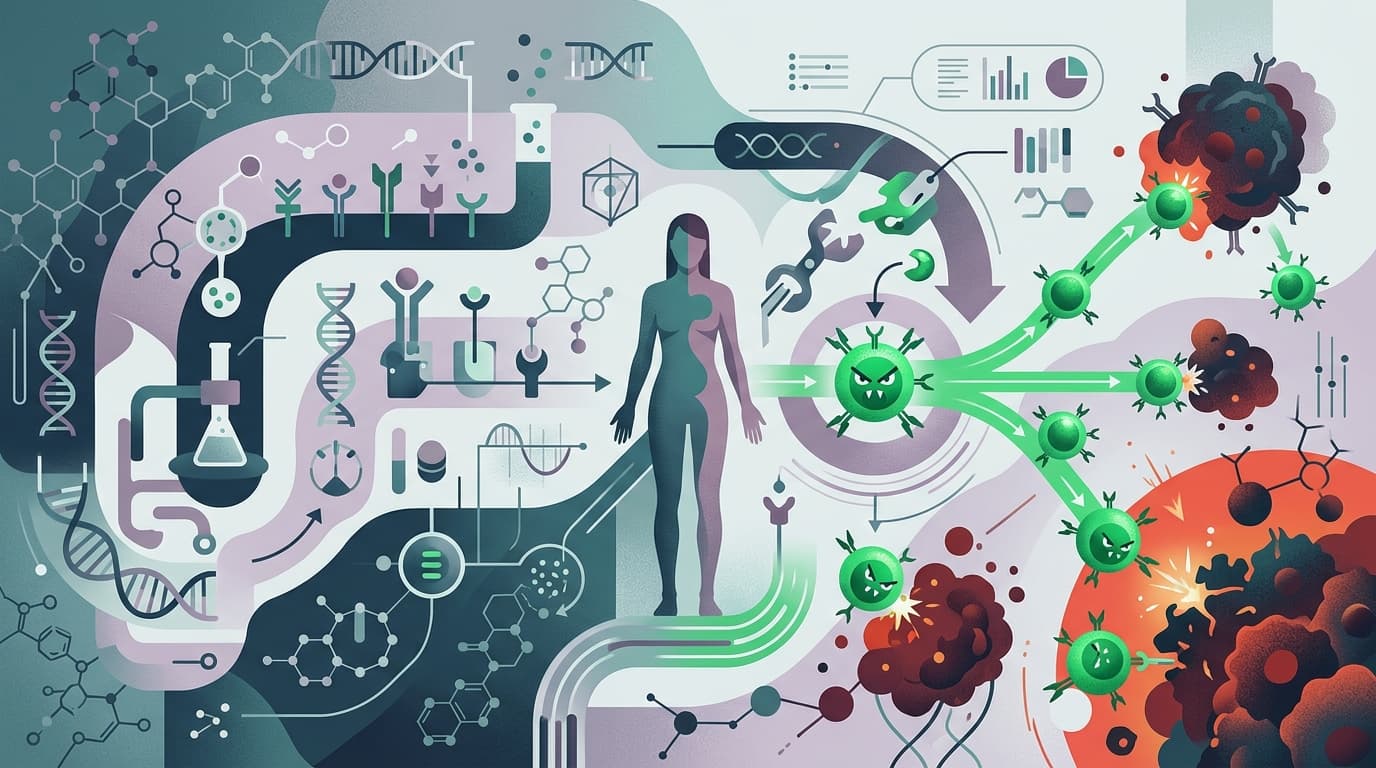
The science here is genuinely clever. VV169 uses a lentiviral vector, which is essentially a modified virus that's been stripped of its ability to cause disease and loaded with genetic instructions instead. Think of it as a tiny delivery drone.
When the vector is infused into the patient's bloodstream, it seeks out T cells (the immune system's soldiers) and delivers a gene that encodes a CAR, or chimeric antigen receptor. That CAR is designed to recognize a protein called BCMA, which sits on the surface of multiple myeloma cells like a neon "attack me" sign.
Once the T cells receive these new instructions, they start producing the CAR on their surface. They become CAR-T cells, right there inside the patient's body. Those freshly programmed cells then go hunting for BCMA-expressing cancer cells.
The elegance is in what you skip. No leukapheresis (the blood draw to collect T cells). No cleanroom manufacturing. No 10 to 15 days of sterility testing. No shipping frozen cells across the country. The patient's body becomes both the factory and the battlefield.
Vyriad Isn't Alone, but the Field Is Tiny
The in vivo CAR-T space is heating up fast, though it's still remarkably small. One 2026 landscape analysis counted just 10 active clinical trials across seven companies working on in vivo approaches. For context, there are hundreds of ex vivo CAR-T trials running worldwide.
The most notable competitors include Umoja Biopharma, whose UB-VV111 was described as the first in vivo CAR-T to receive FDA IND clearance. Umoja is running a Phase 1 trial in CD19-positive B-cell cancers and has earned a Fast Track designation.
Then there's Capstan Therapeutics, which uses a completely different delivery system: lipid nanoparticles (LNPs) carrying mRNA instead of viral vectors. AbbVie announced an agreement to acquire Capstan in June 2025 for up to $2.1 billion, with the deal completing in August 2025. And Kelonia Therapeutics, working with lentiviral vectors like Vyriad, agreed to be acquired by Eli Lilly in a deal announced in April 2026.
The pattern is hard to miss. Big Pharma is betting billions that in vivo CAR-T will work. AbbVie, Lilly, AstraZeneca, BMS: they're all circling the space like sharks that smell blood in the water.
The Risks Are Real
Let's pump the brakes for a second, because first-in-human trials are exactly that: first. The preclinical data from Vyriad looks encouraging; mouse studies showed complete tumor clearance and relatively muted inflammatory cytokines (the molecules that can cause dangerous immune overreactions). But mice are not people. The gap between a clean mouse study and a successful human trial is littered with the wreckage of promising therapies.
Analysts have flagged several specific concerns. Vector immunogenicity is one: the patient's immune system might attack the viral vector before it can do its job. Off-target transduction is another, meaning the vector could accidentally deliver its genetic payload to cells other than T cells. And there's always the specter of insertional mutagenesis, where the viral vector integrates its DNA into the wrong spot in the genome, potentially causing new problems.
These risks aren't unique to Vyriad. Every in vivo CAR-T program faces them. The entire field is still operating on a foundation of cautious optimism rather than proven clinical data.
Why This Matters Beyond the Lab
The accessibility problem with current CAR-T therapies isn't theoretical. Cancer centers have reported waiting lists stretching months for manufacturing slots. Patients who are sick enough to need CAR-T often can't afford to wait that long. Their disease progresses. Their bodies weaken. The treatment window closes.
If in vivo CAR-T works, it could turn a bespoke luxury into something closer to an off-the-shelf treatment. One infusion, administered at the point of care, with no factory in the loop. The potential to reduce cost and expand access is enormous.
Vyriad was co-founded by Dr. Stephen Russell and Dr. Kah-Whye Peng, both from Mayo Clinic, and the company has raised roughly $85 million to over $100 million across multiple rounds (sources vary on the exact total). They've built their platform around engineered viruses, including vesicular stomatitis virus (VSV) and measles-based systems, with programs spanning oncolytic virotherapy and gene therapy.
The Bottom Line
VV169's Phase 1 trial is a single step in what will be a long, uncertain journey. Phase 1 trials are designed to test safety, not prove a therapy works. We won't have meaningful efficacy data for a while.
But the idea behind VV169 is the kind of thing that could reshape cancer treatment if the biology cooperates. Turning the human body into its own cell therapy factory would eliminate the biggest bottleneck in one of oncology's most powerful treatment categories. That's not hype; it's math.
For now, we watch. We wait. And we pay very close attention to what happens in Rochester.
Clinical & Regulatory
4 min read
Two Shots a Year. Two Infections Out of 2,180 People.
Gilead's twice-yearly lenacapavir injection produced just 2 HIV infections out of 2,180 people in the PURPOSE 2 trial, crushing daily Truvada by 89%. The science is settled; now comes the hard part.