
For 40 years, KRAS was cancer's most famous "undruggable" target. Revolution Medicines just posted data suggesting they've cracked one of its nastiest mutations, with tumor response rates that nearly triple what chemotherapy can do.
For decades, cancer researchers had a name for KRAS: the undruggable target. It's a tiny protein that sits inside cells and tells them when to grow. When it mutates, it gets stuck in the "on" position, like a light switch jammed with superglue. Cells multiply out of control. Tumors form. Patients die.
KRAS mutations drive roughly one in four cancers. Scientists knew this for over 40 years. They just couldn't do anything about it.
Until now.
Revolution Medicines walked into the AACR annual meeting last week with data on zoldonrasib, a drug designed to hit one of the nastiest KRAS mutations: G12D. In 27 previously treated lung cancer patients, the drug shrank tumors in 52% of cases. Median progression-free survival (how long patients went before their cancer started growing again) clocked in at 11.1 months.
To appreciate why oncologists are excited, you need some context. The standard second-line treatment for these patients is chemotherapy, which typically holds tumors at bay for about four months. Zoldonrasib nearly tripled that benchmark. And 93% of patients saw their disease at least stabilize, a figure the company calls the disease control rate.
The survival numbers look even more striking. At 12 months, 73% of patients were still alive. Median overall survival hasn't even been reached yet, which means more than half the patients are still living as data continue to mature.
So how does zoldonrasib actually work? Think of it like a molecular matchmaker with a sinister agenda.
KRAS G12D is a mutant protein that's constantly "on," sending growth signals to the rest of the cell. Most drugs try to block a protein directly, like plugging a keyhole. But KRAS is smooth and round, with almost nowhere to grab onto. That's why it earned its "undruggable" reputation.
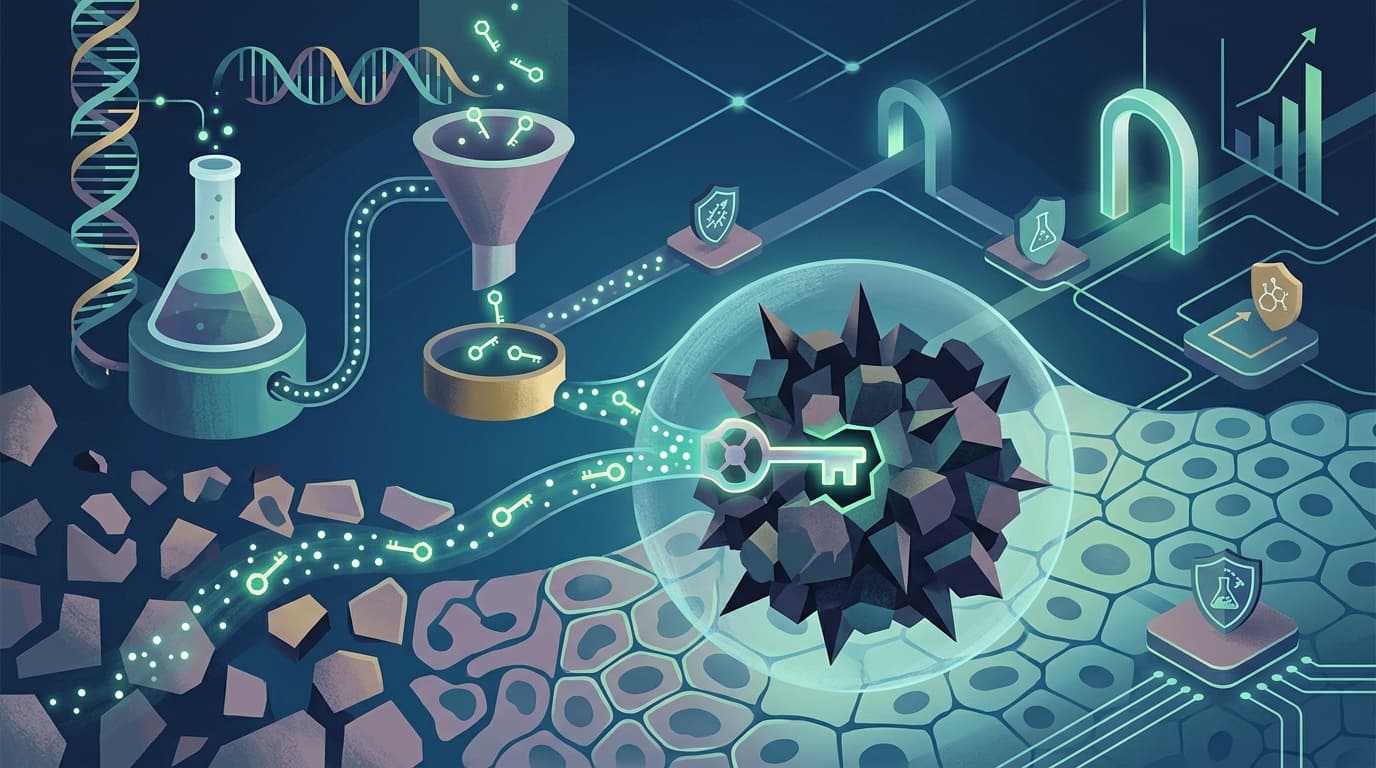
Zoldonrasib takes a completely different approach. It recruits a second protein called cyclophilin A and glues it onto KRAS G12D while the protein is in its active state. Picture slapping a boot on a car's wheel: the engine is still running, but the car isn't going anywhere. With cyclophilin A stuck to its surface, KRAS can't relay its growth signals downstream.

Merck's islatravir nearly died after alarming safety signals forced the FDA to halt clinical trials. Now it's the backbone of Idvynso, the first two-drug HIV regimen that ditches the most popular drug class in the field. The comeback story is worth reading.


Join thousands of biotech professionals who start their day with our free, daily briefing.
This is a meaningful departure from the first generation of KRAS drugs. Sotorasib and adagrasib (approved for a different KRAS mutation called G12C) only work when KRAS cycles into its inactive "off" state. Zoldonrasib hits the target while it's actively causing damage. That distinction could matter a lot when it comes to resistance, which tends to plague "off" state inhibitors.
KRAS G12D mutations show up in about 4% of all non-small cell lung cancers. That sounds small, but lung cancer is so common globally (over two million new cases per year) that this slice still represents tens of thousands of patients annually. Until zoldonrasib, they had zero approved targeted therapies.
The unmet need is real. These patients typically cycle through immunotherapy and platinum-based chemotherapy, then face grim options. Many also carry co-mutations in genes like STK11 and KEAP1, which make their cancers more aggressive and less responsive to standard treatments.
G12C patients got their targeted drugs a few years ago. G12D patients have been watching from the sidelines, waiting for their turn. This data suggests it might finally be coming.
Analysts weren't shy about their reactions. Stifel's Laura Prendergast said the AACR meeting was "buzzing with excitement" over Revolution's data, calling zoldonrasib an "underappreciated" second asset in the company's pipeline. RBC Capital Markets analyst Leonid Timashev described the results as a "clear improvement" over chemotherapy and "definitively better" than G12C inhibitors.
Evercore ISI raised its price target on Revolution Medicines to $200 from $140. Guggenheim bumped theirs to $175 from $160. The consensus: this drug is for real, and the market opportunity is bigger than the Street had priced in.
Before anyone pops champagne, some important caveats. This was a Phase 1 study with only 27 patients evaluated for efficacy at the recommended dose. That's a promising signal, not a proof of concept in the way a large randomized trial would be. Small studies can look great and then disappoint when tested more broadly.
The safety profile, at least, is encouraging. Among 40 patients at the recommended dose, no one experienced grade 4 or 5 side effects (the most severe categories). Grade 3 treatment-related adverse events hit 13% of patients, mostly diarrhea and anemia. Only 5% had to stop treatment entirely. Nausea (43%), vomiting (33%), and diarrhea (30%) were the most common complaints; unpleasant, but manageable compared to chemotherapy's typical toll.
Revolution Medicines already secured FDA Breakthrough Therapy designation in January 2026, which essentially puts the drug in the express lane for regulatory review. The company plans to launch a Phase 3 trial called Rasolve-308 in the first half of this year, testing zoldonrasib in combination therapy for first-line KRAS G12D lung cancer.
That pivot to first-line treatment is ambitious. Rather than waiting to treat patients after chemotherapy fails, Revolution wants zoldonrasib in the mix from the start. If the Phase 3 data hold up, the path to accelerated approval looks plausible.
They're not alone in this race, either. Incyte, HengRui, and Astellas all have KRAS G12D programs advancing toward or already in Phase 3 trials, with varying mechanisms and tumor types. But Revolution has the most mature clinical data and the clearest regulatory runway.
For 40 years, KRAS was the white whale of oncology: everyone knew it mattered, and nobody could catch it. The first G12C drugs cracked the door open a few years ago. Zoldonrasib is kicking it wider.
If these results hold in larger trials, they won't just help lung cancer patients with one specific mutation. They'll validate a whole new approach to drugging proteins that the field had written off as impossible. And in biotech, proving something can be done is often the hardest part. Everything after that is engineering.
The "undruggable" era? It's looking increasingly over.
Two former Sage Therapeutics leaders just launched a brain-focused biotech with $106 million and four clinical-stage drugs. In a therapeutic area where 85% of drugs fail, they're betting their track record (and two FDA approvals) can beat the odds.