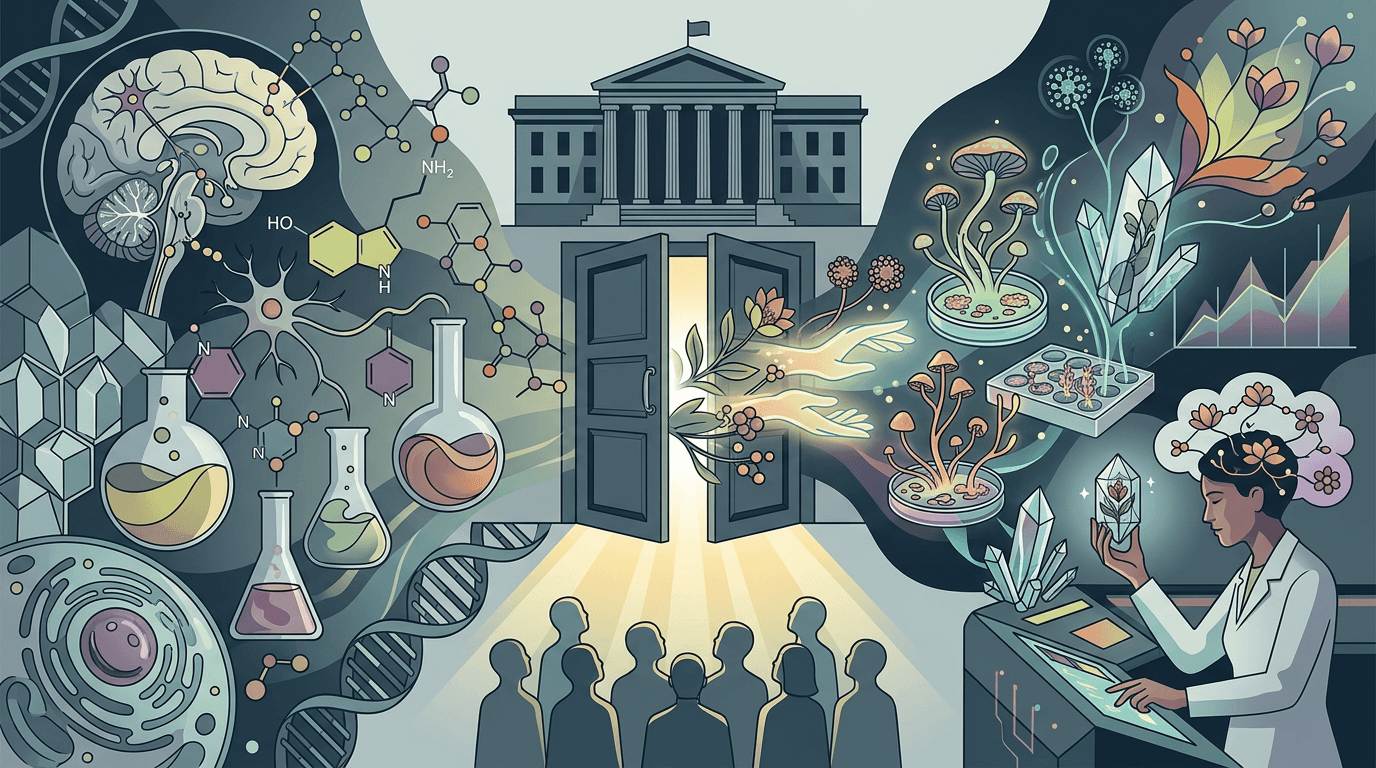

The Trump administration went from blocking a psychedelics company's FDA voucher to signing an executive order calling these drugs "life-saving," all in about 60 days. Three companies just got golden tickets that could slash their FDA review from 10 months to under two.
In February 2026, the White House reportedly blocked a psychedelics company from receiving an FDA priority voucher. Two months later, President Trump signed an executive order calling psychedelic drugs "life-saving."
If that sounds like political whiplash, welcome to the strangest regulatory story in biotech right now.
On April 18, Trump signed Executive Order 14401, titled Accelerating Medical Treatments for Serious Mental Illness. The order directed the Department of Health and Human Services to fast-track access to psychedelic therapies, particularly for veterans. Six days later, the FDA handed out three Commissioner's National Priority Vouchers (CNPVs) to psychedelic drug developers.
Think of a priority voucher like a FastPass at Disney World. Instead of waiting in the standard 10-to-12-month FDA review line, voucher holders get whisked to the front: a review timeline of just one to two months. Same ride, same safety standards, dramatically shorter wait.
The three lucky recipients:
All three had already earned the FDA's Breakthrough Therapy designation, which signals early evidence that a drug offers meaningful improvement over existing treatments. That designation was the price of admission for the voucher program.
Let's state the obvious: nobody expected this White House to become psychedelics' biggest cheerleader.
Psychedelics have been locked behind Schedule I classification for decades. That's the DEA's most restrictive category, reserved for drugs with "high abuse potential" and "no accepted medical use." It's the same classification as heroin. Researching Schedule I substances has historically been a bureaucratic nightmare, requiring layers of federal approval that can take years.

A tiny Minneapolis diagnostics company paid $10 million for a drug Pfizer didn't want. Four years later, it just beat Novartis's Piqray in a head-to-head Phase 3 breast cancer trial, and the implications are enormous.

Join thousands of biotech professionals who start their day with our free, daily briefing.

The Trump administration's early rhetoric leaned hard on strict drug enforcement. The HALT Fentanyl Act, signed in 2025, was all about cracking down on illicit substances. Psychedelics activists weren't exactly popping champagne.
Then came the pivot. FDA Commissioner Marty Makary and HHS Secretary Robert F. Kennedy Jr. had both expressed support for psychedelic medicine. Kennedy, in particular, praised the executive order's focus on veteran-focused therapies. And the $50 million the order earmarks for federal-state collaboration on psychedelic programs? That's not a symbolic gesture. That's real money flowing into research infrastructure through ARPA-H, the government's advanced health research agency.
The FDA has run priority review voucher programs before. The tropical disease voucher program launched in 2007 and has awarded 14 vouchers over nearly two decades. The rare pediatric disease program has been busier, issuing 63 vouchers across 47 rare pediatric indications.
But those programs work differently. In the traditional model, a company earns a voucher by getting an eligible drug approved; it can then use (or sell) that voucher to speed up review of a different product. It's an incentive system: develop a malaria drug, get a golden ticket you can use on your next blockbuster.
The psychedelics vouchers are more direct. The CNPV program, which the FDA launched as a pilot in June 2025, accelerates review of the drug itself. No middleman, no secondary market. The voucher says: "We think this specific therapy is a national health priority, and we're going to review it faster."
That distinction matters. It signals the FDA isn't just trying to lure companies into an underserved space with future rewards. It's actively pushing specific candidates toward the finish line.
Before you start envisioning psilocybin at your local pharmacy, some important caveats.
First, a faster review doesn't mean a lower bar. Every voucher recipient has emphasized this point. The scientific and regulatory standards remain identical. The FDA will scrutinize the same safety and efficacy data; it'll just do it on a compressed timeline. Think of it as your professor grading your paper over the weekend instead of in three weeks. Same rubric, faster turnaround.
Second, these drugs still need to clear the regulatory finish line. FDA approval decisions for the psilocybin programs aren't expected until late 2026 or early 2027. The voucher helps after companies submit their applications, not before.
Third, some analysts have raised a counterintuitive concern: could priority vouchers actually hurt these drugs commercially? If insurance companies and the public perceive fast-tracked psychedelics as having weaker evidence, that perception problem could slow adoption even after approval. There's also the practical question of who would administer these therapies. Psychedelic-assisted treatment requires specially trained clinicians to guide patients through the experience, and that workforce doesn't really exist yet at scale.
The executive order goes beyond vouchers. It directs the Attorney General to review Phase 3 successes for potential rescheduling, which would move approved psychedelics out of Schedule I. It establishes Right to Try pathways for investigational psychedelic drugs that meet safety thresholds. And the FDA has signaled that final guidance on psychedelic drug development is coming "imminently."
For an industry that has spent years knocking on Washington's door, this is the door swinging wide open. Transcend Therapeutics is in the process of being acquired by Otsuka Pharmaceutical, a deal that suggests big pharma sees real commercial potential here. A fourth company (unnamed) was reportedly allowed to advance into human trials following the executive order.
The mental health crisis in America is staggering, and existing treatments leave millions of patients without adequate options. If psilocybin and methylone can clear the regulatory bar, they could become the first genuinely new class of psychiatric medication in decades.
But for now, the most remarkable thing might simply be the source. An administration built on law-and-order messaging just told the FDA to treat psychedelic drugs like a national priority. Politics, as they say, makes strange bedfellows. Apparently, it makes even stranger medicine.
Intellia just posted Phase 3 results for the first CRISPR therapy designed to edit genes inside a living patient. One injection, 87% fewer attacks, and an FDA submission already underway. The gene editing revolution might finally have its breakthrough product.