
Transgene's personalized cancer vaccine TG4050 posted 100% disease-free survival across all 16 treated patients at three years in a head-and-neck cancer trial. The study is tiny, but in a disease that kills half its patients within five years, a perfect score is impossible to ignore.
Imagine a cancer treatment where nobody's disease comes back. Not after one year. Not after two. Not after three full years of follow-up.
That's exactly what Transgene just reported for TG4050, its personalized cancer vaccine for head-and-neck cancer. In the Phase 1 portion of a randomized trial, all 16 patients who received the vaccine remained disease-free at a median follow-up of 41 months. The control group? Three out of 16 patients relapsed over the same period.
Transgene's stock jumped about 20% on the news. And while this is still a tiny, early-stage study, the result is turning heads across the oncology world. Because in a disease where roughly half of patients die within five years, a perfect scorecard is the kind of thing that makes you sit up and pay attention.
To appreciate why this matters, you need to understand what these patients are up against. HPV-negative head and neck squamous cell carcinoma (HNSCC) is one of the nastier cancers to deal with. Unlike HPV-positive cases, which can have three-year survival rates above 90%, the HPV-negative version is far more aggressive.
The current standard of care for high-risk patients after surgery is adjuvant chemoradiation, typically cisplatin paired with radiation. It's brutal, and the outcomes still aren't great. Real-world data show that three-year overall survival hovers around 55% for locally advanced patients treated with definitive (non-surgical) approaches. Even after surgical resection, about 30% of patients see their cancer come back locally.
So when a vaccine posts a 100% disease-free survival rate at three years in this population, even in just 16 patients, the biotech world perks up like a dog hearing a treat bag crinkle.
TG4050 isn't your typical shot-in-the-arm vaccine. It's closer to a bespoke suit than something off the rack.
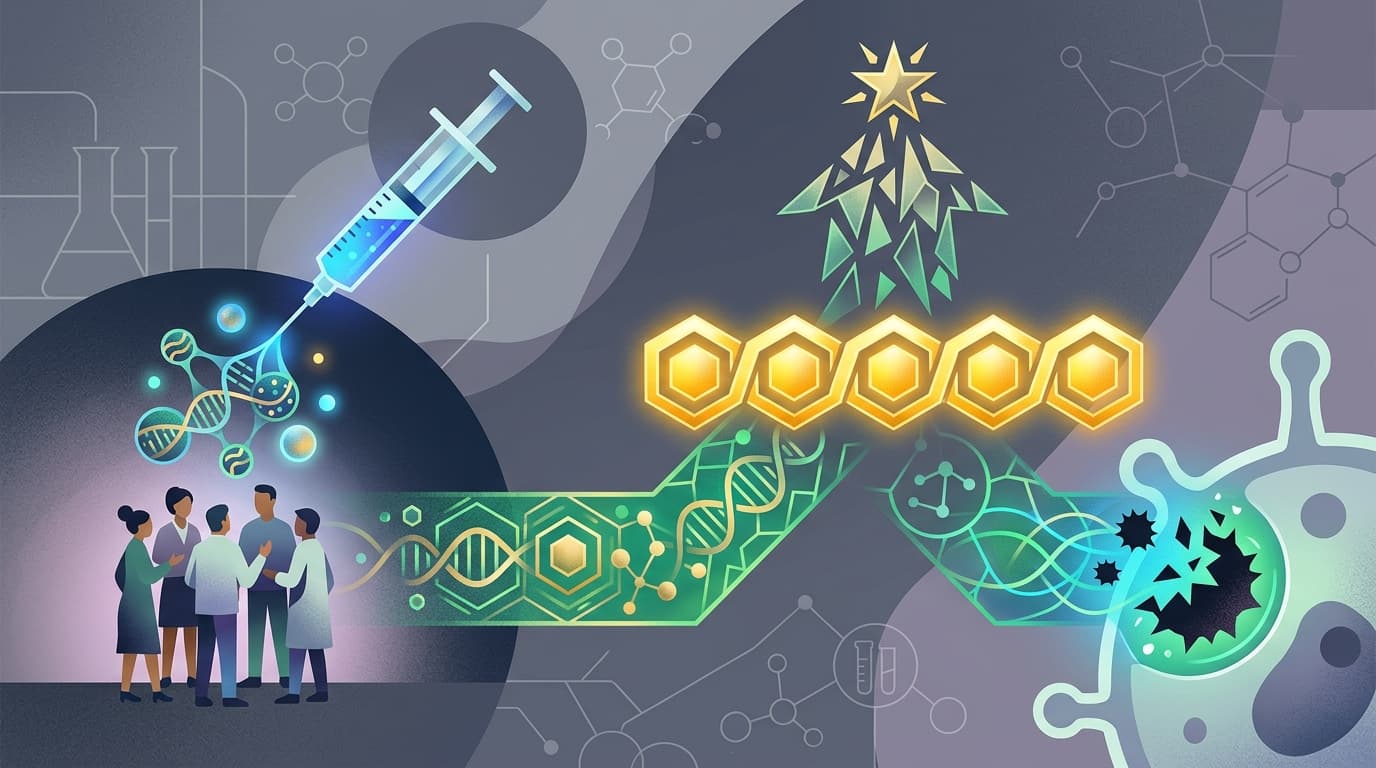
The process starts after a patient's tumor is surgically removed. Transgene and its partner NEC compare the tumor's DNA to the patient's normal tissue, hunting for mutations unique to the cancer. NEC's AI system then predicts which of those mutations (called neoantigens) are most likely to trigger the immune system. The best candidates, up to about 30 per patient, get encoded into a modified vaccinia Ankara (MVA) viral vector: basically a harmless virus reprogrammed to teach the immune system what to attack.

AstraZeneca is reportedly negotiating a deal worth up to $15 billion with Summit Therapeutics for ivonescimab, a bispecific antibody that beat Keytruda in a head-to-head lung cancer trial. If it closes, it would be one of the largest licensing deals in biopharma history.


Join thousands of biotech professionals who start their day with our free, daily briefing.

Think of it like showing a bouncer a photo of every troublemaker who might try to sneak back into the club. The vaccine trains your T cells (the immune system's bouncers) to recognize and destroy any leftover cancer cells hiding after surgery.
Translational data from the trial confirmed this is actually working as designed. Patients showed persistent neoantigen-specific CD8+ T-cell responses, meaning their immune systems stayed on high alert for years after vaccination.
Let's not kid ourselves. Sixteen patients is a tiny study. You could fit the entire treatment group in a large elevator.
Reuters was quick to note that the number of patients and events is simply too small to establish statistical significance. Three relapses in the control arm versus zero in the treatment arm is encouraging, but it's the kind of result that could shift meaningfully with just a few more data points in either direction.
Kempen analyst Chiara Montironi acknowledged the longer follow-up provides a "robust dataset" supporting the vaccine's relapse-prevention potential, but the emphasis was clearly on the word "potential." The full Phase 1/2 study is expected to enroll about 80 patients total, and Phase 2 results (with more statistical power) are still pending.
Transgene had already reported 100% two-year disease-free survival at a median follow-up of 30 months back in 2025. The new three-year data extends the trend line, which is exactly what analysts want to see in a relapse-prevention setting. Each additional month of clean follow-up makes the signal harder to dismiss as a fluke.
TG4050 isn't racing alone. The personalized neoantigen vaccine field has attracted some of biotech's biggest names, and Transgene is arguably the scrappy underdog.
Moderna and Merck are the clear frontrunners with mRNA-4157 (also called V940 or intismeran autogene), which is already in Phase 3 trials for melanoma and non-small cell lung cancer. They have the deepest pockets and the most advanced regulatory path. BioNTech and Genentech are right behind them with BNT122, an mRNA-based neoantigen vaccine in Phase 2 for pancreatic cancer. Gritstone Bio rounds out the field with its GRANITE program, though it trails the mRNA leaders in clinical maturity.
What makes Transgene different is its platform. While Moderna and BioNTech use mRNA to deliver neoantigen instructions, Transgene uses a viral vector (the MVA approach). It's a fundamentally different delivery mechanism, and it could offer distinct advantages in terms of immune response durability. Whether that technical differentiation translates into clinical superiority is the billion-dollar question.
With shares trading around €0.86 on Euronext Paris, Transgene is also orders of magnitude smaller than its mRNA competitors. This is a company whose next earnings report (expected September 24, 2026) could move the stock as much as the clinical data itself.
Transgene's CEO framed the data as evidence that TG4050 can generate "durable anti-tumor immunity" and may eventually become a treatment option for high-risk head-and-neck cancer patients. That's corporate-speak for: we think this actually works, and we're going to keep pushing.
The broader significance is really about the field. Every positive data readout for personalized cancer vaccines, whether from Moderna, BioNTech, or a smaller player like Transgene, strengthens the case that the entire approach has legs. These vaccines represent a fundamental shift in how we think about cancer treatment: instead of carpet-bombing the body with chemo, you're giving the immune system a personalized hit list.
Sixteen patients isn't proof. But it's a signal that's getting louder with every month of follow-up. And in a disease where the current standard of care still fails roughly half of patients within five years, even a whisper of something better is worth listening to closely.
AstraZeneca's oral breast cancer pill camizestrant missed its primary endpoint in the pivotal SERENA-4 trial, failing to prove a statistically significant benefit in first-line advanced breast cancer. The setback narrows the drug's commercial ceiling just as Eli Lilly's competing therapy racks up its second FDA approval.