Scientists Built a Cell From Scratch. It Eats, Grows, and Divides. But Is It Alive?
Scientists at the University of Minnesota assembled a cell entirely from non-living parts that can eat, grow, copy its DNA, and divide. It runs for about five to ten generations before breaking down, and its creators are clear: they haven't created life. But they may have built the most important chemistry set in history.
Imagine dumping a pile of car parts on a garage floor: engine block, axles, seats, windshield wipers. Now imagine those parts somehow snap together and the car drives itself around the block. Five times. Then it dies.
That's roughly what just happened in biology.
Meet SpudCell
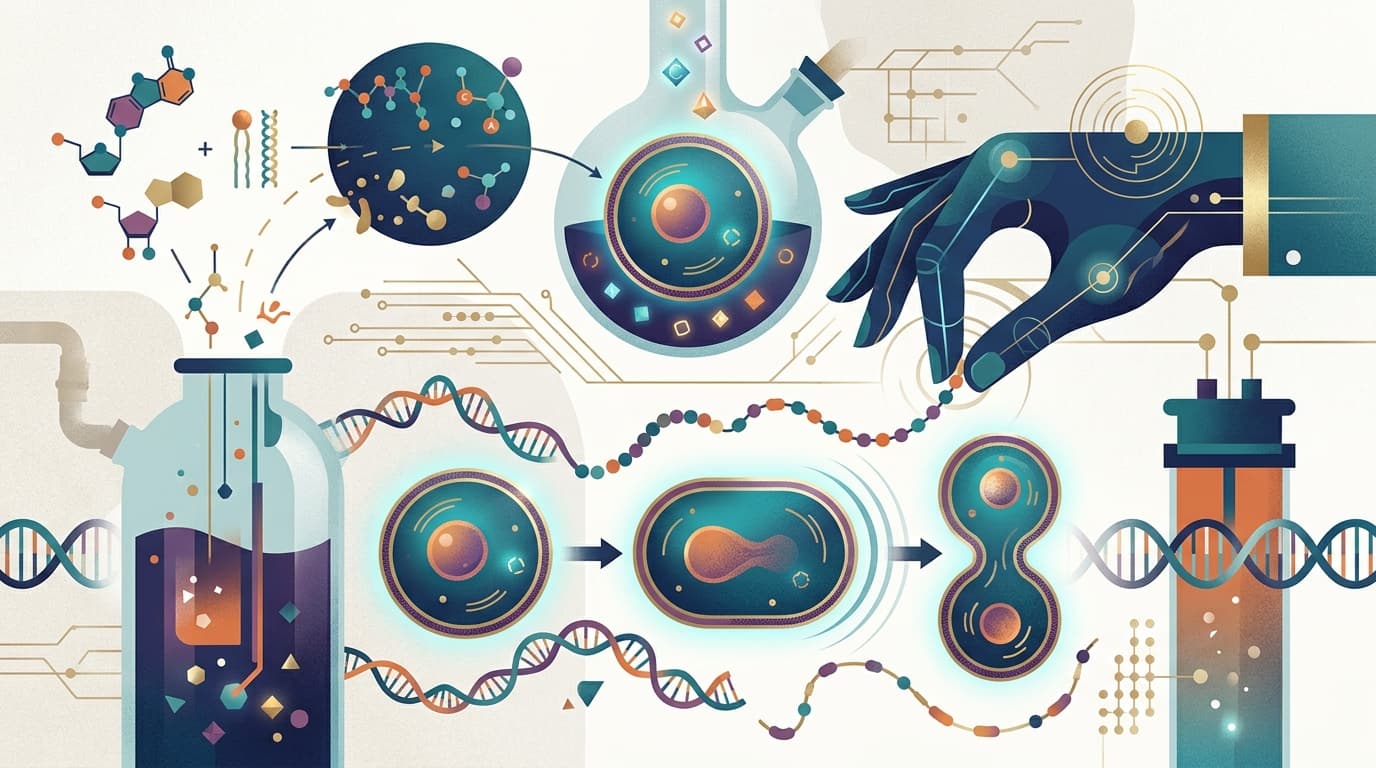
A team led by Kate Adamala and Aaron Engelhart at the University of Minnesota has built a cell entirely from non-living, purified chemical components. They call it SpudCell, and it can do something no synthetic creation has done before: feed on nutrients, grow larger, copy its own DNA, and split in two. It completes a full cell cycle, the fundamental loop that every living thing on Earth runs.
The catch? It can only pull off this trick about five to ten times before it breaks down. After that, SpudCell is just a tiny bubble of molecular debris floating in a dish.
The work was posted as a 190-page preprint on bioRxiv on July 1, 2026. It has not yet been peer-reviewed. But that hasn't stopped some of the biggest names in biology from weighing in. John Glass of the J. Craig Venter Institute called it "a landmark event in the history of biology."
Others are more cautious. And the SpudCell team itself is clear: they have not created life.
So what did they create, exactly?
A Cell Built Like IKEA Furniture (But Way Harder)
SpudCell was assembled bottom-up. That means the researchers didn't start with a living cell and strip it down. They started with individual molecules, mixed them in precise ratios, and watched a cell-like system emerge.
Think of it like baking from scratch versus using a cake mix. Previous synthetic biology breakthroughs, like Craig Venter's famous JCVI-syn3.0 in 2016, took a natural bacterium, swapped in a lab-made genome, and let the existing cellular machinery do the rest. The genome was synthetic; the cell body was borrowed from nature.
SpudCell borrows nothing. Every ingredient is defined and purified.
Get tomorrow's biotech intelligence before your competitors.
Join thousands of biotech professionals who start their day with our free, daily briefing.
The recipe has roughly 150 to 200 distinct molecular components. At its core: a lipid membrane (the bubble that forms the cell wall), a DNA genome spread across seven plasmids totaling about 90,000 base pairs and encoding 36 genes, and a protein-making engine called the PURE system (a cocktail of 36 purified enzymes from E. coli, plus ribosomes, amino acids, and energy molecules like ATP).
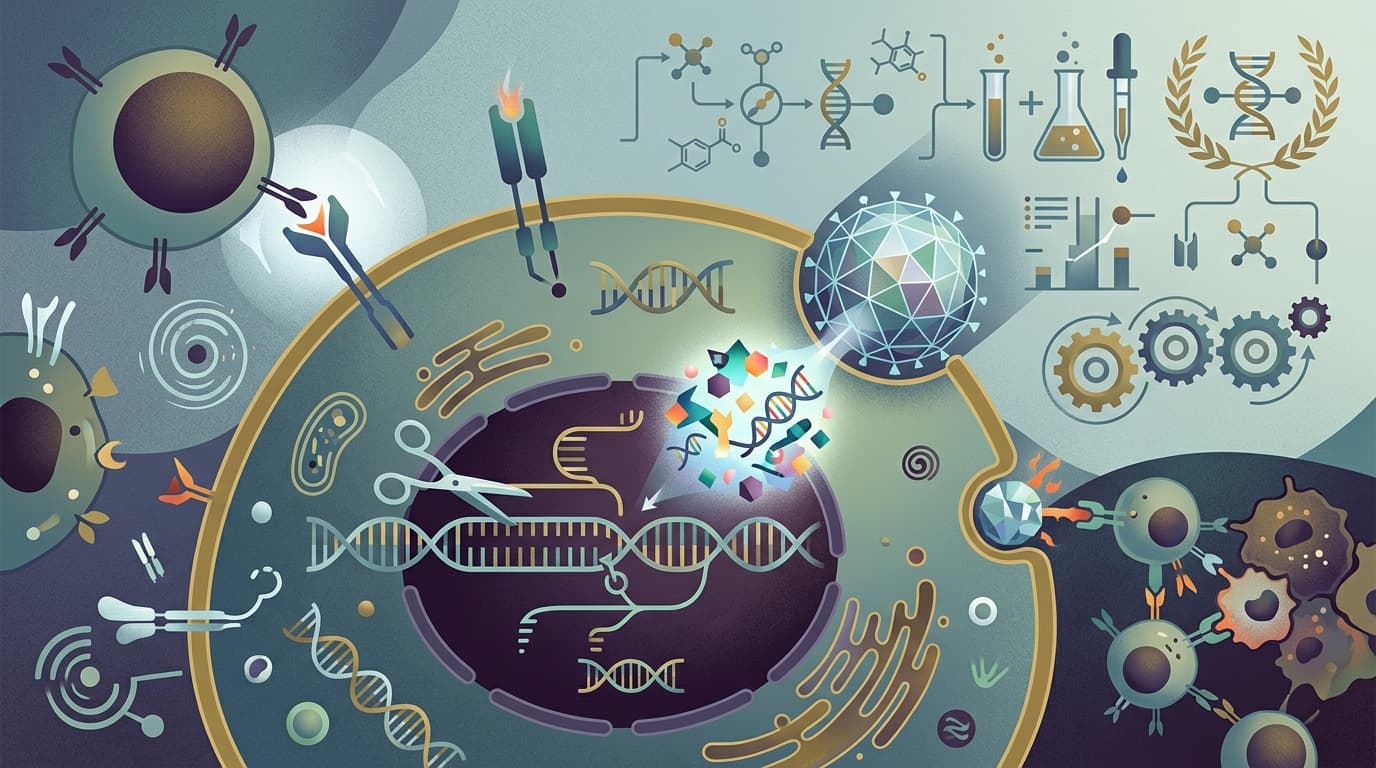
Genes in SpudCell's DNA were borrowed from well-studied sources, including E. coli bacteria and bacteriophages. These genes tell SpudCell how to copy its DNA, build membrane proteins, and grab food.
The whole project took about five researcher-years to develop.
How SpudCell Eats Lunch
Living cells import nutrients through their membranes. SpudCell does something similar, but with a clever workaround.
Its genome encodes a protein called α-hemolysin, a well-known pore-forming molecule. When expressed, this protein is equipped with a polyhistidine tag and serves as a fusogen, mediating fusion between SpudCell and feeder liposomes—small nutrient-packed bubbles that carry matching molecular hooks on their surface. SpudCell displays corresponding tags on its own membrane. When a feeder liposome bumps into SpudCell and the hooks connect, the two bubbles fuse. SpudCell absorbs everything inside, including ribosomes, enzymes, extra lipids, and small molecules like amino acids, nucleotides, and sugars.
It's a bit like a cell ordering DoorDash. The meal shows up in a bag (the feeder liposome), the cell grabs it (via surface tags), and the contents get dumped inside.
The brilliant part: because the feeding machinery is encoded in SpudCell's own DNA, how fast it eats is under genetic control. Cells that express more of the feeding protein grow faster. Cells with mutations that boost that expression outcompete their neighbors. The researchers observed this kind of rudimentary selection happening in real time.
Splitting Without a Skeleton
Division is where things get really creative.
Normal cells divide using an internal scaffolding system called the cytoskeleton, a network of protein filaments that physically pulls the cell apart. Building a synthetic cytoskeleton from scratch is, to put it mildly, absurdly difficult.
So the SpudCell team skipped it entirely.
Instead, SpudCell's genome encodes surface proteins with a specific molecular tag (a FLAG tag) that sticks out from the membrane. When researchers add a protein called streptavidin to the surrounding liquid, streptavidin binds to those tags. As more and more streptavidin piles onto the membrane surface, it creates crowding. That crowding generates mechanical stress. Eventually, the membrane buckles inward and pinches apart, yielding two daughter cells.
No cytoskeleton needed. Just molecular peer pressure.
For additional rounds of division, researchers also forced SpudCells through a fine mesh with tiny pores to help physically separate them. It's not elegant, but it works.
The Five-Generation Wall
If SpudCell can eat, grow, copy its DNA, and divide, why isn't it alive?
Because it falls apart.
The core problem is ribosomes, the molecular machines that read genetic instructions and build proteins. SpudCell's ribosomes are imported from E. coli via feeder liposomes. They work for a while, then they wear out. SpudCell cannot build new ribosomes on its own, even though it carries ribosomal genes. Without fresh ribosomes, protein production grinds to a halt.
The genome inheritance problem is just as severe. SpudCell's DNA sits on seven separate plasmids. When the cell divides, those plasmids don't sort themselves neatly into each daughter cell (no cytoskeleton, remember). After five rounds of division, only about 30% of daughter SpudCells still carry the complete set of seven plasmids. The rest are missing critical genetic instructions.
Put these two problems together, and you get a system that runs for five to ten generations before it effectively dies. It's like a car with no way to change its own oil or replace its own spark plugs. It drives great off the lot, but the odometer has a hard limit.
"Not Alive" (But Closer Than Anything Before)
NASA's widely cited working definition of life is: a self-sustaining chemical system capable of Darwinian evolution. SpudCell fails on both counts.
It is not self-sustaining; researchers must continuously supply feeder liposomes, streptavidin, and mechanical assistance. And while it shows hints of selection (mutations that boost feeding do spread through the population), it cannot sustain open-ended evolution over many generations because its genome falls apart too quickly.
The SpudCell team has been refreshingly honest about this. Adamala and her collaborators explicitly say they have not created life. Other synthetic biologists interviewed by Science and Science News describe SpudCell as "stunning" and a "major step" while underscoring its non-living status.
The philosophical line between "lifelike" and "alive" turns out to be stubbornly hard to cross. Having a membrane and DNA doesn't make you alive, just as a pile of car parts doesn't make a car. What's missing is coordination, autonomy, and persistence: the ability to keep going without someone standing over you with a pipette.
Why This Matters Beyond the Philosophy
Set aside the "is it alive" debate for a moment. SpudCell's practical implications are significant, even in its current, fragile form.
Drug discovery is the nearest-term opportunity. Because SpudCell runs on the PURE translation system, it can incorporate non-canonical amino acids, unusual molecular building blocks that many cutting-edge drug candidates require but that natural cells struggle to produce. SpudCell could become a programmable factory for therapeutic proteins that are currently expensive and difficult to synthesize.
Synthetic metabolism is the bigger prize. Because every component in SpudCell is known and controllable, researchers can design metabolic pathways that would be toxic to natural cells. Want to produce a chemical whose intermediate steps would kill E. coli? Build the pathway in a SpudCell, where you've explicitly engineered around the toxicity.
And then there's the origin-of-life question. SpudCell gives scientists an unprecedented tool for testing which cellular functions are truly essential for life to emerge from chemistry. It's the closest thing we have to a rewind button on the first billion years of biology.
The Road From Here
Alongside the SpudCell paper, Adamala and colleagues announced Biotic, a new public-benefit research institution designed to build open, shared infrastructure for synthetic cell engineering. The model: open-source for academic research, licensed for commercial use.
The to-do list is daunting. The team needs to consolidate those seven fragile plasmids into a single, stable genome. They need SpudCell to build its own ribosomes. They need better genome segregation during division. Each of those problems could take years.
A prior submission of the SpudCell paper to Cell was rejected after one reviewer argued that SpudCells were "not real biology." That reviewer might have had a point, technically. But the 190 pages of data suggest something remarkable is happening in a University of Minnesota lab: chemistry is learning to act like life.
It's just not very good at it yet.
4 min read
BMS Is Printing Money Right Now. The Clock Is Ticking.
Bristol Myers Squibb just crushed Q2 estimates and hiked its 2026 forecast by billions, thanks to a blood thinner that won't quit and a new drug lineup firing on all cylinders. There's just one problem: the biggest patent cliff in pharma history is about 18 months away.