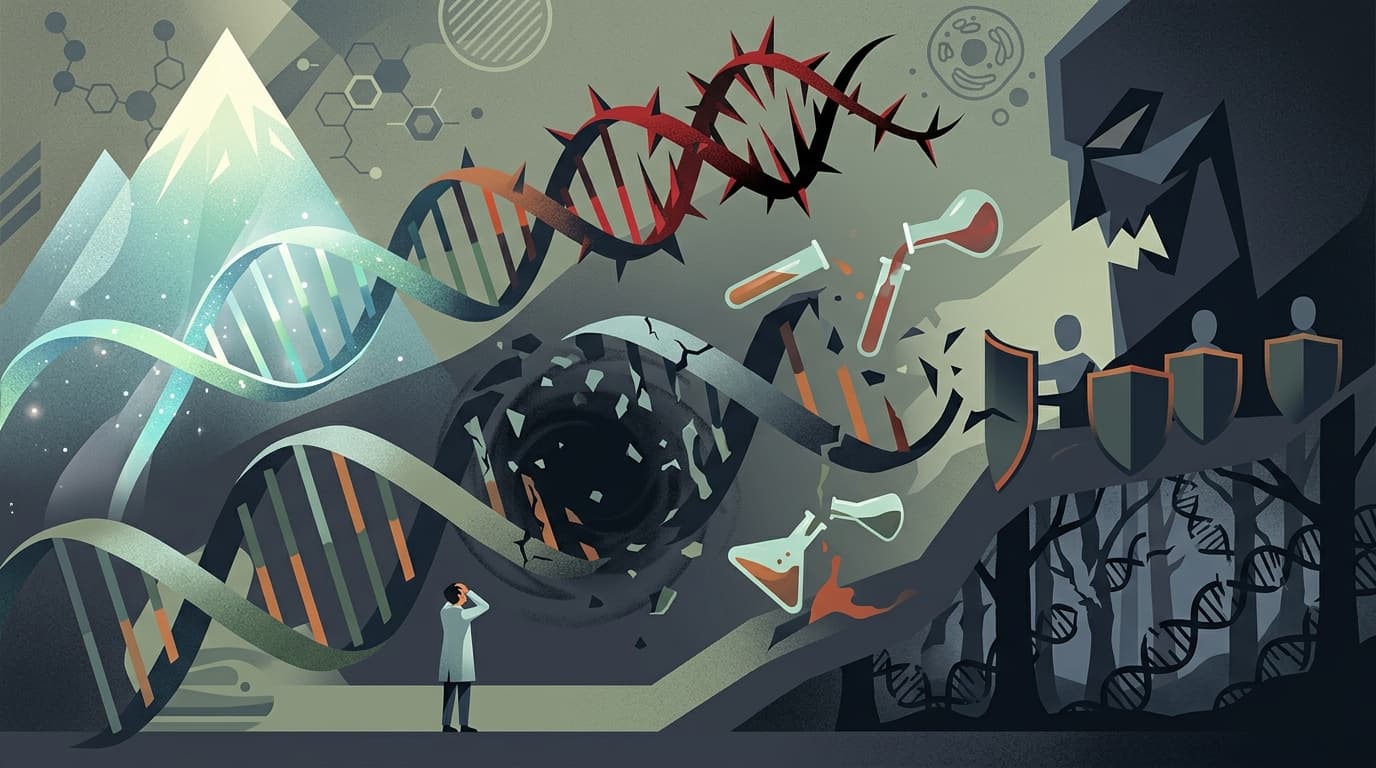

Sarepta Therapeutics slapped the FDA's most severe safety warning on its flagship Duchenne gene therapy after patient deaths, then cut 500 jobs in the same breath. It's the biggest crisis yet for the company that was supposed to prove gene therapy could work at scale.
Imagine spending years building the most ambitious gene therapy on the market, convincing the FDA to approve it, watching nearly $900 million in sales roll in, and then having to slap the most severe safety warning in medicine onto the label while handing pink slips to 500 people.
That's Sarepta Therapeutics right now.
The company just added a black box warning to Elevidys, its one-time gene therapy for Duchenne muscular dystrophy (DMD), a devastating disease that progressively destroys muscle in young boys. Simultaneously, Sarepta announced it's cutting roughly 500 jobs and pausing several pipeline programs. For a company that once symbolized the promise of gene therapy, this is a gut punch.
The black box warning, the FDA's most serious safety label, centers on acute liver injury and liver failure, including fatal cases. Think of it as the FDA putting a giant red stop sign at the top of the drug's prescribing information. Doctors can still use Elevidys, but they now have to reckon with a warning that says: this therapy has killed patients.
The trouble traces back to 2025, when the FDA began investigating three deaths linked to Sarepta's AAV-based therapies. Two were non-ambulatory (wheelchair-bound) boys with DMD who developed fatal liver failure after receiving Elevidys. A third death occurred in a clinical trial for limb-girdle muscular dystrophy, which uses the same viral delivery system, called AAVrh74.
The FDA's response was swift. It told Sarepta to pause shipments to non-ambulatory patients. Then it went further: the agency stripped the non-ambulatory indication entirely from the label, meaning Elevidys is now only approved for patients who can still walk and are at least four years old. That's a significant narrowing of who can receive the treatment.
The safety crisis didn't just hit the label. It hit the business.

Eli Lilly is slashing Zepbound prices to as low as $449/month through direct-to-consumer vials, targeting the millions of cash-paying patients currently tempted by a booming (and dangerous) black market for GLP-1 drugs. It's part pricing strategy, part public health play, and entirely about protecting a $13.5 billion franchise.


Join thousands of biotech professionals who start their day with our free, daily briefing.

Sarepta pulled in $898.7 million in Elevidys revenue during 2025. That sounds impressive until you look at the trajectory. In Q1 2025, the therapy generated $375 million. By Q4, that had cratered to $110.4 million after the safety events spooked doctors and patients alike.
The first half of 2026 hasn't been much better: just $200.1 million in Elevidys sales across six months. Analysts say the drug is "stabilizing rather than reaccelerating," which is Wall Street code for "this franchise is in trouble."
So Sarepta is cutting deep. The company said its restructuring should save about $400 million annually, with the 500-person layoff alone generating roughly $120 million in yearly cash savings. That's not trimming fat; that's survival mode. Sarepta originally issued $980 million in aggregate principal of senior notes due in 2027, though extensive refinancing has since reduced the outstanding balance to approximately $158.6 million.
The company is also pausing most of its limb-girdle muscular dystrophy gene therapy programs and pivoting toward its siRNA (a different type of genetic medicine) platform instead. Translation: Sarepta is quietly backing away from the very technology that made it famous.
Sarepta's crisis isn't happening in a vacuum. It's the loudest alarm bell in a chorus of warnings about AAV gene therapy safety across the entire industry.
AAV (adeno-associated virus) is the most popular delivery vehicle for gene therapies. Scientists load a working copy of a gene into this tiny virus, inject it into a patient, and let the virus deliver the genetic payload to cells. It's an elegant idea, like using a drone to deliver a package directly to someone's front door. The problem? At high doses, the body's immune system can treat that drone like an invader, triggering dangerous inflammation in the liver, heart, or kidneys.
The pattern keeps repeating. Reviews of clinical data have flagged myocarditis (heart inflammation), thrombotic microangiopathy (a blood clotting disorder that can damage kidneys), and liver toxicity as recurring problems, especially at the high doses needed for diseases like muscular dystrophy.
And companies are voting with their feet. Biogen shut down all its AAV gene therapy programs in September 2025. Pfizer, Vertex, and Takeda have similarly pulled back from the space. The industry's enthusiasm for AAV gene therapy, once white-hot, is cooling fast.
For families dealing with Duchenne muscular dystrophy, this is especially painful. DMD is relentless; it typically appears in early childhood and progressively robs boys of their ability to walk, then breathe, then survive. Every year matters.
Elevidys remains the only FDA-approved gene therapy for DMD, and it still has its approval for ambulatory patients. But the black box warning creates a chilling effect. Doctors and parents who were already agonizing over a one-time, irreversible gene therapy now have even more reason to hesitate.
The alternatives are limited. Exon-skipping drugs (like Exondys 51 and Vyondys 53) work only for specific genetic mutations and don't cure the disease. Corticosteroids slow progression but come with brutal side effects. Duvyzat, a newer oral medication that works across all DMD genetic variants, offers some hope, but it's not a gene therapy and doesn't replace the missing dystrophin protein the way Elevidys was designed to.
No other gene therapy competitor is close to market. The pipeline programs that might have offered alternatives are mostly in early-stage trials, and the AAV safety concerns are making investors and companies think twice about pushing them forward.
Sarepta is guiding to $1.2 billion to $1.4 billion in total revenue for 2026, leaning on its older RNA-based therapies and whatever Elevidys demand holds up. But the company's stock has been hammered, its workforce is shrinking, and its flagship product now carries the scarlet letter of pharmaceutical safety warnings.
The FDA has also required a postmarketing observational study to further assess the liver injury risk, which means this story isn't over. More data will come in. More scrutiny will follow.
For the gene therapy field broadly, Sarepta's fall from grace is a sobering reminder: delivering genes into the human body is still incredibly hard, and the gap between scientific ambition and clinical reality remains wide. The dream of one-shot genetic cures hasn't died, but it just got a lot more complicated.
PTC Therapeutics just scooped up a near-approval Fabry disease gene therapy from Sangamo's bankruptcy auction for $211 million. It's either the deal of the year or a cautionary tale waiting to happen.