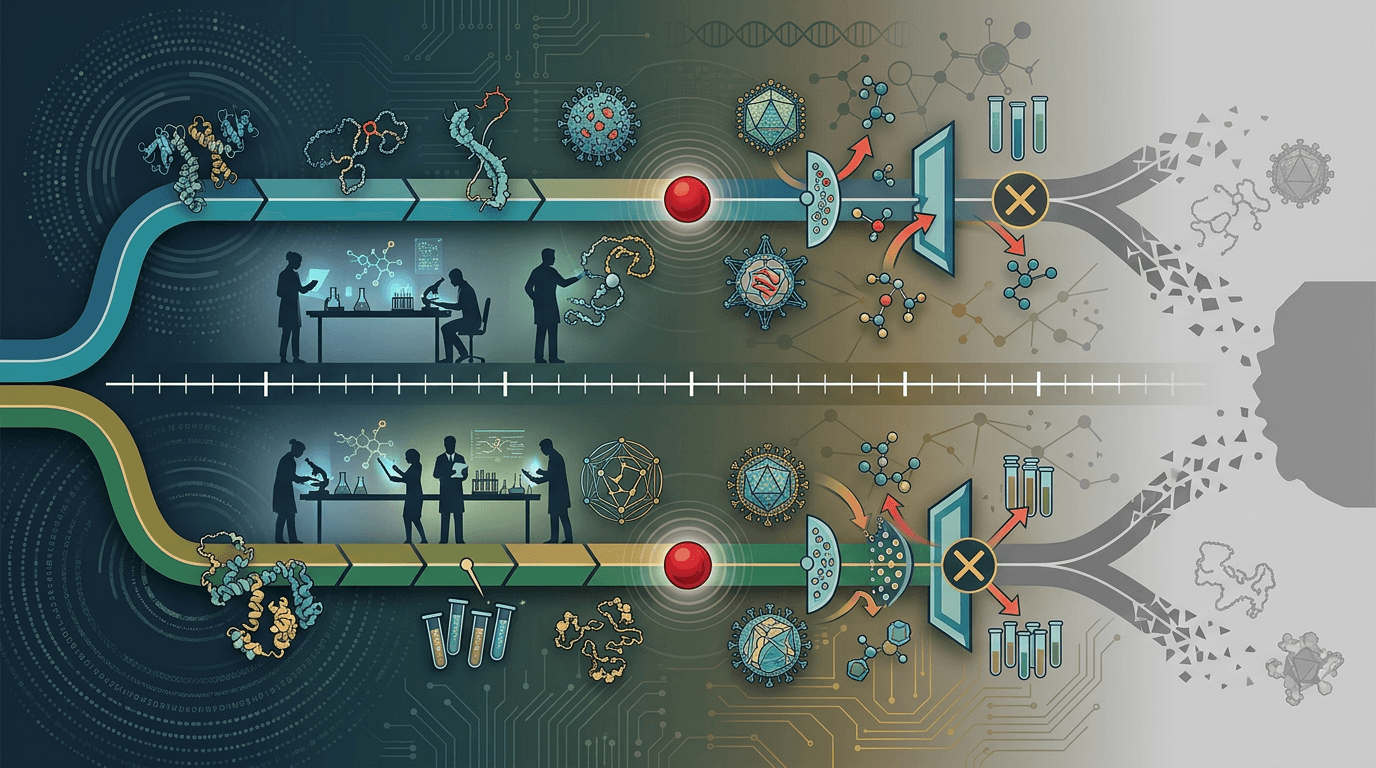
Two Companies, One 40-Year-Old Disease, Zero Cures
For 40 years, the best treatment for a devastating genetic lung disease has been a weekly IV drip. Now Sanofi and Wave Life Sciences are racing toward radically different solutions, and the data is getting very interesting.
Imagine your lungs have a bodyguard. A protein called alpha-1 antitrypsin (AAT) patrols your airways, neutralizing enzymes that would otherwise chew through lung tissue like acid through paper. Now imagine being born without enough of that bodyguard. That's alpha-1 antitrypsin deficiency (AATD), a genetic disease affecting roughly 200,000 people in the U.S. and Europe.
For four decades, the best medicine could offer these patients was a weekly IV drip of replacement protein harvested from donor plasma. It slows lung damage but doesn't stop it. It does nothing for the liver disease many patients also develop. And it requires showing up to an infusion center every single week, for life.
That might finally be about to change. At the American Thoracic Society (ATS) conference in May 2026, Wave Life Sciences dropped clinical updates for AATD. Meanwhile, Sanofi continues advancing its own AATD program. One is a pharma giant swinging a $1.7 billion acquisition. The other is a scrappy biotech betting everything on a technology that rewrites genetic mistakes without touching DNA. They're racing toward the same finish line, but they're running completely different races.
The Protein Upgrade vs. the Spell-Check
To understand why this showdown matters, you need to know what each company is actually doing.
Sanofi's approach is essentially a better version of the existing treatment. Their drug, efdoralprin alfa, is a lab-made AAT protein fused to an antibody fragment. That fusion trick (borrowed from the same biology that keeps antibodies circulating in your blood for weeks) extends the protein's lifespan in the body. Instead of weekly infusions, patients could get dosed every three to four weeks. Think of it as upgrading from a flip phone to a smartphone: same basic concept, way better execution.
Phase 2 results from the ElevAATe trial looked strong. Efdoralprin alfa pushed functional AAT levels into the normal range, significantly outperforming weekly plasma-derived therapy at 32 weeks. The difference was statistically significant (p < 0.0001, for the stats nerds). Patients also spent more days with protective AAT levels above the danger zone. Safety looked comparable to existing treatments.
Get tomorrow's biotech intelligence before your competitors.
Join thousands of biotech professionals who start their day with our free, daily briefing.
Wave's approach is fundamentally different. Their drug, WVE-006, doesn't replace the missing protein at all. Instead, it fixes the typo in the genetic instructions that caused the problem in the first place.
Most AATD patients carry a mutation called Pi*Z: a single wrong letter in their SERPINA1 gene. This produces a misfolded "Z" version of AAT that clumps up in liver cells (causing liver damage) instead of getting released into the bloodstream (where lungs need it). Wave's drug is a small molecule that recruits the body's own editing machinery to correct that wrong letter at the RNA level, converting mutant Z-AAT back into normal, functional M-AAT.
If Sanofi is refilling a leaky bucket, Wave is trying to patch the hole.
The Data That Has Everyone Talking
Wave's Phase 1b/2a trial, RestorAATion-2, has been rolling out data in escalating doses. The numbers tell an increasingly compelling story.
At the 200 mg repeat dose, patients achieved mean total AAT levels of ~11.9 µM, with normal M-AAT making up about 7.2 µM of that total. Why does 11 µM matter? Because that's the threshold regulators have historically used to approve augmentation therapy. It's the line between "your lungs are probably protected" and "they're not."
More importantly, WVE-006 shifted the AAT pool so that more than half was the correct M-type protein. Patients effectively went from a dangerous ZZ profile to something resembling a much safer MZ carrier state. MZ carriers generally live normal lives without severe lung or liver disease.
Then there was the moment that made scientists sit up straight. One patient on WVE-006 got sick with an unrelated infection. Their AAT levels surged to ~20.6 µM, with M-AAT climbing to ~10.3 µM. This was the body's natural acute-phase response kicking in, something that only works if the underlying biology is still running the show. Wave's drug didn't just produce static protein levels; it restored the body's ability to ramp up its own defenses when threatened. No replacement therapy can do that.
The 400 mg single dose pushed total AAT even higher, to roughly 12.8 µM. Data from the 400 mg multidose and 600 mg single-dose cohorts were scheduled for presentation at ATS, with the 600 mg multidose cohort expected in the second half of 2026.
The Liver Problem Nobody Else Is Solving
This is where the competition gets really interesting.
Current augmentation therapy treats the lungs. Full stop. But AATD is a two-organ disease. The same misfolded Z-AAT that starves the lungs also piles up inside liver cells, causing inflammation, fibrosis, and eventually cirrhosis. There is no approved therapy for AATD liver disease. None. The only option for end-stage patients is a liver transplant.
Sanofi's efdoralprin alfa, for all its improvements, is still a lung-focused augmentation therapy. It adds more protein to the bloodstream but does nothing about the toxic Z-AAT accumulating in the liver.
Wave's WVE-006, by converting Z-AAT production to M-AAT at the source, reduces the harmful Z protein itself. Early data showed consistent reductions in circulating Z-AAT across dose cohorts. If that translates to less liver accumulation over time (still unproven in long-term studies), WVE-006 could become the first therapy to address both organs from a single subcutaneous injection.
That's a potentially massive commercial differentiator.
The Business Chess Match
Sanofi landed efdoralprin alfa through its $1.7 billion acquisition of Inhibrx in mid-2024. The deal signaled how seriously Big Pharma takes the AATD market. Current augmentation therapies (Prolastin-C, Zemaira, Aralast, Glassia) generate roughly $1.7 billion in annual worldwide sales, and some analysts project the overall AATD market could exceed $4 billion by 2030.
Sanofi has the infrastructure, the sales force, and the regulatory experience to move quickly. Phase 3 seems straightforward. If the drug gets approved, it could become the new standard of care for AATD lung disease within a few years.
Wave is playing a different game. After GSK declined to exercise its option on WVE-006 (a move initially seen as a red flag), Wave regained full global rights in February 2026 and announced plans to pursue an accelerated approval pathway with the FDA. The company expects regulatory feedback by mid-2026.
The bull case for Wave is compelling: a subcutaneous injection given monthly or less, targeting both lung and liver disease, with the potential to make weekly IV infusions obsolete for ZZ patients. The bear case is equally real: Wave has around $545 million in cash, but will likely need a partner or a capital raise before it can cross the finish line with a full Phase 3 program.
Analysts have described Wave as sitting at a "critical juncture." The science is increasingly validated, but the execution risks are significant for a small-cap biotech going it alone.
The Crowded Track Ahead
Sanofi and Wave aren't the only runners in this race. Beam Therapeutics is testing BEAM-302, a one-time DNA base-editing therapy that could permanently fix the Z mutation at the genomic level. Early Phase 1/2 data showed a 2.8-fold increase in functional AAT and up to 78% reduction in mutant Z-AAT. Tessera Therapeutics, partnered with Regeneron, is approaching the clinic with its own DNA-editing approach.
On the RNA side, Korro Bio (KRRO-110) and AIRNA (AIR-001) are both running early clinical trials with RNA-editing drugs that compete directly with WVE-006. And Arrowhead's fazirsiran, an RNAi drug that silences Z-AAT production to protect the liver, is the furthest along among genetic approaches, with Phase 3 trials ongoing.
Each modality occupies a slightly different niche. Arrowhead addresses the liver but not the lungs. Sanofi addresses the lungs but not the liver. Wave and the DNA editors aim to address both, but at different stages of proof.
Why This Race Matters Beyond AATD
For 40 years, AATD patients have been stuck with a treatment that amounts to bailing water out of a sinking boat. Now, within the span of a few months, they're seeing data from a next-generation protein replacement, multiple RNA-editing programs, and DNA-editing approaches.
The Sanofi vs. Wave matchup is the most fascinating because it captures a broader question facing all of medicine: is the future about making better versions of existing treatments, or about fixing the root cause of disease? Sanofi is betting on the former. Wave is betting on the latter. Both could win, potentially serving different patient populations and disease stages.
But for the 200,000 people whose lungs and livers are slowly deteriorating because of one wrong letter in their DNA, the real victory is that someone is finally, seriously trying to do better than "come back next week for another infusion."
The next six months will tell us a lot. Wave's higher-dose data, FDA feedback on accelerated approval, and Sanofi's Phase 3 plans will all shape how this competition unfolds. One thing is already clear: AATD's four-decade drought is over.
4 min read
Quince Therapeutics Just Sold Itself for 7 Cents on the Dollar
Quince Therapeutics just handed 93% of its company to a private biotech most people have never heard of. After a failed Phase 3 trial left it with no drugs, no pipeline, and not enough cash to survive a year, the reverse merger with Orphai Therapeutics might be the best bad option available.