Roche Just Walked Away From Huntington's Disease. Now What?
Roche killed two Huntington's disease programs on the same day, ending a 13-year bet with Ionis that the right biomarkers would lead to the right treatment. They didn't. Here's what it means for patients running out of options.
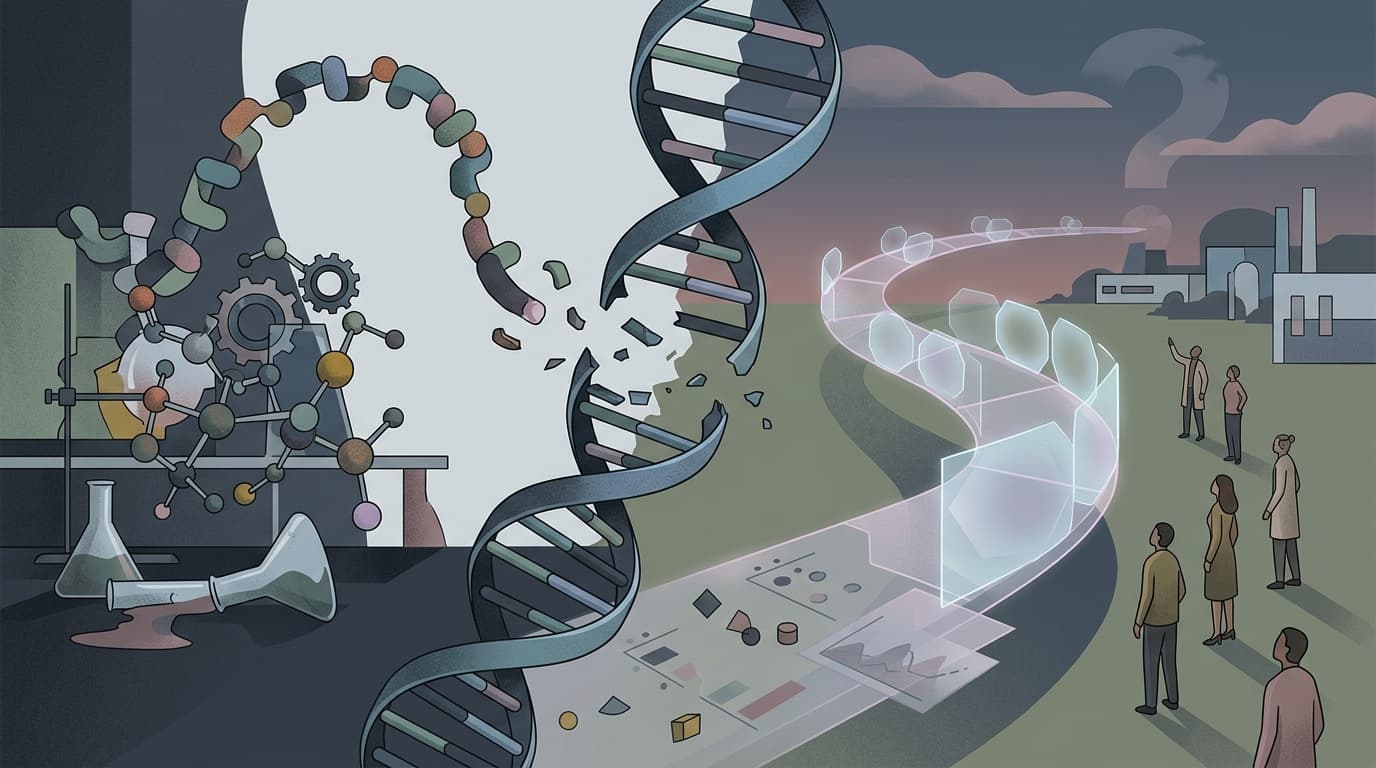
Imagine spending over a decade and hundreds of millions of dollars trying to fix a broken gene. You prove your drug hits the target. You show it lowers the toxic protein. You nail the biomarkers. And then the patients don't get better.
That's what just happened to Roche. On July 9, the Swiss pharma giant pulled the plug on two Huntington's disease programs in a single day, ending a partnership with Ionis Pharmaceuticals that stretches back to 2013. The decision leaves patients with a disease that has no cure, no disease-modifying treatment, and vanishingly few advanced options left in the pipeline.
This isn't just a clinical trial failure. It's a crisis of confidence for an entire field.
Thirteen Years, Two Strikes, You're Out
The story of Roche and Huntington's is one of the longest-running heartbreaks in biotech.
It starts in 2013, when Roche partnered with Ionis on an antisense oligonucleotide (ASO) called tominersen. Think of ASOs like molecular interceptors: they latch onto a specific RNA message and prevent it from making a harmful protein. In Huntington's, that harmful protein is mutant huntingtin, produced by a defective gene that every patient carries from birth.
Early results were electric. A Phase 1/2a trial showed tominersen could reduce mutant huntingtin in spinal fluid by roughly 40%. The safety profile looked clean. Roche paid $45 million to fully license the drug in late 2017, and the biotech world started whispering about a genuine disease-modifying therapy for Huntington's.
Then came GENERATION HD1, the big Phase 3 trial. It enrolled 791 patients across 18 countries and tested tominersen at two dosing frequencies against placebo. This was supposed to be the moment.
It wasn't. In March 2021, an independent safety board recommended stopping all dosing. Not because of a dramatic safety crisis, but because of something arguably worse: the drug simply wasn't working. Patients on tominersen showed no improvement on functional scales measuring motor control, cognition, or daily living. Worse, those getting the more frequent dose actually showed signs of doing than placebo, including increased brain volume loss and rising levels of a nerve-damage biomarker called neurofilament light chain.
Get tomorrow's biotech intelligence before your competitors.
Join thousands of biotech professionals who start their day with our free, daily briefing.
worse
The Comeback That Wasn't
Most companies would have walked away after a Phase 3 failure of that magnitude. Roche didn't.
Buried in the wreckage of GENERATION HD1 was a tantalizing clue. Post-hoc analyses (the kind of data-mining you do after a trial fails, hoping to find a silver lining) suggested that younger patients with less advanced disease might have responded differently. Maybe, Roche reasoned, the problem wasn't the drug itself. Maybe it was the population and the dose.
So they designed GENERATION HD2, a Phase 2 trial focused on younger adults with prodromal or early-stage Huntington's. Lower doses, less frequent injections, healthier brains that might respond better. It was a reasonable hypothesis. It was also a Hail Mary.
The results landed in July 2026, and they landed hard. Tominersen, once again, did exactly what it was supposed to do biologically: it significantly reduced mutant huntingtin and lowered neurofilament light chain. The biomarkers moved in all the right directions. The safety profile was acceptable.
But after 16 months of treatment, patients on tominersen looked no different from those on placebo across every clinical measure that matters. No improvement in motor function. No slowing of cognitive decline. No preservation of daily living skills.
Roche's conclusion was unsparing: "no path forward." No open-label extension. No compassionate use. No further development of tominersen in Huntington's, period.
A Second Casualty on the Same Day
As if one termination weren't enough, Roche simultaneously killed RG6496, a newer ASO that was supposed to be the smarter version of tominersen.
Where tominersen was a blunt instrument (it knocked down both the mutant and healthy versions of the huntingtin protein), RG6496 was designed to be selective. It targeted only the mutant copy using a genetic marker called a single nucleotide polymorphism, or SNP, leaving the normal huntingtin protein untouched. Think of it as the difference between carpet-bombing and a surgical strike.
RG6496 had barely gotten started in humans. Its Phase 1 trial, POINT-HD, had dosed just three participants with a single injection, and none of them had any safety problems. But running in parallel were long-term animal studies testing what happens with repeated, chronic dosing, which is exactly what Huntington's patients would need.
Those animal studies found something bad enough that Roche won't even disclose the details. Whatever they saw, it convinced them the drug "cannot be given chronically with repeated doses." Game over.
Roche stressed that these two decisions were independent: tominersen failed on efficacy; RG6496 failed on chronic safety. But the timing, the same day, felt like a funeral with two caskets.
The Biomarker Trap
The tominersen story contains a lesson that should make every biotech investor uncomfortable.
For years, the Huntington's field operated on a seemingly logical assumption: the mutant huntingtin protein is toxic, so if you lower it, patients should improve. Tominersen proved that you can lower it. GENERATION HD2 proved that lowering it doesn't necessarily help.
This is what analysts are calling the "biomarker trap." The drug hit its biological target with precision, yet the clinical benefit was zero. It's like perfectly tuning a car engine while the transmission is broken; the RPMs look great on the dashboard, but the car isn't moving.
The implications extend far beyond Huntington's. Across neurodegeneration, companies are building billion-dollar valuations on the premise that moving a biomarker (amyloid in Alzheimer's, alpha-synuclein in Parkinson's) will translate into clinical improvement. Tominersen is now Exhibit A for why that assumption deserves serious scrutiny.
Ionis stock dropped roughly 20 to 25 percent on the news. Analysts are effectively writing HD value down to zero in their models for the company.
What's Left for Patients?
The current state of Huntington's treatment is bleak. There is no approved therapy that slows, stops, or reverses the disease. The only FDA-approved drugs — tetrabenazine, deutetrabenazine, and valbenazine — treat involuntary movements (chorea) but do nothing about the relentless cognitive and psychiatric decline that ultimately kills patients.
Population studies paint a grim picture of daily reality: 92% of HD patients have unmet care needs, with the highest burden in mid-stage disease, where 95% of patients report gaps in health, personal, and social support.
So what's still in the pipeline? A handful of programs, each carrying its own question marks.
uniQure's AMT-130 is arguably the most advanced remaining hope. This one-time gene therapy uses a viral vector to deliver a microRNA that lowers huntingtin inside the brain. Phase 1/2 data showed it "strongly and significantly reduced disease progression" in high-dose patients, and the FDA granted it Breakthrough Therapy designation in April 2025. The company is meeting urgently with regulators to define a path toward approval, though no Phase 3 trial has been formally announced.
Wave Life Sciences' WVE-003 takes the allele-selective approach that RG6496 was pursuing, but with different chemistry. Early data showed up to a 46% reduction in mutant huntingtin while sparing the normal protein, and the company is planning a potentially registrational Phase 2/3 study. Rodman & Renshaw analysts argue Roche's exit actually "tightens the case" for Wave's approach, since it clarifies that non-selective knockdown doesn't work.
Votoplam, developed by PTC Therapeutics with Novartis, offers something none of the others do: it's a pill. This oral small-molecule splicing modulator is moving toward Phase 3 and has FDA Fast Track designation. An oral drug would be transformative for a patient population currently stuck with spinal injections or brain surgery.
Roche itself hasn't fully abandoned Huntington's. Its RG6662 gene therapy (inherited from the Spark Therapeutics acquisition) remains in early clinical testing, though it's years from any potential approval.
The Uncomfortable Truth
Huntington's disease has one of the clearest genetic stories in all of medicine. One gene, one mutation, one protein. If any neurodegenerative disease should be "easy" to treat with precision medicine, it's this one.
And yet the field keeps failing. Tominersen is just the highest-profile casualty in a string of setbacks that includes Wave's earlier ASO programs, Sage Therapeutics' dalzanemdor (which flopped on cognition endpoints), and the general humbling of the huntingtin-lowering hypothesis.
The uncomfortable truth is that knowing the cause of a disease and being able to treat it are separated by an enormous chasm. Lowering a toxic protein sounds straightforward until you realize that the "normal" version of huntingtin plays important roles in brain cells, that delivering drugs deep into the brain remains maddeningly difficult, and that decades of neuronal damage may not be reversible by the time symptoms appear.
For Roche, this chapter cost over a decade of effort and a partnership that once symbolized the promise of genetic medicine. For Ionis, it means pivoting the narrative toward cardiovascular, rare disease, and better-validated neurology programs. For investors, HD is now a "long-horizon, binary R&D arena" rather than anything resembling a near-term revenue opportunity.
But for patients and their families, the math is simpler and more painful. The most advanced drug candidate they had is gone. The next wave of therapies is still years from the finish line. And the disease doesn't wait.
Clinical & Regulatory
5 min read
One Shot a Week: The Insulin That Could Change Everything for 100 Million Indians
Novo Nordisk just launched the world's first once-weekly insulin in a country with 100 million diabetics, and it's actually cheaper than the daily alternatives. India could be the ultimate test case for whether convenience can fix the global insulin adherence crisis.