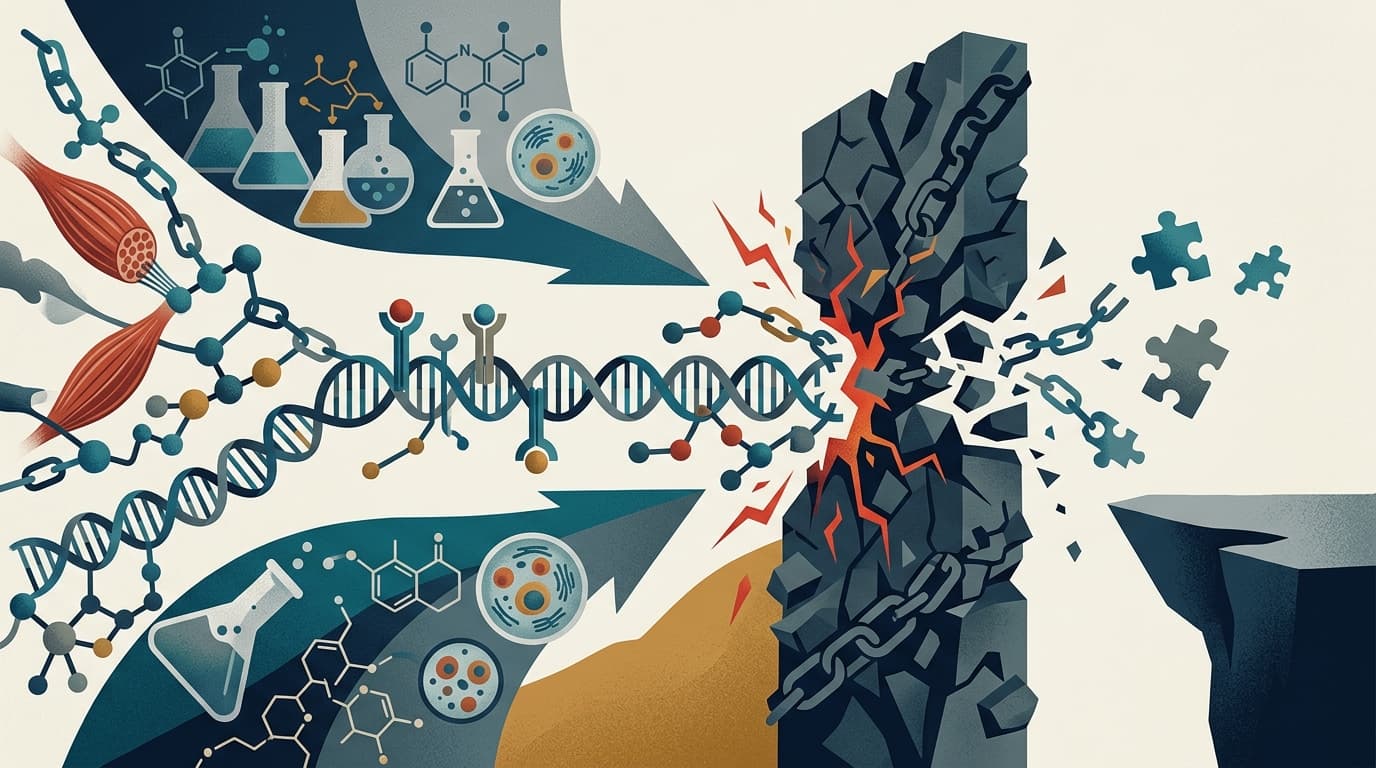
Roche killed its muscle-preserving obesity antibody after it flopped in a mid-stage trial. It's the latest non-GLP-1 approach to crash against an impossibly high bar set by incretin drugs, and it tells us a lot about where the obesity race is really headed.
The One That Got Away
Imagine you're on a diet and losing weight fast, but half of what you're losing is muscle. That's one of the biggest unsolved problems in obesity medicine. Roche thought it had the answer: an antibody that could protect your muscles while a weight-loss drug melted the fat. Turns out, the body had other plans.
Late last week, Roche pulled the plug on emugrobart (also known as GYM329), an anti-myostatin antibody it was developing with Chugai Pharmaceutical. An interim analysis of the Phase 2 GYMINDA trial suggested the drug was unlikely to hit its efficacy goals. The antibody was well tolerated, with no new safety concerns. It just didn't work well enough.
That's a tough break for a company spending billions to crack the obesity market.
What Myostatin Actually Does (and Why Blocking It Sounded So Good)
Myostatin is a protein your body makes to put the brakes on muscle growth. Think of it like a governor on an engine: it caps how big your muscles can get. Block myostatin, and theoretically, muscles keep growing (or at least stop shrinking).
The logic for obesity was compelling. GLP-1 drugs like tirzepatide are phenomenal at driving weight loss, but patients lose a meaningful chunk of lean mass along the way. Roche wanted to pair emugrobart with a GLP-1/GIP agonist so patients could shed fat and keep their muscle. It was the peanut butter-and-jelly thesis of obesity therapeutics.
The GYMINDA trial was designed around that exact idea: combine a myostatin blocker with incretin-based weight loss and see if you could get the best of both worlds. The interim data said no.
Another Non-GLP-1 Approach Bites the Dust
Emugrobart isn't the only non-incretin obesity program to stumble recently. Pfizer killed danuglipron in April 2025 after a liver-injury signal. Eli Lilly halted a Phase 2b trial of bimagrumab in obesity with type 2 diabetes on June 10, 2025, though a parallel trial in patients with obesity without diabetes remained active. And across the board, single-pathway non-GLP-1 mechanisms have struggled to break the 10% average body-weight loss barrier.
Get tomorrow's biotech intelligence before your competitors.
Join thousands of biotech professionals who start their day with our free, daily briefing.
That number matters because the drugs they'd be competing against (tirzepatide, semaglutide, and the next wave of multi-agonists) routinely blow past it. When the bar keeps rising, anything that can't clear it gets cut.
The pattern is becoming hard to ignore. Antibody-based approaches to obesity remain high-risk bets. They're mechanistically interesting but haven't translated into the kind of dramatic, durable weight loss that gets drugs approved and prescribed. In the 2026 pipeline landscape, the most advanced "beyond GLP-1" programs are peptides, oral small molecules, and multi-agonists; antibodies and bispecifics are barely represented in late-stage development.
Roche Still Has a Loaded Gun
Before you write Roche's obesity obituary, pump the brakes. The company didn't bet everything on one antibody. It bet on an entire portfolio.
Roche's $2.7 billion acquisition of Carmot Therapeutics gave it a deep bench of incretin-based assets. The crown jewel is enicepatide (CT-388), a dual GLP-1/GIP receptor agonist now heading into Phase 3. Analysts have largely shrugged off the emugrobart setback because enicepatide's mid-stage data looked strong. Roche has projected aggregate obesity revenue potential of more than $3 billion annually across its Carmot-derived programs (enicepatide, CT-996, and CT-868).
The company also has an oral play: CT-996, a daily pill candidate from the Carmot pipeline, targets the convenience gap that injectables can't fill. And on the combination front, Roche licensed petrelintide (an amylin analog) from Zealand Pharma to study as both a standalone treatment and in a fixed-dose combo with enicepatide. That combination could help with tolerability, particularly the nausea that plagues so many incretin drugs.
All told, Roche says it has six assets in obesity and metabolic disease development. Losing emugrobart narrows its approach, but the broader strategy (scale a multi-asset incretin franchise, add combinations, offer both injectable and oral options) is intact.
The Competitive Reality Check
The obesity market in 2026 looks like a Formula 1 grid where Novo Nordisk and Eli Lilly are starting on pole position and everyone else is fighting for the midfield.
Novo has CagriSema (amylin plus GLP-1) and an oral version of Wegovy in its pipeline. Lilly is pushing retatrutide, a triple agonist hitting GIP, GLP-1, and glucagon receptors simultaneously, alongside orforglipron, its oral small-molecule GLP-1. Viking Therapeutics has VK2735, a GLP-1/GIP dual agonist generating buzz. Boehringer Ingelheim and Zealand are advancing survodutide, a GLP-1/glucagon dual agonist.
More than 200 companies now have obesity drugs in development. The ones gaining traction share a few traits: they either produce massive weight loss, offer oral convenience, improve tolerability, or (the holy grail) preserve muscle mass during treatment.
That last category is where Roche just lost its most interesting card.
What This Really Means
The emugrobart failure isn't going to derail Roche's obesity ambitions. But it does highlight a brutal truth about this market: good science isn't enough. You need results that beat an increasingly insane benchmark set by incretin drugs.
Roche's goal of becoming a top-three obesity company by 2030 now rests almost entirely on its incretin-based programs, particularly enicepatide. That's a strong horse to ride, but it means competing head-to-head with Lilly and Novo on their own turf rather than flanking them with a differentiated muscle-preservation play.
Chugai, meanwhile, gets the molecule back and plans to continue developing emugrobart for spinal muscular atrophy (SMA), a rare genetic disease where the biology might be more forgiving. The drug isn't dead; it's just leaving the obesity party.
And if you're keeping score at home, the obesity drug race just got a little clearer. The incretins are winning, and everyone trying to compete with something different keeps running into the same wall. The question isn't whether non-GLP-1 approaches could work in theory. It's whether any of them can work well enough to matter in a market that's already decided what "good" looks like.
4 min read
Merck Just Paid $400M for a Drug That Doesn't Exist Yet
Merck just dropped $400 million on a Chinese biotech's preclinical cancer drug targeting a protein scientists called "undruggable" for 40 years. The KRAS G12D race is on, and Merck's gamble says everything about where Big Pharma is shopping for its next blockbuster.