Roche Just Paid $700M Upfront for a Drug That Destroys Its Target
Roche is paying Nurix Therapeutics $700 million upfront (up to $2.3 billion total) for a drug that physically destroys a cancer-driving protein instead of just blocking it. The deal for BTK degrader bexobrutideg is the loudest signal yet that protein degradation has become big pharma's favorite new weapon.
Most cancer drugs work like a bouncer at a nightclub: they block a troublemaker from getting in. Roche just bet $700 million on a drug that skips the bouncer and throws the troublemaker out of the building entirely.
The Swiss pharma giant announced a deal with Nurix Therapeutics to co-develop bexobrutideg, an oral drug that physically destroys a protein called BTK. The total deal could reach $2.3 billion in payments. And it signals that one of the hottest ideas in drug design, protein degradation, has officially graduated from science experiment to big pharma priority.
The Protein That Won't Stay Down
BTK (Bruton's tyrosine kinase) is a protein that helps B cells, a type of immune cell, survive and multiply. In blood cancers like chronic lymphocytic leukemia (CLL), BTK goes haywire, fueling uncontrolled growth. Drugs called BTK inhibitors, like ibrutinib and zanubrutinib, have been blockbusters. They park themselves in BTK's active site and stop it from working.
The problem? Cancer cells are crafty. Over time, they mutate BTK so the drug can't latch on anymore. The most common culprit is a mutation called C481S, which accounts for over 90% of BTK mutations found in ibrutinib resistance. Newer "non-covalent" BTK inhibitors can handle C481S, but they create their own resistance mutations (T474, L528W, and others). It's a game of whack-a-mole, and the moles keep evolving.
This is where bexobrutideg flips the script. Instead of blocking BTK, it tags the protein for destruction. The cell's own recycling machinery chews it up. No protein, no problem; not just the kinase activity, but all of BTK's functions, gone.
How You Destroy a Protein (Without a Flamethrower)
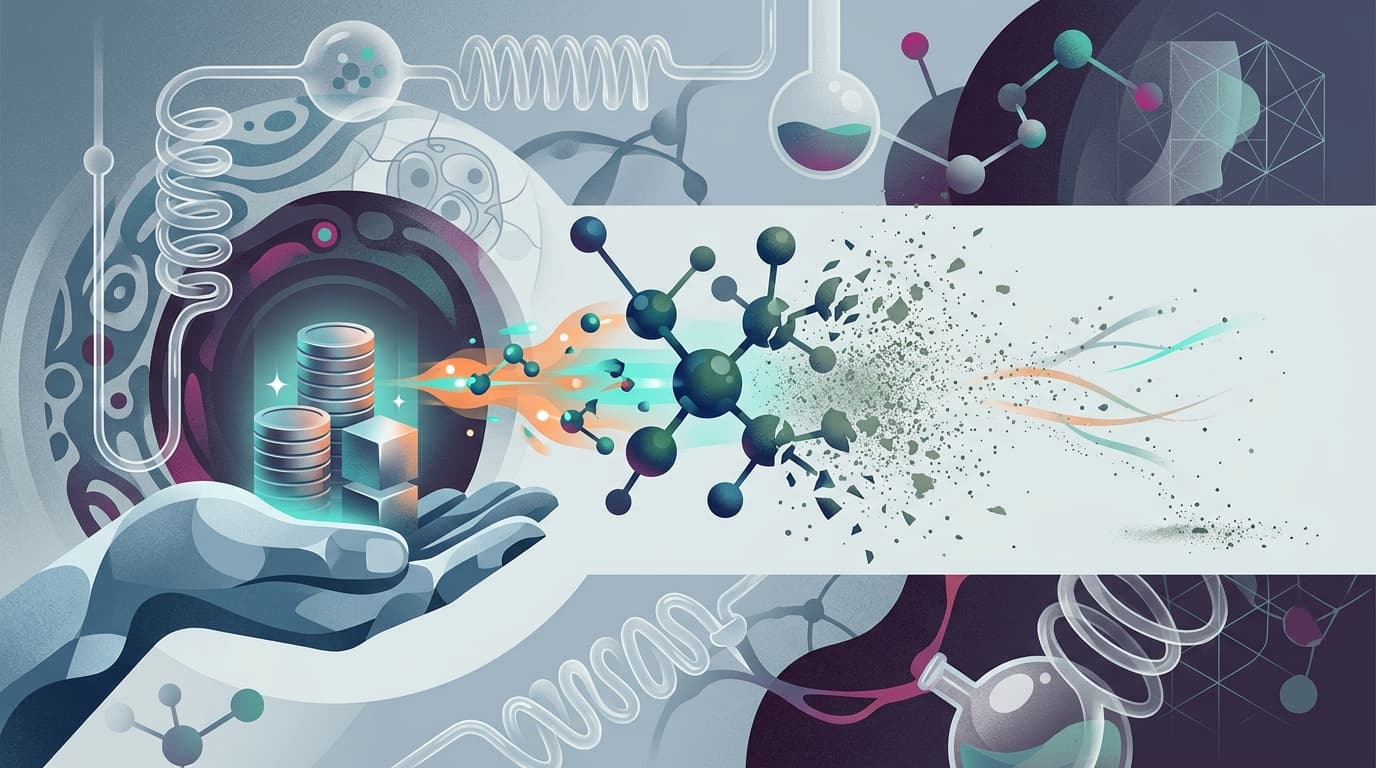
Bexobrutideg is what scientists call a heterobifunctional degrader. Think of it like molecular handcuffs: one end grabs BTK, the other end grabs an enzyme called cereblon (part of the cell's waste disposal system). Once the two are cuffed together, cereblon slaps a "destroy me" tag on BTK, and the cell's protein shredder does the rest.
Get tomorrow's biotech intelligence before your competitors.
Join thousands of biotech professionals who start their day with our free, daily briefing.
The beauty of this approach is that it doesn't care whether BTK is normal or mutated. If the handcuff can still grab the protein, the protein gets destroyed. Preclinical data showed bexobrutideg can degrade both wild-type and C481-mutant BTK at very low concentrations. It even penetrates the brain in animal models, which matters for cancers that hide in the central nervous system.
One caveat: degraders aren't invincible. Researchers have already identified at least one mutation (BTK A428D) that can block degrader-mediated destruction. The whack-a-mole game continues, just with better hammers.
The Data That Got Roche's Attention
Bexobrutideg is still early-stage, with all human data coming from its ongoing Phase 1a trial in heavily pretreated blood cancer patients. But the numbers are striking.
In 47 evaluable CLL patients, the overall response rate hit 83%. These weren't easy cases; many had already failed both BTK inhibitors and venetoclax, another standard treatment. Responses came fast, too, with a median time to first response of just 1.9 months.
Durability looks promising so far. The median duration of response hasn't been reached yet (a good sign this early), and 13 patients have stayed on treatment for over a year. Perhaps most interesting: responses held up regardless of whether patients carried TP53, BTK, PLCG2, or BCL2 mutations, the usual suspects that make CLL hard to treat.
On the safety side, no dose-limiting toxicities were observed. The most common side effects were bruising (42%), fatigue (31%), and neutropenia (29%, with about 23% at higher grades). Notably, in early data only one case of new-onset atrial fibrillation was observed, a significant improvement over older BTK inhibitors like ibrutinib, where atrial fibrillation has been a notorious problem for years.
Follow the Money
The deal structure tells you how much Roche believes in this drug. Nurix gets $700 million in cash upfront, with the rest of the $2.3 billion tied to development, regulatory, and sales milestones. The two companies will split development costs 60/40 (Roche pays the bigger share) and split U.S. profits 50/50. Outside the U.S., Roche handles commercialization and pays Nurix tiered royalties in the low- to high-teens range.
That 50/50 U.S. profit share is remarkable. It means Roche sees bexobrutideg not as a small niche product, but as something with blockbuster-scale commercial potential across blood cancers, autoimmune diseases, and even neurology.
For Nurix, this is a coming-of-age moment. The San Francisco biotech has been quietly building a protein degradation empire, inking partnerships with Gilead, Sanofi, and Pfizer that have generated roughly $482 million in non-dilutive funding with up to $6.1 billion in future milestone potential. The Roche deal is the crown jewel.
Roche's Degrader Shopping Spree
This isn't Roche dipping a toe into protein degradation. It's a cannonball. The company has assembled a full portfolio of degrader partnerships over the past two years:
Vividion Therapeutics: $135 million upfront for small-molecule degraders targeting new E3 ligases in oncology.
Monte Rosa Therapeutics: $50 million upfront (up to $2 billion in milestones) for molecular glue degraders in cancer and neuroscience.
C4 Therapeutics: $20 million upfront (over $1 billion in milestones) for degrader-antibody conjugates, basically ADCs with protein-destroying payloads.
Add bexobrutideg, and Roche now has degrader programs spanning small molecules, molecular glues, antibody conjugates, and a clinical-stage BTK destroyer. At its JPMorgan 2026 presentation, the company noted that roughly 60% of its pipeline comes from external partnerships. Protein degradation is clearly the modality Roche is betting heaviest on.
The Bigger Picture
Roche's deal lands in a year that's shaping up as an inflection point for the entire protein degradation field. The first TPD drug has reached approval (Arvinas' vepdegestrant-based therapy), and 2026 has already seen an estimated $15 billion in upfront TPD-related deals. Novartis, AbbVie, Gilead, and others have all made big bets. The pipeline now includes roughly 215 degrader assets in clinical trials.
For CLL patients specifically, the stakes are personal. After exhausting BTK inhibitors and venetoclax, options narrow to clinical trials, bispecific antibodies, or CAR-T cell therapy. A drug that can destroy mutated BTK proteins and potentially work where multiple prior treatments have failed would fill a real gap.
Bexobrutideg still has a long road ahead. Phase 3 trials are planned for CLL, and the 83% response rate will need to hold up in larger, controlled studies. The deal is expected to close in Q3 2026.
But if you want to know where big pharma thinks oncology is heading, follow the money. And right now, $2.3 billion says the future isn't about blocking proteins. It's about destroying them.
Clinical & Regulatory
4 min read
Roche Just Crashed the Obesity Party With a Number Nobody Expected
Roche's obesity drug enicepatide posted 22.5% weight loss in 48 weeks, landing squarely in Zepbound territory and turning Roche from a latecomer into a legitimate contender. The real question: can it compete with what Lilly and Novo are cooking up next?