Roche Wants to Fire Its Lab Scientists (and Replace Them With Robots)
Roche just announced it's building autonomous AI-driven labs and chasing "AI independence" in drug discovery. With 2,176 NVIDIA GPUs, CHF 2 billion in redirected R&D savings, and an AI tool influencing 80% of research decisions, this is pharma's boldest robot-lab bet yet.
The Factory Nobody Saw Coming
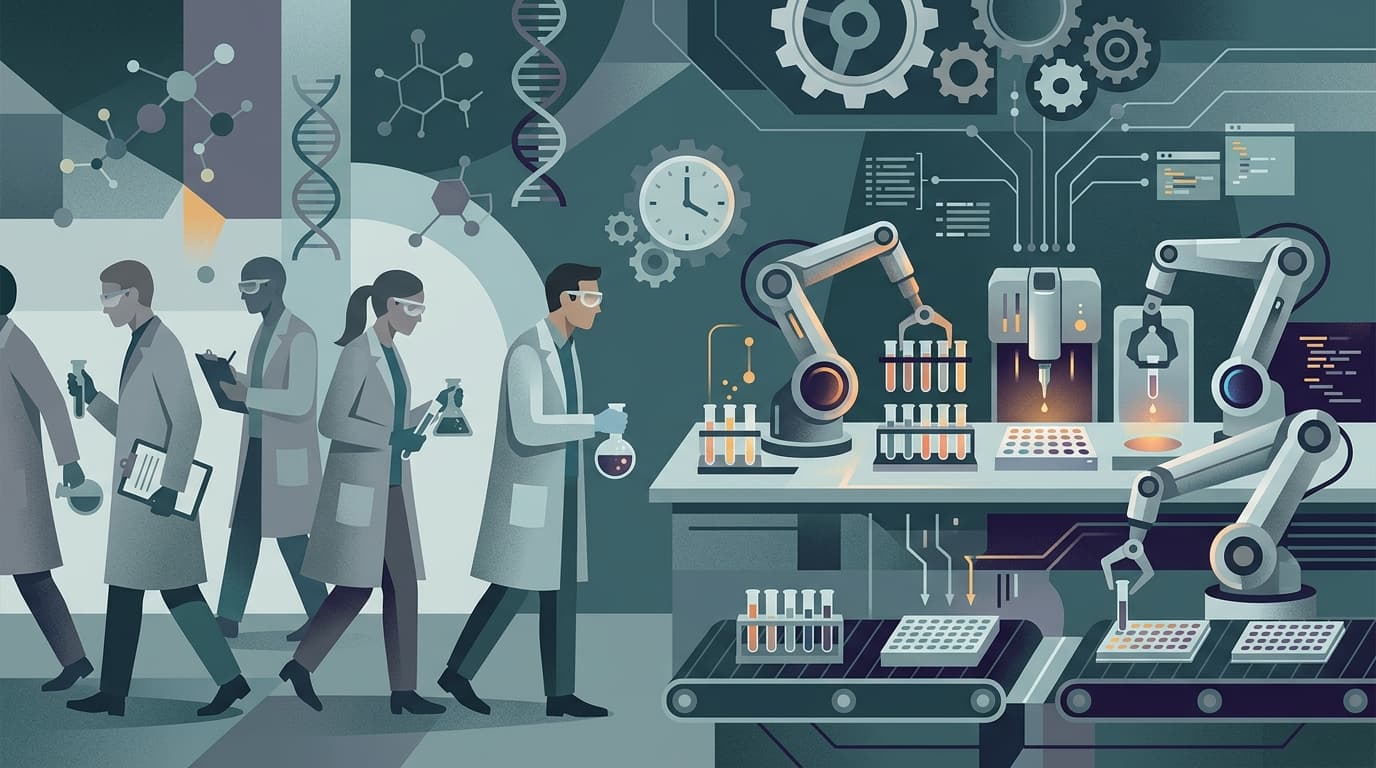
Imagine walking into a pharmaceutical lab and finding no one there. No lab coats, no pipettes in human hands, no grad students stress-eating vending machine snacks at 2 a.m. Just machines running experiments, analyzing results, and deciding what to test next.
That's where Roche says it's headed.
On September 28, the Swiss pharma giant announced it has started building autonomous AI-driven laboratories and is pursuing what it calls "AI independence" in its R&D operations. Not AI-assisted. Not AI-augmented. Independent. The kind of setup where algorithms don't just recommend the next experiment; they run it, interpret it, and plan the follow-up.
It's one of the boldest AI bets any pharma company has ever made public. And it raises a question the entire industry is quietly wrestling with: can a machine actually discover a drug?
What Roche Is Actually Building
Let's be clear about what this is and isn't. Roche isn't claiming it already has Skynet cooking up cancer drugs. The company frames this as a six-level progression toward full autonomy, and it's still in the early-to-mid stages. Think of it like self-driving cars: Tesla has been promising Level 5 autonomy for years, but most cars on the road are still at Level 2. Roche is somewhere on that spectrum, moving fast but not at the finish line.
The more concrete pieces are already impressive, though. Roche's internal AI tool, Target Nexus, is on track to contribute to 80% of the company's research portfolio decisions by the end of 2026. That means the vast majority of choices about which drug targets to pursue will have an AI fingerprint on them.
And this isn't vaporware optimism. Roche disclosed that 40% of its pipeline decisions between Q4 2025 and Q2 2026 already included an AI or computational contribution. So the flywheel is spinning; the question is how fast it accelerates.
Follow the Money
Whenever a company announces a big AI initiative, the smart move is to check the receipts. Roche's are substantial.
Get tomorrow's biotech intelligence before your competitors.
Join thousands of biotech professionals who start their day with our free, daily briefing.
The company said roughly CHF 2 billion (about $2.3 billion) in R&D savings will be redirected to new programs and productivity initiatives by the end of 2026. That's not cost-cutting for the sake of fatter margins. It's reallocation: spending less on slow, manual processes so you can fund more shots on goal.
Roche's overall pharmaceutical R&D budget tells an interesting story, too. In 2024, the company spent CHF 11.1 billion on pharma R&D. For the full year 2026, that number had dipped to CHF 10.4 billion, a 3% decline. Spending less while doing more is the whole promise of AI in drug development, and Roche appears to be making early progress on that front.
Analysts at Fitch expect Roche's R&D spend as a percentage of sales to drop from 25% in 2024 to the low 20s by 2028. If that happens while pipeline productivity holds up, it's a genuinely transformative shift in how a $60+ billion pharma company operates.
The GPU Arms Race
You can't run autonomous labs without serious computing horsepower, and Roche has been quietly stockpiling it. In March 2026, the company expanded its partnership with NVIDIA by adding 2,176 Blackwell GPUs across sites in the U.S. and Europe. That gave Roche what it claims is the largest GPU footprint in all of pharma.
The NVIDIA relationship started back in 2023, when Genentech (Roche's U.S. biotech arm) signed a strategic collaboration combining its biological datasets with NVIDIA's accelerated computing. Three years later, it's grown into a full-blown AI factory supporting drug discovery, diagnostics, molecular modeling, and clinical trial workflows.
Roche also recently opened its Boston Innovation Center, partly focused on AI and machine learning in drug development. The physical infrastructure is catching up to the ambition.
The Competition Isn't Standing Still
Roche may be grabbing the loudest headlines, but it's not the only pharma giant building robot labs.
AstraZeneca has been running its iLab automated platform since 2017 and is now on a third-generation system that can synthesize and purify multiple compounds in parallel. It's arguably the most operationally mature player in actual lab automation, even if it hasn't branded the effort as dramatically as Roche.
Novartis has taken a data-first approach, deploying internal AI platforms across preclinical workflows and signing a partnership with Google's Isomorphic Labs. Its data42 database gives it one of the deepest proprietary datasets in the industry.
Pfizer is active too, collaborating with XtalPi on physics-based AI modeling and working with PostEra on closed-loop labs. But its approach reads as more incremental, partnership-driven rather than a grand autonomous vision.
If this were a race, AstraZeneca leads on hardware execution, Novartis leads on data depth, and Roche is trying to leapfrog both by going all-in on autonomy.
The Productivity Receipts
Beyond the autonomous lab headline, Roche shared some eye-catching R&D efficiency numbers that help explain why the company is so bullish on AI.
The company's R&D Excellence program has been targeting a 20% reduction in R&D cost per new drug launched and a 40% cut in average development cycle length. Roche also reported shaving about four months off timelines through faster study-site activation and automated content creation. In an industry where every month of delay costs millions in lost revenue, four months is real money.
Perhaps most telling: Roche said it's aiming for 20 new molecular entities by 2030. That's an aggressive target for any single company, and it only makes sense if you believe AI can meaningfully compress discovery and development timelines.
The Big Question Nobody Can Answer Yet
The honest truth is that no one knows if autonomous AI labs will actually produce better drugs faster. We've heard similar promises before (remember when combinatorial chemistry was going to revolutionize everything in the '90s?). The history of pharma R&D is littered with silver bullets that turned out to be silver-plated.
But Roche is backing this with real infrastructure, real money, and measurable milestones. The 80% Target Nexus goal, the CHF 2 billion reallocation, the NVIDIA GPU buildout: these aren't PowerPoint dreams. They're operational commitments with deadlines attached.
The next 18 months will tell us whether Roche's autonomous labs produce compounds that actually make it through clinical trials, or whether this is an expensive science project with great marketing. For now, the rest of pharma is watching closely, and probably updating their own AI budgets.
Clinical & Regulatory4 min read
The Obesity Drug That Worked Better at a Lower Dose
Zealand Pharma's obesity drug petrelintide posted 9.8% weight loss in Phase 2, but with a catch: the middle dose outperformed the highest one. The inverted dose-response curve complicates Phase 3 planning and raises fascinating questions about the limits of amylin biology.