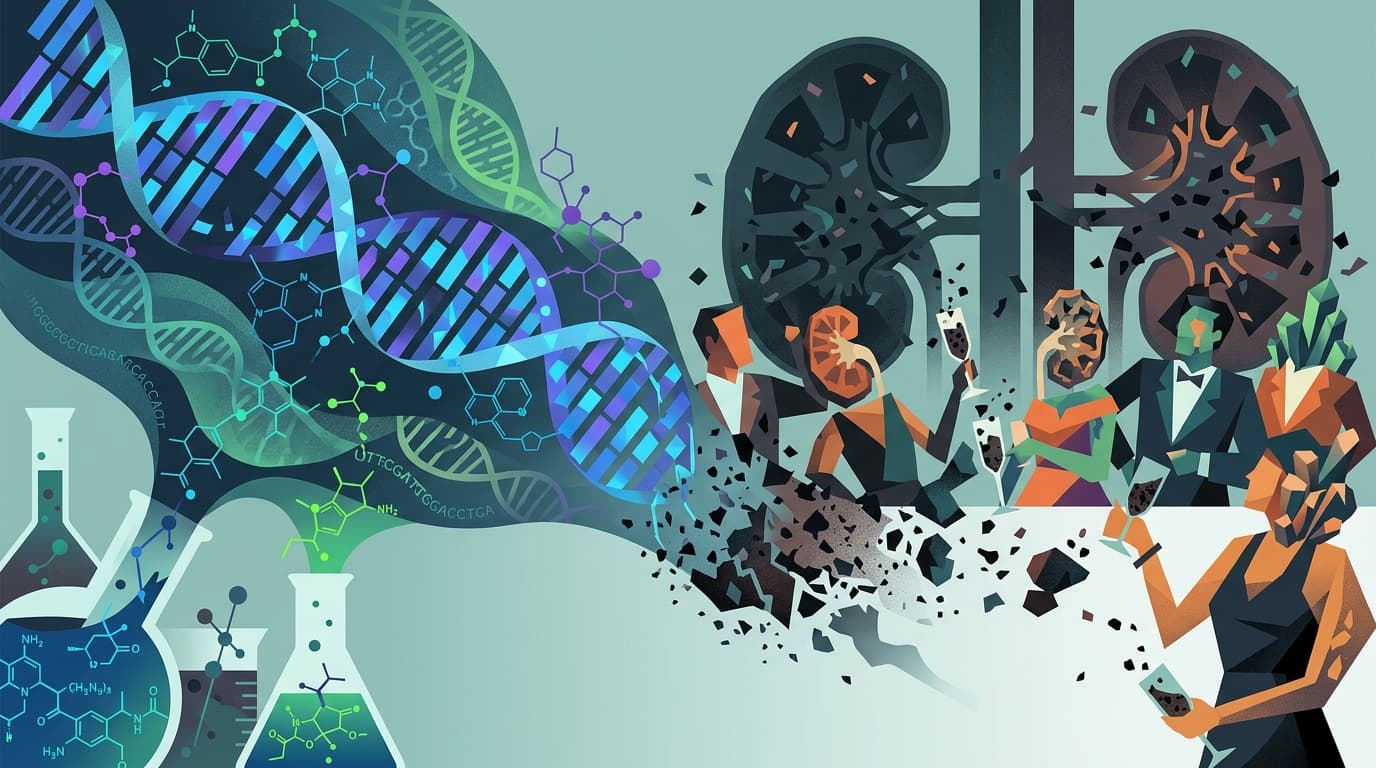
The RNA Drug That Just Crashed Kidney Disease's Biggest Party
Roche and Ionis's RNA drug sefaxersen just cleared a major Phase 3 hurdle in IgA nephropathy, proving it can significantly reduce kidney-damaging protein leakage. But with six drugs already approved for the disease, the real question is whether being seventh is good enough.
Your kidneys filter about 50 gallons of blood every single day. They never clock out, never take a vacation. So when something goes wrong with them, it goes wrong fast.
For the roughly 200,000 Americans living with IgA nephropathy (IgAN), their immune system is slowly wrecking the filters. The disease deposits antibody clumps in the kidneys like mineral buildup in old pipes. Over time, those clumps trigger inflammation, leak protein into the urine, and push patients toward kidney failure. For decades, doctors could only manage blood pressure and hope for the best.
Now Roche and Ionis Pharmaceuticals just showed that an RNA-based drug can go after the root cause. And the data look good.
A Win at the Halfway Mark
The drug is called sefaxersen, and it just passed its biggest test yet. In a prespecified interim analysis of the Phase 3 IMAgINATION trial, sefaxersen hit its primary endpoint: a statistically significant and clinically meaningful reduction in urine protein compared to placebo at 37 weeks.
In plain English, that means the drug is doing what it's supposed to do. Protein leaking into urine is a hallmark of kidney damage in IgAN. Less protein means less damage. The trial enrolled 459 patients with primary IgAN who were at high risk of their disease getting worse, and they were split evenly between the drug and a placebo.
Roche and Ionis didn't release the exact numbers (companies love to save that for medical conferences), but the signal was strong enough to declare victory at the interim look. The full trial will continue, blinded, to track kidney function over two years, with a longer-term readout on eGFR (a measure of how well the kidneys actually filter blood) expected at week 105.
No new safety signals popped up either, which is the kind of boring news you want to hear from a clinical trial.
How It Works: Shooting the Messenger
Sefaxersen is an antisense oligonucleotide, which sounds like something from a sci-fi movie but is actually a clever piece of molecular engineering. Think of it this way: your DNA is the recipe book, and mRNA is the photocopy your cells use to actually cook the dish. Antisense drugs intercept the photocopy and shred it before the dish gets made.
Get tomorrow's biotech intelligence before your competitors.
Join thousands of biotech professionals who start their day with our free, daily briefing.
In this case, the "dish" is a protein called complement factor B. Factor B is a key ingredient in the body's complement system, part of the immune response that goes haywire in IgAN. When there's too much factor B floating around, it supercharges a chain reaction called the alternative complement pathway, which dumps inflammatory molecules onto the kidneys like gasoline on a campfire.
Sefaxersen gets injected subcutaneously (a shot under the skin), travels to the liver where factor B is manufactured, and tells the cellular machinery to stop making it. By cutting production at the source, the drug dials down the inflammation that drives kidney damage.
This is important because it's a fundamentally different approach from many other IgAN drugs on the market. Most of the recently approved therapies target other parts of the disease cascade. Sefaxersen goes after the complement system's supply chain.
A Kidney Market That Got Very Crowded, Very Fast
Two years ago, IgAN was a therapeutic wasteland. Patients had almost no disease-specific treatment options. Today, there are six FDA-approved medications for the condition, according to the National Kidney Foundation's 2026 count. The transformation has been remarkable.
Sparsentan (FILSPARI) was one of the first movers, blocking endothelin and angiotensin receptors to reduce proteinuria. Then came iptacopan (Fabhalta), an oral complement inhibitor approved in August 2024. Atrasentan (Vanrafia) followed in April 2025 as another endothelin-targeted oral option. And sibeprenlimab (Voyxact) arrived in November 2025 as the first approved drug targeting APRIL, a protein that helps the rogue antibodies survive.
Behind the approved drugs, the pipeline is stacked even deeper. Novartis has zigakibart in Phase 3, going after the same APRIL biology as sibeprenlimab. Povetacicept is a Phase 3 candidate that hits both BAFF and APRIL. There's also felzartamab, which takes an entirely different approach by depleting the plasma cells that produce the troublesome antibodies.
So where does sefaxersen fit? It slots into the complement inhibitor lane alongside iptacopan, but with a twist: it's an RNA therapy that blocks complement factor B production rather than an oral pill that blocks complement activity downstream. That's a meaningful distinction. Cutting the supply versus blocking the signal are two different strategies, and doctors may eventually want both in their toolkit.
Wall Street Liked It, But Didn't Love It
The market reaction was positive, though tempered by the reality that IgAN is no longer an open field. H.C. Wainwright reiterated a Buy rating on Ionis with a $100 price target, calling the readout supportive of regulatory discussions. RBC described sefaxersen as an underappreciated pipeline asset, noting that its monthly dosing schedule could be a competitive advantage.
The broader analyst consensus on Ionis remains favorable.
But not everyone was popping champagne. JPMorgan and Guggenheim reportedly trimmed their price targets to $70 and $80, respectively, even while keeping positive ratings. Their concerns are practical: pricing pressure in a six-drug market, execution risk around launches, and uncertainty about how payers will treat yet another IgAN therapy.
That tension makes sense. Being the seventh (or eighth, or ninth) approved drug in a space means you need to prove you're not just good; you need to prove you're different enough to justify a spot on the formulary.
The Long Game: A Partnership Built Over Eight Years
This result didn't come out of nowhere. Roche and Ionis first struck a deal on sefaxersen back in 2018, when Ionis granted Roche an option to develop the drug across complement-mediated diseases, including IgAN and geographic atrophy (an eye disease). Roche took on all global development, regulatory, and commercialization responsibilities.
The Phase 2 data in IgAN were encouraging: patients saw a 43% mean reduction in proteinuria from baseline to week 29. That was enough for Roche to officially license the drug in 2022, paying Ionis $35 million with additional regulatory milestones, sales milestones, and tiered royalties still on the table. (The broader 2018 option package was valued at up to $760 million with $75 million upfront.)
Not everything worked out, though. Roche pulled the plug on sefaxersen for geographic atrophy in 2024 after Phase 2 data showed the drug hit its target but didn't translate that into meaningful clinical benefit for the eye. It was a reminder that complement biology plays out differently in different organs.
The IgAN program, clearly, is a different story.
Why This Matters Beyond One Drug
Step back from the specific numbers for a moment. What Roche and Ionis have shown is that RNA-based medicines can compete in kidney disease, a field that has historically been dominated by small molecules and antibodies. Antisense drugs have proven themselves in neurology and liver disease, but the kidney has been trickier territory.
Sefaxersen's success at the interim mark validates the idea that you can use RNA therapeutics to modulate complement pathways in a meaningful way for kidney patients. That has implications not just for IgAN but for other complement-driven kidney conditions that currently lack good treatment options.
For patients, the growing IgAN armamentarium is genuinely good news. IgAN tends to hit younger adults, often in their 20s and 30s, and a diagnosis used to come with a grim forecast: manage your blood pressure, watch your protein levels, and hope you don't end up on dialysis. Now there are drugs targeting at least four distinct biological mechanisms, and more are coming.
The question for sefaxersen is whether its complement-blocking, RNA-based approach can carve out a meaningful niche in a market that's gone from barren to bustling in under three years. The Phase 3 interim data say it belongs in the conversation. The two-year kidney function data will determine whether it belongs on the prescription pad.
The Bottom Line
Sefaxersen just proved it can reduce the protein leak that defines IgAN, and it did so convincingly enough to clear its Phase 3 interim hurdle. Wall Street is cautiously optimistic. The competitive landscape is intense but still evolving. And the fact that an RNA drug pulled this off in kidney disease is, itself, a milestone worth watching.
Roche and Ionis now face the harder challenge: turning a mid-trial win into a regulatory filing, a launch, and eventually, a reason for nephrologists to choose their drug over five or six alternatives. The science is working. The business case is the next test.
5 min read
The Rare Disease Drug That's Fixing Hearts Nobody Knew Were Breaking
BridgeBio's BBP-418 didn't just slow decline in a rare muscular dystrophy trial; it pushed cardiac biomarkers back toward healthy levels. With an FDA decision weeks away, these results could rewrite the playbook for a disease with zero approved treatments.