The RNA Trick Nobody Thought Would Work Just Worked in Humans
Ractigen Therapeutics just showed that RNA activation, a technology designed to turn genes ON instead of off, works in humans for the first time. The Duchenne muscular dystrophy data are early, but the implications for genetic medicine could be enormous.
A Whole New Way to Talk to Your Genes
For decades, the RNA therapy playbook has had two main chapters. You can silence a gene (RNA interference), or you can deliver a synthetic message so cells build a protein directly (mRNA therapy, à la COVID vaccines). Both are powerful, and both have made it to the clinic.
But what if you could do something entirely different: turn a gene on?
That's exactly what a small Chinese biotech called Ractigen Therapeutics just showed is possible in humans. At the 2026 World Muscle Society (WMS) Congress, the company presented first-in-human data for RAG-18, a treatment for Duchenne muscular dystrophy (DMD) that uses a technology called RNA activation (RNAa). The result: early but real evidence that a tiny piece of synthetic RNA, injected under the skin, can travel to skeletal muscle and crank up a gene the body already owns.
It's not a cure. It's not even proof that patients will feel better yet. But as a proof-of-mechanism, it's a milestone that could reshape how the industry thinks about genetic disease.
What RNA Activation Actually Does
Think of your DNA as a massive library of cookbooks. In diseases like DMD, one critical cookbook (the gene for dystrophin) has pages ripped out, so the recipe doesn't work. Most current therapies try to either patch the damaged recipe or deliver a simplified version from outside.
RNAa takes a completely different approach. Instead of fixing the broken cookbook, it walks over to a different cookbook on the shelf, one that's been gathering dust, and props it open.
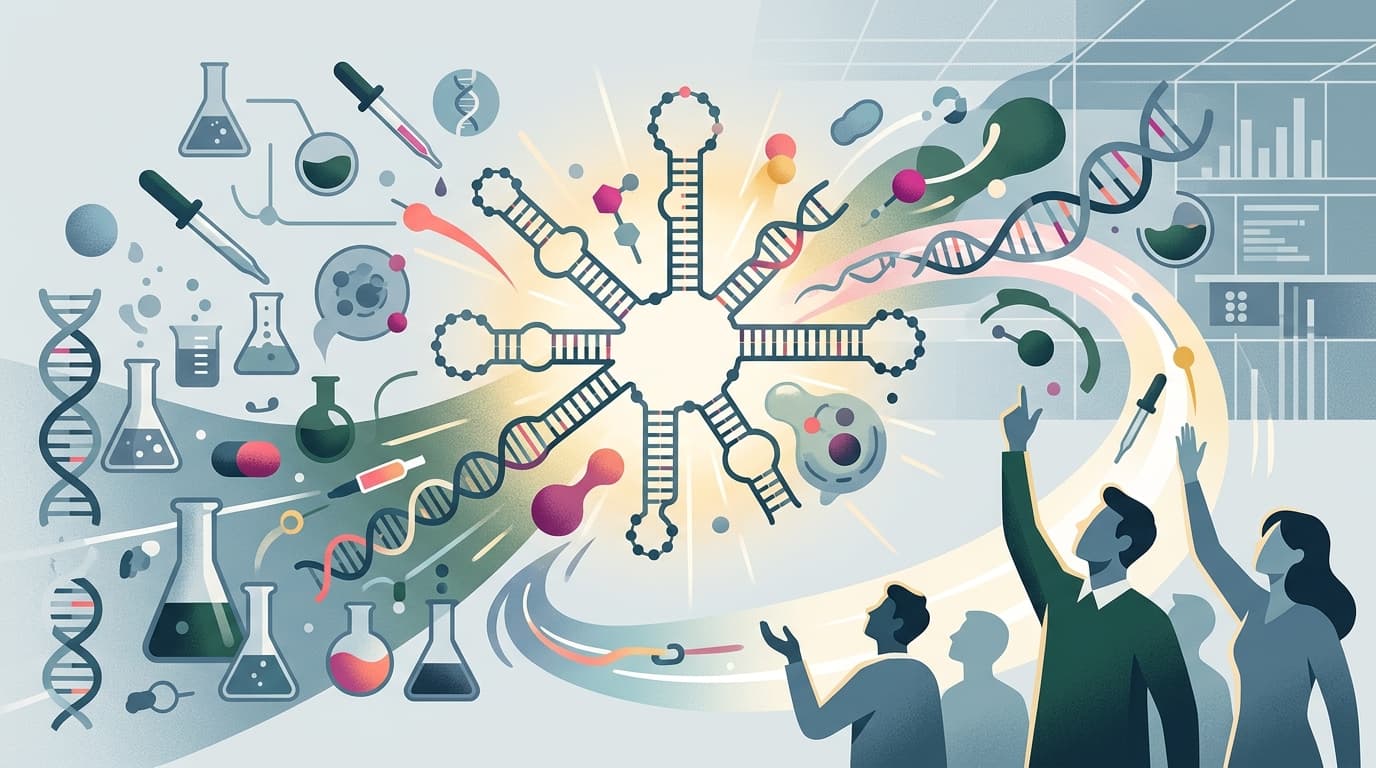
In technical terms, Ractigen's small activating RNA (saRNA) targets the promoter region of the utrophin gene (UTRN). Utrophin is a protein that's structurally similar to dystrophin; it can do many of the same jobs in muscle cells. The saRNA essentially tells the cell's machinery: "Hey, start reading this gene more often." The cell obliges by producing more utrophin on its own.
This is the opposite of RNA interference, which tells cells to making a protein. And it's different from mRNA therapy, which hands the cell a temporary instruction manual. RNAa nudges the cell's own transcription into higher gear.
Get tomorrow's biotech intelligence before your competitors.
Join thousands of biotech professionals who start their day with our free, daily briefing.
stop
Why DMD Patients Need More Options
Duchenne muscular dystrophy is one of the cruelest genetic diseases. It primarily affects boys, progressively destroying muscle tissue until patients lose the ability to walk, then breathe. There is no cure.
The approved treatment landscape has expanded in recent years, but every option comes with serious asterisks. Exon-skipping therapies (eteplirsen, golodirsen, viltolarsen, casimersen) only work for patients with specific mutation types, leaving many boys ineligible. Elevidys, the first and only FDA-approved gene therapy for DMD, delivers a micro-dystrophin construct in a single IV infusion, but it's constrained by age and ambulatory requirements, immune response concerns, and questions about durability.
Corticosteroids remain a backbone of care, and the HDAC inhibitor givinostat was approved in 2024 for patients six and older. But the field still lacks a therapy that works across all mutations, delivers durable functional benefit, and can be given repeatedly.
That last point is where RAG-18's design gets interesting. Because it targets utrophin rather than dystrophin, the approach is mutation-agnostic: it doesn't matter which pages are ripped out of the dystrophin cookbook. Every DMD patient still has an intact utrophin gene.
What the Data Actually Show
Let's be clear about what Ractigen presented, and what they didn't.
The WMS data came from Cohort 1 of an ongoing open-label, dose-escalation Phase I trial in ambulatory boys with genetically confirmed DMD. Through Day 169, the company reported zero dose-limiting toxicities, zero serious adverse events, and no Grade 3 or higher treatment-related side effects. That's a clean safety profile for a first-in-human study.
On the biology side, paired muscle biopsies showed upregulation of sarcolemmal utrophin (utrophin appearing along the muscle cell membrane, right where you'd want it). The company measured this with quantitative immunofluorescence and also collected data on muscle histopathology, serum creatine kinase, quantitative muscle MRI, spirometry, and motor function.
Ractigen called this clinical proof-of-mechanism for RNA activation in a human monogenic disease. And by that narrow definition, the claim seems fair: a systemically delivered saRNA reached skeletal muscle and turned up the intended target gene.
But the dataset is still interim. Full quantitative functional outcomes haven't been disclosed. This is biomarker validation, not proof of clinical benefit. Translation: we know the light switch works, but we don't yet know if it lights up the whole room.
The Company Behind the Science
Ractigen was founded around 2016 by Dr. Long-Cheng Li, whose foundational work on RNA activation traces back to earlier academic research. The company is headquartered in Suzhou, China, with manufacturing facilities in Jiangsu province.
It's still relatively small but growing quickly. Ractigen has raised over RMB 350 million (roughly $54 million) in venture capital overall, with its Series A led by Hillhouse Venture Capital. In July 2026, just months before the WMS presentation, the company closed a new financing round of over $31 million to support its clinical-stage pipeline and delivery platforms.
RAG-18 isn't their only program. The pipeline includes RAG-01 for bladder cancer, RAG-17 for SOD1-mutant ALS (with Phase II enrollment completed in 2026), and RAG-21, a siRNA therapy targeting the FUS gene for FUS-ALS that has received FDA Orphan Drug Designation. The company uses proprietary delivery platforms called SCAD, LiCO, and GLORY to get saRNAs where they need to go.
Why This Matters Beyond DMD
The DMD data are compelling on their own terms, but the bigger story is about the modality itself. If RNA activation works reliably in humans, the implications stretch far beyond one disease.
Consider the math. RNA interference lets you silence roughly any gene. mRNA therapy lets you temporarily produce almost any protein. RNA activation, if it matures, would let you turn up the volume on genes the body already has but isn't using enough. That's an entirely new category of intervention: not replacing what's broken, not shutting down what's overactive, but amplifying what's underperforming.
For neuromuscular diseases alone, there are dozens of conditions where a related "backup" protein exists but sits underexpressed. The same logic could apply in oncology (reactivating tumor suppressors), neurodegeneration, and liver disease.
Of course, none of that matters if the early signal doesn't translate into functional improvements for patients. The next cohorts of Ractigen's dose-escalation trial will be critical: does more drug produce more utrophin? Does more utrophin produce stronger, more resilient muscle? And can the effect last?
The Bottom Line
Ractigen hasn't proven that RAG-18 will change the lives of boys with DMD. Not yet. What they've shown is something arguably more foundational: that RNA activation, a concept born in academic labs two decades ago, actually works in the human body.
The biotech world has seen platform technologies rise and fall before. Gene therapy spent 30 years in the wilderness. mRNA needed a pandemic to get its big break. RNA activation is earlier on that journey, but for the first time, it has clinical data to point to.
For the DMD community, which has learned the hard way to be cautiously optimistic, this is worth watching closely. For the broader biotech industry, it might be the opening chapter of something much bigger.
Deals & M&A
4 min read
Bayer Just Bet $2.2 Billion That Ohio Is the Future of Pharma
Bayer is pouring $2.2 billion into its first-ever North American pharma manufacturing campus in Ohio. The move signals the German giant's biggest bet yet on U.S.-made drugs, but the factory won't produce a single pill until 2031.