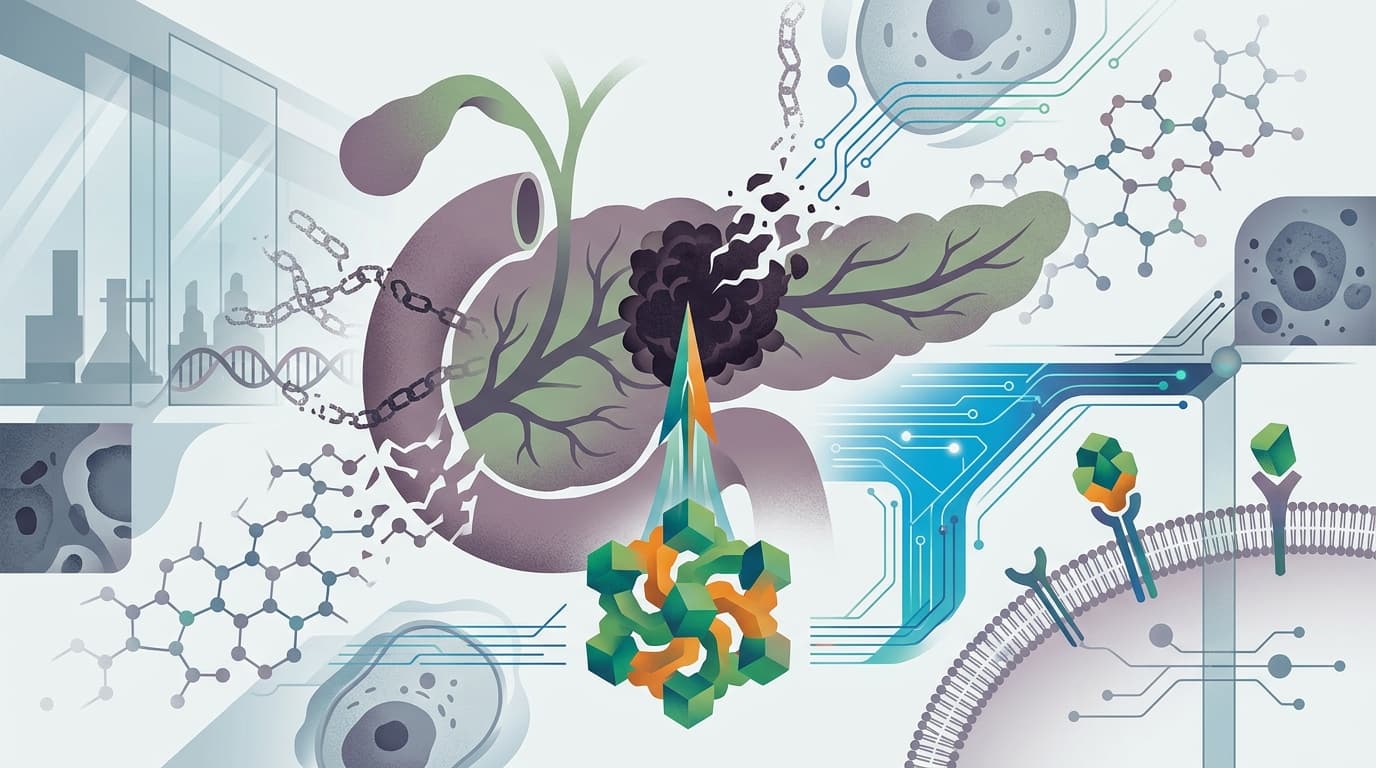

The FDA just approved a drug that nearly doubled survival in metastatic pancreatic cancer, a disease that has resisted every major advance in oncology for decades. Wall Street is projecting it could become one of the best-selling drugs in the world.
Pancreatic cancer has been oncology's cruelest dead end for decades. The five-year survival rate sits at a miserable 13%. Nearly half of all patients already have metastatic disease by the time they're diagnosed. And the best treatments available? The same chemotherapy cocktails doctors have been using for years.
That changed on August 26, 2026.
The FDA approved Rasonque (daraxonrasib) from Revolution Medicines for adults with metastatic pancreatic cancer. Analysts are calling it "historic." Wall Street is modeling it as a potential $15 billion drug. And the clinical data backing it up is the kind of result that makes oncologists do a double-take.
The approval was based on a Phase 3 trial called RASolute 302, which tested Rasonque head-to-head against standard chemotherapy in patients whose pancreatic cancer had already spread and progressed on prior treatment.
The headline number: patients on Rasonque lived a median of 13.2 months, compared to just 6.7 months on chemo. That's roughly double. In a cancer where second-line options have historically offered marginal benefit at best, nearly doubling overall survival is seismic.
The hazard ratio (a statistical measure of relative risk) came in at 0.40, meaning Rasonque cut the risk of death by about 60% versus chemo. Progression-free survival, which tracks how long the cancer stays in check, also doubled: 7.2 months versus 3.6 months.
Think of it like this: if pancreatic cancer treatment has been stuck on a treadmill for the last 20 years, Rasonque just hit the "incline" button in the other direction.
To understand why this matters, you need a quick detour into cancer biology.
Pancreatic cancer is driven by mutations in a gene called KRAS. KRAS acts like a broken "on" switch inside cancer cells, telling them to grow and divide nonstop. For decades, scientists considered KRAS "undruggable" because its protein surface was so smooth there was nowhere for a drug molecule to grab hold. It was like trying to pick up a wet marble.

Gilead built lenacapavir's identity around a twice-yearly injection. Now the FDA just approved it inside a daily pill called Bixlenvo, and the logic behind that counterintuitive move reveals Gilead's broader chess match to defend its HIV empire.


Join thousands of biotech professionals who start their day with our free, daily briefing.
The first generation of KRAS inhibitors, like Amgen's sotorasib (Lumakras) and BMS/Mirati's adagrasib (Krazati), cracked the code for one specific KRAS mutation called G12C. Great for lung cancer, where G12C is common. Not so great for pancreatic cancer, where the KRAS mutations are more diverse.
Rasonque takes a broader approach. It's a pan-RAS inhibitor, meaning it targets multiple forms of the RAS protein family rather than just one narrow mutation. That's what makes it uniquely suited for pancreatic cancer, where KRAS mutations are the dominant driver but come in many flavors.
And here's the kicker: the FDA approved Rasonque without requiring a companion diagnostic test. Patients don't need to confirm a specific RAS mutation to be eligible. That dramatically expands the pool of patients who can receive it.
Revolution Medicines priced Rasonque at $39,800 per month, and analysts nearly tripped over themselves raising their forecasts. The price came in higher than many expected, which in pharma math translates directly into bigger revenue projections.
Evercore ISI estimated peak annual sales of approximately $7.4 billion for the pancreatic cancer indication alone.
RBC Capital Markets raised its price target to $203 from $182, projecting the drug could hit $1.1 billion by the end of 2027. Guggenheim nudged its target up to $240, citing a faster-than-expected launch trajectory.
For context, a drug is considered a "blockbuster" at $1 billion in annual sales. Analysts are modeling Rasonque to blow past that threshold within its first full year on the market.
Pancreatic cancer has been the stubborn holdout in the precision medicine revolution. While breast cancer got targeted therapies, lung cancer got checkpoint inhibitors, and blood cancers got CAR-T cells, the pancreas was stuck with FOLFIRINOX and gemcitabine/nab-paclitaxel (two chemotherapy regimens that remain the standard first-line treatments to this day).
The problem wasn't just biology; it was also timing. Roughly 51% of pancreatic cancer cases are already metastatic at diagnosis. Patients deteriorate quickly, and many can't tolerate aggressive chemo. The treatment window is brutally short.
Rasonque's label addresses both problems. It's approved for patients who've had at least one prior therapy and for those who aren't candidates for multi-drug chemotherapy regimens. That second group (patients too sick for intensive chemo) has historically had almost nothing to offer them. Now they have a pill. One tablet, 300 mg, once daily, with or without food.
No drug is perfect, and Rasonque carries real side effects. The most common ones include rash, diarrhea, mouth sores, nausea, and fatigue. More serious risks on the label include gastrointestinal perforation and a lung condition called interstitial lung disease. These will need careful monitoring as the drug rolls out to a broader patient population beyond clinical trial settings.
There's also the question of durability. A median survival of 13.2 months is transformative for this disease, but pancreatic cancer is notoriously adaptive. Whether patients develop resistance over time, and how quickly, will become clearer as real-world data accumulates.
And then there's the price tag. At nearly $40,000 a month, access and reimbursement will be critical variables. A drug can't be a blockbuster if payers won't cover it.
Pancreatic cancer has humbled the pharmaceutical industry for generations. It resisted immunotherapy. It shrugged off first-generation targeted drugs. It punished late-stage clinical bets with one failure after another.
Rasonque isn't a cure. But cutting the risk of death by 60% in a cancer this aggressive, with an oral pill that doesn't require a genetic test to prescribe? That's not incremental progress. That's a genuine inflection point.
Revolution Medicines didn't just get a drug approved. They proved that the "undruggable" target could be drugged broadly enough to change outcomes in the cancer that needed it most. The rest of the KRAS field will be chasing this benchmark for years.
SK Biopharmaceuticals just paid $795 million for a drug that targets the same brain channel class that flopped a decade ago. The early data on opakalim suggests the second-generation version might actually be worth it.