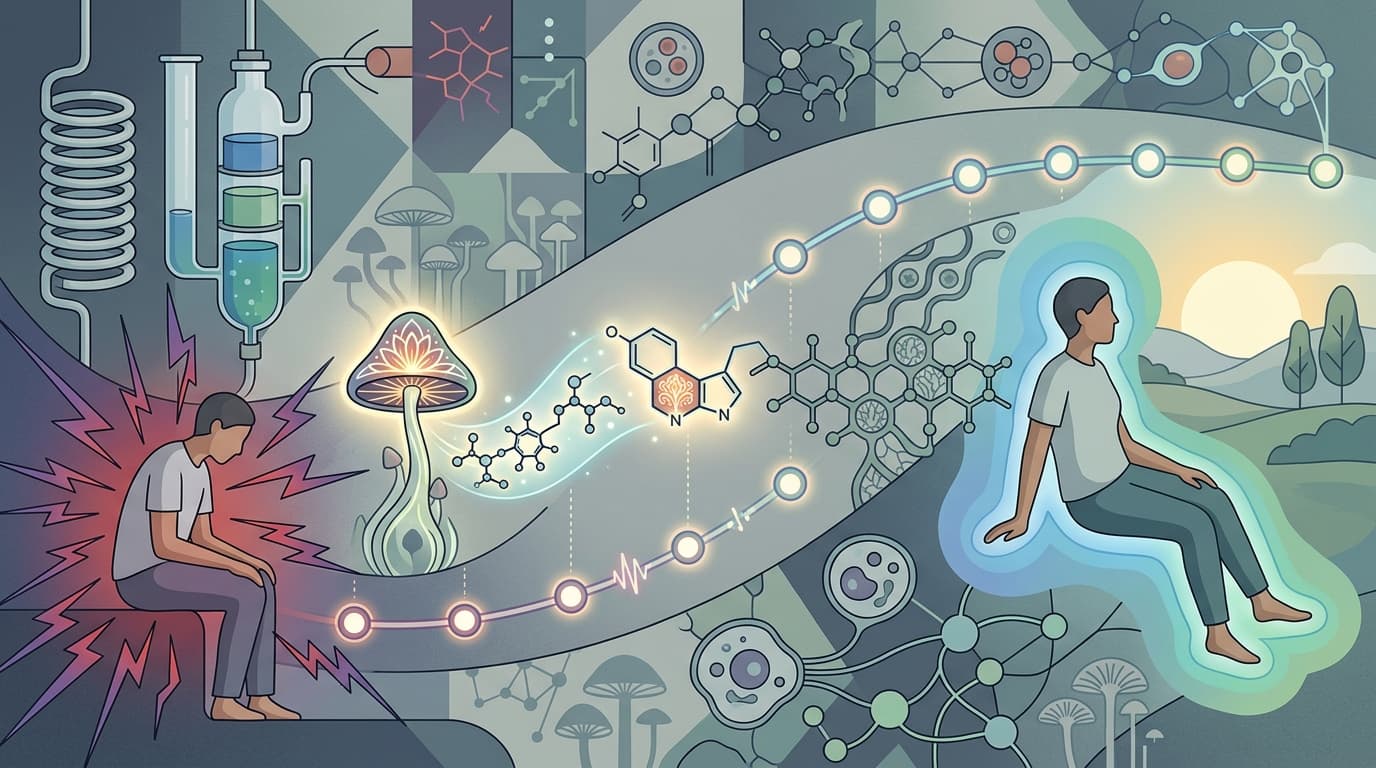

A mouse study published in Science found that psilocybin given before chemotherapy prevented nerve damage for up to 8 months. With zero approved drugs to prevent chemo-induced neuropathy and over half of patients affected, this preclinical finding could reshape how oncologists think about one of cancer treatment's nastiest side effects.
Imagine finishing chemotherapy, beating cancer, and then spending the rest of your life unable to feel your fingertips. That's the reality for millions of cancer survivors dealing with chemotherapy-induced peripheral neuropathy, or CIPN: nerve damage caused by the very drugs that saved their lives.
About 52% of chemo patients develop some form of CIPN. And roughly 30% still have symptoms a full year later. Tingling, burning, numbness, pain so persistent it disrupts sleep, balance, and basic daily tasks. The cruel irony is that the treatment for cancer becomes its own chronic disease.
Now here's what makes it worse: there is currently no approved drug to prevent it. Not one. Oncologists can adjust chemo doses or offer symptom management after the fact, but true prevention? The cupboard is bare. That's what makes a new mouse study out of MD Anderson Cancer Center so striking.
A research team led by Moran Amit at the University of Texas MD Anderson Cancer Center just published findings in Science showing that psilocybin (the psychoactive compound in magic mushrooms) prevented nerve pain in mice when given before chemotherapy began.
Not treated. Not reduced. Prevented.
Two doses of psilocybin, administered before the chemo started, shielded mice from developing CIPN-like symptoms across six full cycles of chemotherapy. The protective effect lasted up to 8 months in the animals. For context, mice don't live that long relative to humans, so 8 months represents a huge chunk of their lifespan. Think of it like a vaccine for nerve damage: one prophylactic intervention, months of protection.
That word, "prophylactic," is doing serious heavy lifting here. Previous research had already shown psilocybin could reverse pain-like behaviors in mice that already had neuropathy. Interesting, sure, but treating a problem after it exists is a fundamentally different (and harder) challenge than stopping it from forming in the first place. This study flipped the script entirely.

Pfizer just sold a clinical-stage cancer drug from its $43 billion Seagen acquisition to a tiny Canadian biotech for $12 million. The deal says a lot about the growing gap between what Pfizer paid for Seagen and what it's getting back.

Join thousands of biotech professionals who start their day with our free, daily briefing.

So how does a compound best known for making people see fractals at a Phish concert end up protecting peripheral nerves from toxic chemotherapy drugs?
The mechanism centers on serotonin receptors, specifically the 5-HT2A receptor. Psilocybin's active metabolite, psilocin, binds to these receptors on neurons. In this study, activation of 5-HT2A (along with a supporting role from 5-HT1A receptors) appeared to preserve mitochondrial transport inside peripheral nerve cells.
Mitochondria are the power plants of your cells. Chemotherapy drugs like taxanes and platinums are brutal on these little engines, especially in the long, delicate nerve fibers that run to your hands and feet. When the mitochondria stop working or can't travel along the nerve properly, the nerve dies. What psilocybin seems to do is keep those cellular power plants humming and moving, even under chemical assault.
There's also a neuroplasticity angle. Psilocybin promotes the growth of new synaptic connections (synaptogenesis) through a signaling cascade involving BDNF and TrkB, proteins that act like fertilizer for neural wiring. Some researchers believe this helps "reset" maladaptive pain circuits before they ever take hold. On top of that, preclinical evidence suggests psilocybin tamps down neuroinflammation, the kind of immune overreaction in the nervous system that fuels chronic pain.
In short: it's a three-pronged defense. Keep the mitochondria alive, promote healthy nerve growth, and cool down inflammation. All from a compound that also happens to make you contemplate the nature of the universe.
The CIPN prevention space is, to put it bluntly, a graveyard of failed ideas. Duloxetine, glutathione, calcium and magnesium infusions, acetyl-L-carnitine: they've all been tried. None has shown consistent enough benefit to earn a guideline recommendation for routine prevention. The best evidence right now is actually for non-drug approaches like cryotherapy (icing your hands and feet during chemo), which tells you everything about how desperate the field is.
Some targeted drug candidates are still in early trials. Nilotinib and dasatinib aim to block the transporters that pull chemo drugs into nerve cells. Calmangafodipir targets oxidative stress. But these are all Phase 1 or Phase 2 efforts with no guarantee of success.
Psilocybin stands out because the duration of effect is genuinely unusual. Most neuroprotective strategies require repeated dosing throughout chemo. The idea that two pre-treatment doses could provide months of protection is a different paradigm entirely. If it translates to humans (big "if"), you're looking at an intervention that's simple, cheap, and doesn't add complexity to an already grueling treatment schedule.
Let's be clear: this is a mouse study. Mice are not people, and the translation gap between preclinical promise and clinical reality is littered with therapies that looked incredible in rodents and flopped in humans. Anyone who's been in biotech for more than five minutes knows the drill.
But the pipeline is moving. A clinical trial to test psilocybin for CIPN prevention in actual chemo patients is reportedly in the works. And it's joining a growing list of psilocybin pain trials across indications like chronic low back pain (NCT07306364), fibromyalgia (NCT05068791), and chronic neuropathic pain with depression (NCT06518720). The broader psychedelic medicine field is still early stage; no psilocybin product has FDA approval for any pain indication.
Regulatory and practical questions loom large, too. Psilocybin is a Schedule I substance in the U.S., and even in clinical trial settings, administration involves supervised psychedelic experiences with trained therapists. Whether a prophylactic dose requires the same level of psychological support is an open question. So is whether the hallucinogenic effects are necessary for the neuroprotective benefit, or whether non-hallucinogenic analogs could do the same job.
Over half of chemo patients develop nerve damage that can last years. Right now, medicine has essentially nothing to offer them before it happens. A study in Science just showed that psilocybin, given before chemo, prevented that damage in mice for 8 months.
It's preclinical. It's early. But in a field with zero approved preventive options and millions of patients in need, "early" is still the most exciting place to be. The next chapter depends on whether this holds up in human trials. For cancer patients dreading the numbness in their fingertips, that chapter can't come fast enough.
Three patients with autoimmune diseases died in Novartis CAR-T trials, forcing the company to pause eight studies and the entire field to confront an uncomfortable question: can cancer's most powerful therapy ever be safe enough for diseases that aren't trying to kill you?