
Pharma and biotech M&A has already topped $100 billion by mid-2026, with analysts projecting the biggest dealmaking year since 2019. Behind the frenzy: a massive patent cliff and two therapeutic areas every company wants to own.
Imagine walking into Costco, loading up two flatbed carts with everything in sight, and realizing you're not even halfway through your list. That's Big Pharma in 2026.
By late June, pharma and biotech companies have already announced roughly $100 to $135 billion in mergers and acquisitions, depending on which tracker you check. PitchBook counts $106 billion across 201 transactions. Other tallies of blockbuster deals north of $1 billion put the figure closer to $134 billion. Either way, the number is staggering for a half-year of dealmaking.
And the second half hasn't even started.
Some analysts think 2026 could become the biggest M&A year since 2019, when Bristol-Myers Squibb swallowed Celgene for $74 billion and AbbVie gobbled up Allergan for $63 billion. That year's total deal value topped $230 billion by some estimates and exceeded $340 billion by others (the gap depends on whether you count medtech and licensing alongside traditional pharma deals).
If the current pace holds, investment bank Stifel projects 2026 could blow past $250 billion in total deal value. That's the bull case. IQVIA, which tends to be more conservative, forecasts a base case of $140 to $160 billion for the full year, with upside into the $190 billion range. The truth probably lands somewhere in between, but even the low end would make 2026 one of the most active dealmaking years in a decade.
So what's driving all this urgency?
Think of pharmaceutical patents like an hourglass. When the sand runs out, generic competitors rush in, and revenues can crater almost overnight. Between 2026 and 2028, the hourglass is running out on some of the most profitable drugs ever made.
Keytruda, Merck's blockbuster cancer immunotherapy, generates over $25 billion in annual sales. Its core U.S. patents expire around late 2028. , the blood thinner co-marketed by Bristol-Myers Squibb and Pfizer, brings in more than and faces generic entry as early as . Pfizer's breast cancer drug Ibrance, Amgen's autoimmune staple Enbrel, Regeneron's eye disease treatment Eylea: all hitting their expiration dates in this same narrow window.

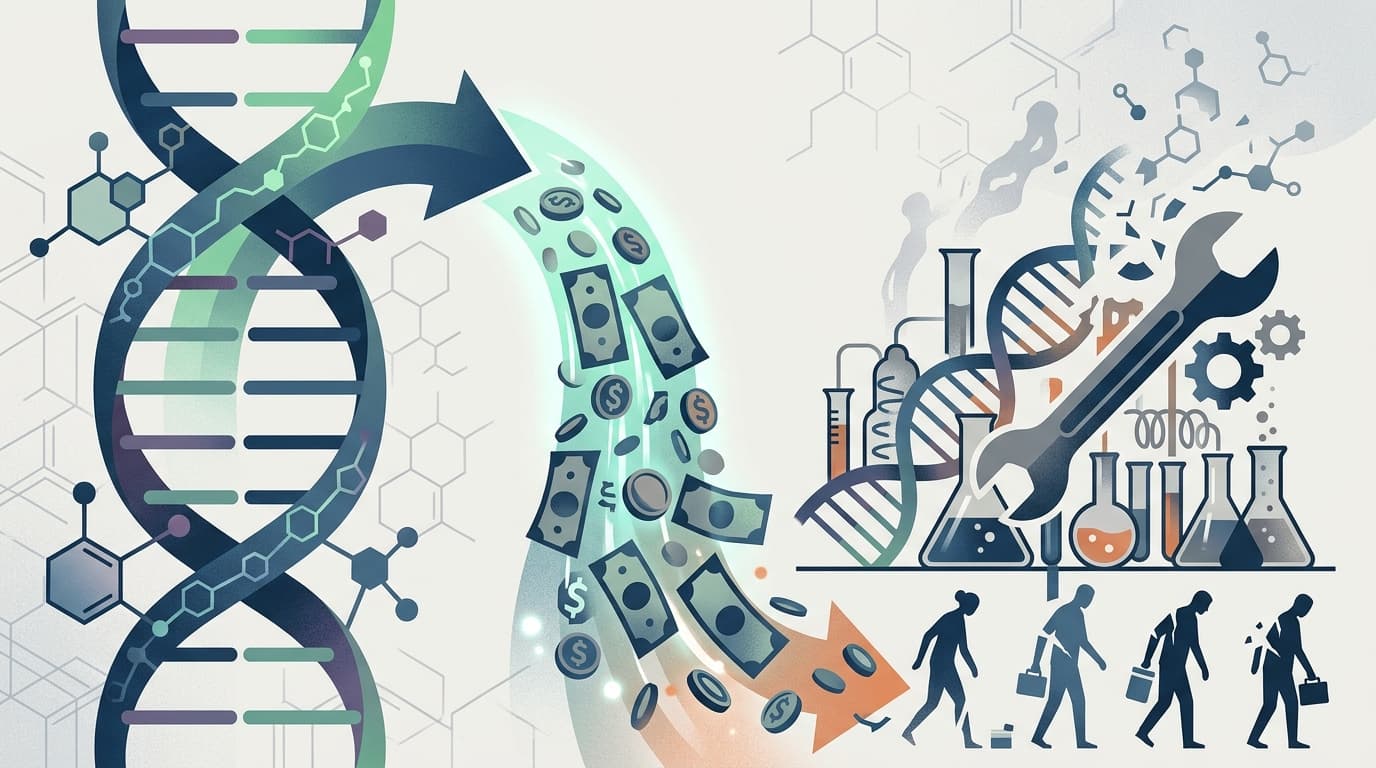
Biogen closed its $5.6 billion Apellis acquisition and almost immediately gutted the biotech's research pipeline, keeping only two approved drugs. It's a playbook Big Pharma has run for decades, and the cost isn't always measured in dollars.

Join thousands of biotech professionals who start their day with our free, daily briefing.

We're talking about well over $150 billion in annual revenue suddenly up for grabs. That kind of exposure doesn't just encourage dealmaking; it demands it.
The biggest acquisitions of 2026 so far read like a strategic playbook for surviving the cliff. They fall into two buckets: oncology (cancer drugs) and immunology (drugs that modulate the immune system). And two deals in particular capture the frenzy perfectly.
AbbVie just agreed to buy Apogee Therapeutics for roughly $10.9 billion, paying $135.11 per share in an all-cash deal. That's a 49% premium over Apogee's closing price. Not subtle.
What's AbbVie getting? A pipeline of next-generation biologics for eczema and asthma, anchored by a drug called zumilokibart. It's an antibody that blocks IL-13, a protein that drives the kind of inflammation behind severe skin conditions. In Phase 2 trials, about two-thirds of patients achieved significant skin clearance after 16 weeks. AbbVie is calling it "best-in-category."
The real selling point, though, is convenience. Current eczema biologics require injections every two to four weeks. Zumilokibart could potentially be dosed once every three to six months. For patients and doctors alike, that's a game-changer; think of it as the difference between weekly grocery runs and a single Costco haul that lasts until summer.
AbbVie expects the deal to turn profitable in 2032. That's a long runway. But for a company still managing life after Humira (its former crown jewel that lost patent protection), this is a bet on owning the next generation of immunology blockbusters.
Meanwhile, GSK is writing a $10.6 billion check for Nuvalent, a biotech with two late-stage lung cancer drugs already under FDA review.
The drugs, zidesamtinib and neladalkib, are highly targeted therapies for specific genetic mutations (ROS1 and ALK) that drive certain lung cancers. Both have FDA decision dates in 2026: September for zidesamtinib, November for neladalkib. Both carry Breakthrough Therapy designations, which is the FDA's way of saying "we think this could be a big deal."
GSK is paying a 40% premium and financing the whole thing with debt. The company frames this as a bridge across its own patent cliff, particularly the loss of HIV drug exclusivity expected around mid-2028. Analysts at Stifel noted the timing surprised investors; many expected GSK to wait until after the drugs launched to buy. Instead, GSK moved early and paid full price.
Not everyone is sold on the valuation. Barclays called the deal "conceptually sound" but questioned whether the drugs can truly reach blockbuster status, given the relatively small patient populations for ALK- and ROS1-positive lung cancer. One analyst projection pegs combined revenue at about $823 million by 2029: significant, but not exactly the "multi-blockbuster" narrative GSK is pushing.
Zoom out, and the pattern is clear. Big Pharma isn't just shopping; it's stockpiling. Companies are paying premium prices for late-stage, clinically validated assets in the two hottest therapeutic areas: oncology and immunology.
The strategy has shifted from "spray and pray" across dozens of early-stage bets to "fewer but larger" acquisitions of drugs that are close to (or already at) the FDA's doorstep. PwC and IQVIA both cite pipeline replenishment ahead of patent cliffs as the single biggest driver of 2026 dealmaking. Biotech valuations have recovered enough to reopen the M&A market, and buyers are deploying cash aggressively.
Platform technologies are also in demand. Antibody-drug conjugates, bispecifics, radiopharmaceuticals: anything that can spawn multiple products across multiple cancer types commands a premium. It's not enough to buy one drug anymore. Companies want the factory that makes the drugs.
The second half of 2026 could be even wilder. Multiple large pharma companies still have significant patent exposure and relatively thin late-stage pipelines. Merck, facing the Keytruda cliff, hasn't made its marquee move yet. Pfizer, dealing with erosion across several franchises simultaneously, remains a likely buyer.
Whether the full year lands at $160 billion or $250 billion depends on a handful of mega-deals that may or may not materialize. But the direction is unmistakable. When hundreds of billions in revenue are about to vanish, the only question isn't whether Big Pharma will keep buying.
It's what's left on the shelf.
Lantheus' cancer imaging agent had flawless clinical data and a clean safety profile. The FDA rejected it anyway, and the reason has nothing to do with science. It's a cautionary tale about the hidden risk that keeps torpedoing biotech approvals.