Pharma's $10 Billion Bet That Robots Can Find Better Drugs Than Humans
Big pharma is pouring over $10 billion into AI partnerships to fix its brutal R&D economics, and early clinical data shows AI-designed drugs succeeding at nearly double the historical rate. But the ultimate test (a fully AI-discovered, FDA-approved drug) still hasn't happened.
The Most Expensive Science Project Just Got a New Partner
It costs roughly $2.6 billion to bring a single new drug to market. The process takes about a decade. And nine out of ten candidates that enter clinical trials will fail before reaching patients.
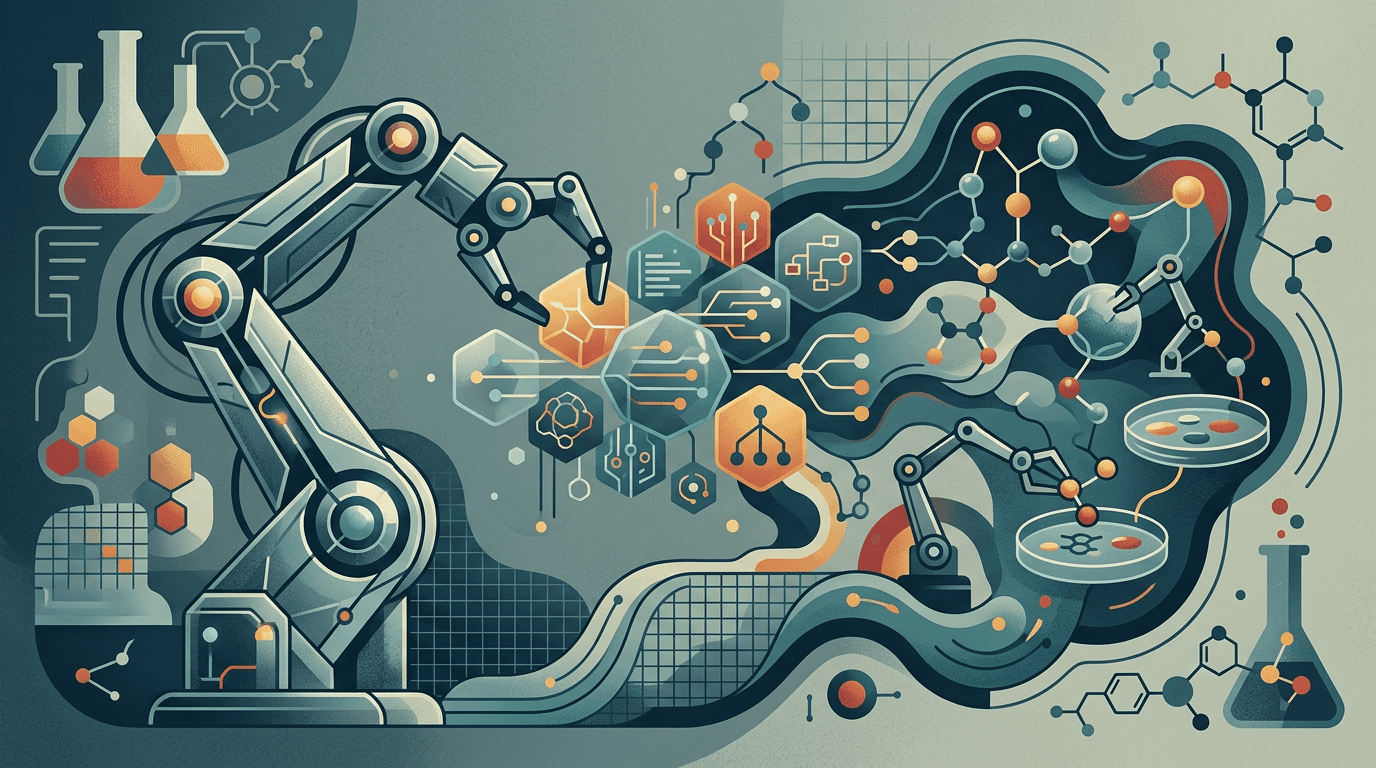
Those numbers have haunted pharmaceutical executives for years. Now, according to Reuters, the biggest drugmakers on the planet are placing an enormous collective wager that artificial intelligence can fix the problem. We're not talking about a few pilot programs or flashy press releases anymore. This is billions of dollars flowing into AI partnerships, platform deals, and infrastructure that will reshape how medicines get made.
The question isn't whether AI belongs in drug development. It's whether the hype matches the math.
The Deal Avalanche
The sheer volume of money changing hands tells the story. AstraZeneca signed a $5.33 billion AI-enabled R&D collaboration with China's CSPC in June. Eli Lilly inked a deal worth up to $1.3 billion with Superluminal Medicines to use AI for designing obesity drugs. Isomorphic Labs, the DeepMind spinoff backed by Google, holds partnerships with both Lilly and Novartis valued at a combined $3 billion.
These aren't moonshot bets from scrappy startups. These are the world's largest pharmaceutical companies rewriting their R&D playbooks.
Sanofi's deal with Insilico Medicine (worth up to $1.2 billion) covers six drug targets. AstraZeneca paired AI with CRISPR gene-editing technology in a $555 million collaboration with Algen Biotechnologies. Even the platform companies are raising war chests: Isomorphic Labs pulled in $600 million in funding just to scale its AI drug design engine.
If you're keeping score, that's well over $10 billion in disclosed deal value from just the past couple of years. And those are only the deals with public price tags.
Where AI Is Already Saving Real Time and Money
Forget the sci-fi version of AI inventing miracle cures in a basement server room. The actual gains so far are more mundane, and arguably more valuable because of it.
Get tomorrow's biotech intelligence before your competitors.
Join thousands of biotech professionals who start their day with our free, daily briefing.
Think of drug development like building a house. AI isn't designing the whole blueprint yet. But it's dramatically speeding up the permits, the contractor search, and the inspections.
Novartis reported that AI collapsed a four-to-six-week site selection process into a two-hour meeting. That's not a marginal improvement; that's deleting an entire bottleneck. GSK aims to speed all clinical trials by 15%.
Reuters cited TD Cowen's analysis suggesting a fully AI-enabled late-stage trial could wrap up in 47 months instead of 58. That's nearly a year shaved off a single trial. When you're burning millions per month to run a study, eleven months of savings adds up fast.
The Report Card: Phase I Is Crushing It, Phase II Is Just... Fine
Here's where things get genuinely interesting. AI-designed drug candidates are posting 80 to 90% success rates in Phase I trials (the first stage of human testing). The historical industry average? Roughly 40 to 65%.
That's a massive gap. It's like comparing a basketball team that makes the playoffs every year to one that occasionally wins a game.
The reason makes intuitive sense. AI can screen millions of molecular combinations before a single test tube gets used. It weeds out the obvious losers earlier. The compounds that survive are, on average, better designed and better tolerated by humans.
But Phase II tells a humbler story. AI-discovered molecules are succeeding at about 40%, which is roughly the same as traditional drugs. The magic touch fades once you're testing whether a drug actually treats the disease it's supposed to treat, not just whether it's safe.
Projections suggest AI could eventually double overall R&D productivity, pushing the chance of any molecule going from first-in-human testing to full approval from the historical 8 to 13% up to 9 to 18%. Those are projections, though. As of early 2026, zero AI-discovered drugs have received full FDA approval.
The Messy Middle Problem
Reuters flagged a critical caveat that deserves its own spotlight. AI is excellent at optimizing the "messy middle" of drug development: paperwork, logistics, trial operations, molecular optimization. It's like having a brilliant project manager who never sleeps.
But the hardest part of drug discovery (finding genuinely new, high-value biological targets) hasn't been cracked by AI at scale. Not yet. Johnson & Johnson says AI is halving the time to generate drug-development leads. Novo Nordisk claims it could cut time-to-market by up to two-thirds. Those are bold statements, and the industry is watching closely to see if the receipts match the promises.
McKinsey projects that agentic AI (systems that can independently execute multi-step tasks) could boost clinical development productivity by 35 to 45% over five years. TD Cowen, playing the skeptic, says investors may need one to three years just to measure whether any of this is real.
The Players Building the New Arsenal
Four companies sit at the center of this AI gold rush. Isomorphic Labs leverages DeepMind's structural biology expertise and holds the biggest pharma partnerships. Insilico Medicine runs an end-to-end platform covering everything from target identification to clinical trial design, with programs already in human testing. Exscientia was among the first to push AI-designed molecules into clinical development, with partnerships spanning Sanofi, Bristol Myers Squibb, and a $674 million Merck deal. Recursion Pharmaceuticals brings a unique phenomics approach (essentially letting AI watch how cells behave in millions of experiments) and counts Bayer and Roche as partners.
Meanwhile, the tech giants are muscling in. Thermo Fisher partnered with OpenAI to embed AI into clinical trial operations. Lundbeck signed a strategic deal with OpenAI spanning "molecule to patient." Roche and Novo Nordisk joined an NVIDIA supercomputing initiative for drug discovery.
The line between pharma company and tech company is blurring fast.
What This Actually Means for Drug Costs
Let's be honest about timelines. Drugs approved in 2026 were mostly discovered around 2013 to 2016, long before these AI tools existed. The true test comes when AI-native programs start hitting late-stage trials and approvals, likely in the 2027 to 2030 window.
Historically, the cost of developing a new drug has risen about 7.5 to 9% per year in real terms since the 1970s. The most optimistic scenario isn't that AI will slash costs overnight. It's that AI will flatten that relentless upward curve, potentially delivering 20 to 40% savings on discovery and clinical costs by the early 2030s for companies that adopt aggressively.
The pessimistic scenario? AI lets companies tackle harder, more complex diseases, and costs stay stubbornly high. Think of it like GPS: navigation got infinitely easier, but people used the convenience to drive farther, not less.
The Bottom Line
Pharma's AI bet is real, it's enormous, and the early returns are genuinely promising. The Phase I data is hard to argue with, the operational savings are tangible, and the deal flow suggests this isn't a passing trend.
But the industry hasn't proven the ultimate thesis yet: that AI can discover a truly novel, first-in-class drug and carry it all the way to approval. Until that happens, we're watching the most expensive dress rehearsal in the history of medicine. The good news? The curtain is about to go up.
Clinical & Regulatory
4 min read
The First Pill That Stops COVID Before It Starts
The FDA just approved the first oral antiviral that prevents COVID after exposure, not just treats it. Shionogi's Xocova cut symptomatic infection by 67% in a pivotal trial, filling a gap that's been wide open since Omicron killed off the antibody options.