The Cancer Vaccine That's Built From Scratch for Every Single Patient
Moderna and Merck just reported the first-ever positive Phase 3 results for a personalized cancer vaccine, one that's built from scratch using each patient's own tumor DNA. It could reshape how we treat cancer after surgery, and Wall Street is calling it a make-or-break moment.
Imagine going to a tailor and handing over your suit for alterations. Now imagine the tailor sequences your tumor's DNA instead, builds a one-of-a-kind vaccine from the mutations it finds, and ships it back to your doctor's office. That's not science fiction anymore. It just passed the biggest test in cancer vaccine history.
On August 19, Moderna and Merck announced that their personalized mRNA cancer vaccine hit its primary goal in a Phase 3 trial. The vaccine, called intismeran autogene (also known as V940 or mRNA-4157), slowed melanoma from coming back after surgery when combined with Merck's blockbuster immunotherapy Keytruda. It's the first time an individualized neoantigen therapy has ever delivered positive Phase 3 results. And it could change how we treat cancer after the surgeon puts down the scalpel.
A Vaccine That's Never the Same Twice
Most drugs are mass-produced. Millions of identical pills roll off the assembly line. This vaccine works nothing like that.
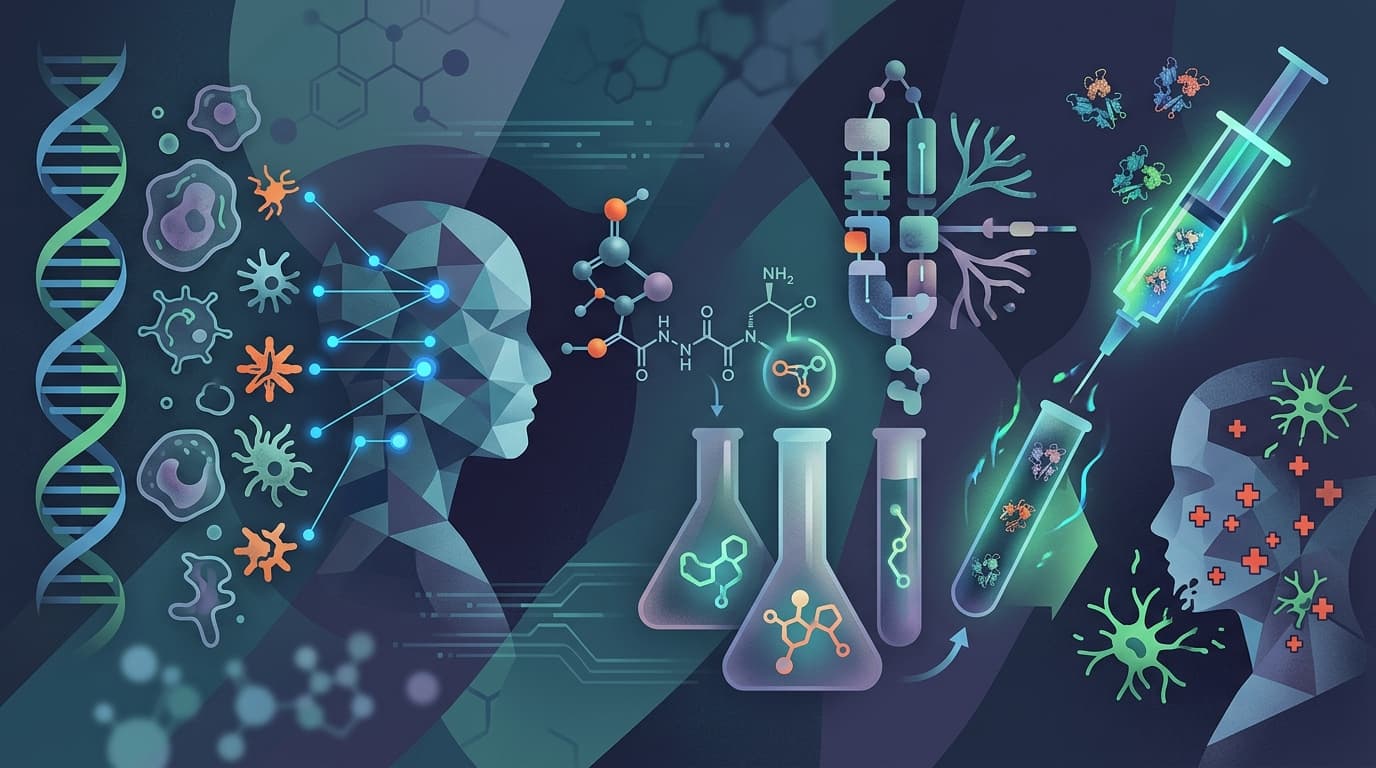
Every single dose is custom-built for one patient. The process starts with the patient's tumor tissue. Scientists sequence the tumor's DNA to find mutations unique to that person's cancer. An algorithm then selects up to 34 of those mutations (called neoantigens) as targets.
Those targets get encoded into a single strand of synthetic mRNA, wrapped in tiny fat particles called lipid nanoparticles, and injected into the patient. Once inside the body, cells read the mRNA instructions, produce fragments of those tumor-specific proteins, and wave them in front of the immune system like a wanted poster. The result: T cells learn to recognize and hunt down cancer cells carrying those exact mutations.
Think of it like giving your immune system a personalized mugshot book. Instead of a generic "be on the lookout for cancer" alert, it gets 34 specific faces to memorize. That precision is what makes the approach so compelling, and so difficult to manufacture at scale.
The Trial That Changes the Conversation
The study, called INTerpath-001, enrolled over 1,000 patients with high-risk melanoma (stages IIB through IV) who had already undergone surgery to remove their tumors. It was randomized, double-blind, and placebo-controlled: the gold standard of clinical evidence.
Get tomorrow's biotech intelligence before your competitors.
Join thousands of biotech professionals who start their day with our free, daily briefing.
Patients received either the personalized vaccine plus Keytruda, or a placebo plus Keytruda. That's an important detail. The control arm wasn't "no treatment." It was Keytruda alone, which is already one of the most effective cancer drugs on the planet. This vaccine had to prove it could make a great drug even better.
And it did. At a pre-specified interim analysis, the combination showed statistically significant and clinically meaningful improvements in both recurrence-free survival (how long patients stayed cancer-free) and distant metastasis-free survival (how long before cancer spread to other parts of the body).
In plain English: patients who got the personalized vaccine on top of Keytruda were less likely to see their melanoma come back, and less likely to see it spread.
Years in the Making
This didn't come out of nowhere. The earlier Phase 2b study, called KEYNOTE-942, had been building the case for years. In that smaller trial of about 157 patients, the vaccine-plus-Keytruda combination cut the risk of recurrence or death by 49% compared to Keytruda alone. Even more striking, it reduced the risk of distant spread or death by 65%.
Those numbers held up over time, too. At three years, the benefit was still there. At five years, it was still there. That kind of durability is what gave Moderna and Merck the confidence to bet on a full Phase 3 study.
But Phase 2 results in oncology are a bit like a band that sounds amazing in a small club. The real question is whether they can sell out an arena. Phase 3 trials are the arena. Larger patient populations, stricter statistical requirements, more scrutiny. Plenty of promising cancer therapies have crumbled at this stage.
V940 didn't crumble.
Why Wall Street Is Paying Very Close Attention
Analysts had been calling this readout a "make-or-break" moment for Moderna's stock. The company built its name on COVID vaccines, but investors have been waiting (impatiently) to see whether Moderna's mRNA platform could deliver beyond respiratory viruses. This result answers that question with a loud yes.
Jefferies sees the melanoma opportunity alone as potentially worth multiple billions in peak sales. Citi noted that a clean result bolsters confidence in Moderna's broader strategy, though commercial and execution questions remain. And the implications go well beyond skin cancer; analysts at Morningstar have pointed out that if the Phase 3 benefit holds, it could support expansion into kidney, bladder, and lung cancers.
For Merck, the math is equally interesting. Keytruda is the world's best-selling drug, but its core patents are expiring. Finding new uses and new combinations is existential for Merck's growth story. A validated companion vaccine that extends Keytruda's relevance in a new treatment setting? That's exactly the kind of lifecycle extension investors love.
The Personalized Vaccine Arms Race
Moderna and Merck aren't the only ones chasing this idea. BioNTech and Genentech (Roche's biotech arm) are running their own individualized mRNA neoantigen program, called autogene cevumeran, across multiple Phase 2 trials in pancreatic cancer, melanoma, and colorectal cancer. Their pancreatic cancer data showed the vaccine could trigger neoantigen-specific T-cell responses in roughly half of patients, with hints that those responses correlated with delayed recurrence.
Gritstone has taken a slightly different approach, focusing on shared neoantigens (mutations common across many patients' tumors) rather than building a fully custom vaccine each time. It's a potentially simpler manufacturing model, but it sacrifices the hyper-personalization that made V940's results so compelling.
What sets this Moderna/Merck readout apart from everything else in the field is the Phase 3 validation. Nobody else has gotten there yet. BioNTech's programs are still in Phase 2. Gritstone hasn't matched this level of clinical evidence. Being first to cross the Phase 3 finish line in personalized cancer vaccines is a massive competitive advantage, both scientifically and commercially.
The Hard Part Nobody Talks About
There's a catch, and it's a big one: manufacturing. Building a unique vaccine for every patient is extraordinarily complex. You need the tumor tissue, the sequencing, the algorithm, the mRNA synthesis, the formulation, and the quality checks, all on a patient-by-patient basis. This isn't like cranking out flu shots.
In the clinical trial, patients received up to nine doses of their personalized vaccine over roughly a year, alongside Keytruda infusions every six weeks. Scaling that from a thousand-patient trial to tens of thousands of real-world patients will test Moderna's manufacturing infrastructure like nothing before.
The company has spent years building mRNA production capacity (thank COVID for that). But personalized oncology is a fundamentally different challenge from mass-producing a single vaccine sequence. Each batch is a batch of one. If they can solve that logistics puzzle, the commercial potential is enormous. If they can't, even the best clinical data in the world won't matter.
What Comes Next
Several dominoes still need to fall. The trial will continue tracking overall survival, the ultimate measure of whether a cancer therapy truly works. Moderna and Merck haven't announced a regulatory filing timeline yet, and the full dataset will need to be presented at a major medical meeting before the oncology community renders its verdict.
Investors should watch for three things: the magnitude of the survival benefit when full data drops (is it similar to the 49% risk reduction from Phase 2, or has it narrowed?), the safety profile across this larger population, and any signal on how quickly the companies can move toward an FDA submission.
The Bigger Picture
For decades, the idea of a cancer vaccine was treated like cold fusion: theoretically beautiful, practically impossible. The immune system is maddeningly complex. Tumors are shape-shifters. And the history of cancer vaccine failures is long enough to fill a medical library.
But mRNA technology changed the equation. The same platform that let Moderna rapidly design a COVID vaccine now lets them build a bespoke cancer vaccine from a patient's own tumor mutations. And for the first time, a Phase 3 trial has shown that this approach actually works in practice, not just in theory.
We're not at the finish line yet. Full data, regulatory review, and the manufacturing gauntlet all lie ahead. But August 19, 2026, might be remembered as the day personalized cancer vaccines stopped being a futuristic promise and started becoming a medical reality.
The tailor is open for business.
Funding & Financings
5 min read
CSL Just Had Its Best Day in 25 Years. Here's What Lit the Fuse.
CSL posted a $2.6 billion net loss and its stock soared 18%, the best single-day move in 25 years. Behind the apparent contradiction lies a "reset year" ending, a massive buyback, and a plasma market where demand keeps outrunning supply.