Pennsylvania Just Became Big Pharma's Favorite Zip Code
Merck and GSK are betting nearly $4 billion on Pennsylvania, building AI-powered labs and biologics factories that could reshape American drug manufacturing. Here's why one state just became Big Pharma's most popular construction site.
$4 Billion Says a Lot About Where Pharma Is Headed
If you wanted to pick one state that's quietly becoming the center of gravity for American drug manufacturing, you'd be forgiven for guessing Massachusetts or New Jersey. But Pennsylvania just made a $4 billion argument for itself.
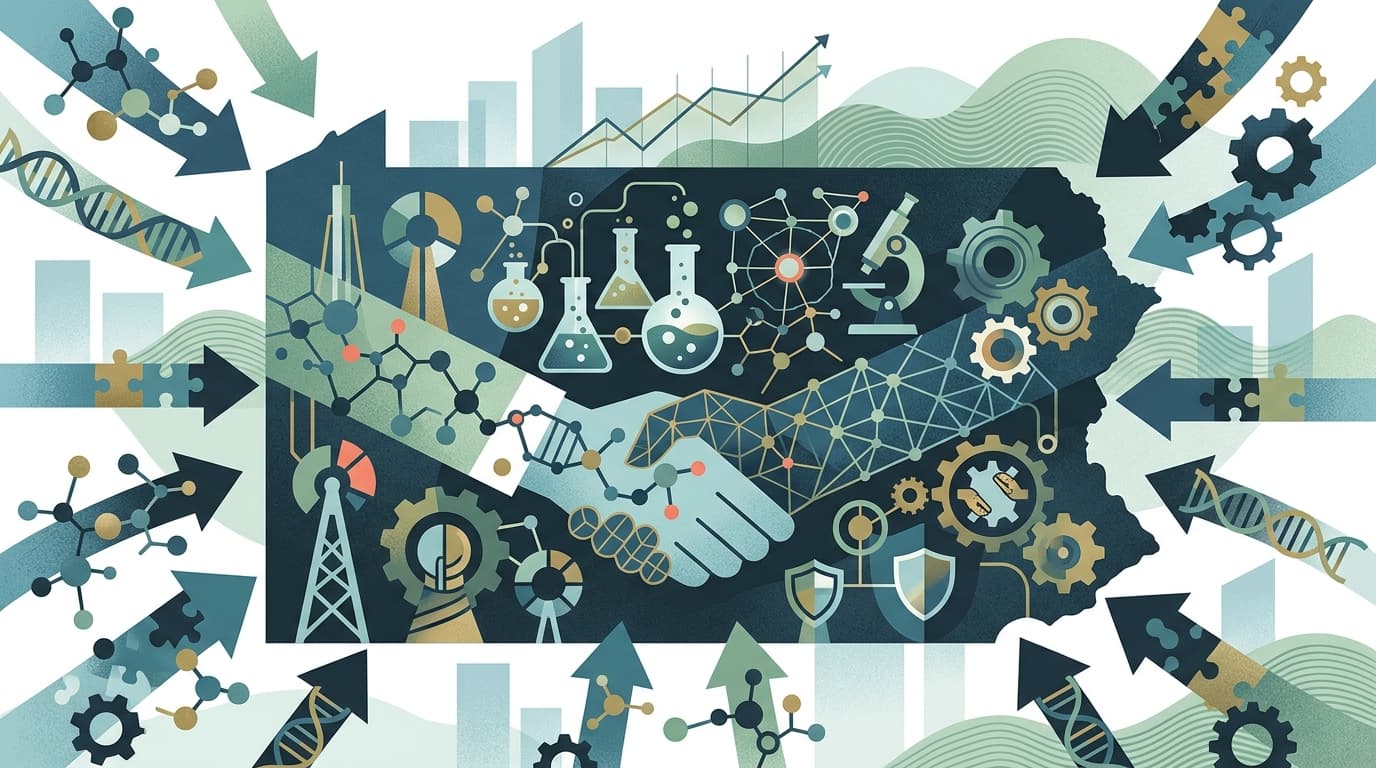
Governor Josh Shapiro announced last week that the Commonwealth secured more than $4 billion in private-sector life sciences investment commitments. The headliners: Merck is pouring $2.9 billion into Montgomery County, and GSK is committing over $800 million to expand its Upper Merion Township campus. Together, these projects are expected to create more than 6,300 jobs across the state.
That's not a press release; it's a statement of intent. And it tells us something important about where Big Pharma wants to build its future.
Merck Goes All In on Robots and AI
Merck's $2.9 billion bet is the bigger story here, and not just because of the price tag. About $550 million of that total is going toward a facility called ADVANCE, a robotics- and AI-enabled drug research and development center at Merck's West Point campus and the nearby Spring House Innovation Park.
Think of ADVANCE as a lab where robots handle the grunt work of analyzing biological samples from clinical trials, while AI systems help scientists spot patterns and make faster decisions. It's the difference between hand-washing every dish and buying a dishwasher; the cooks can focus on cooking.
Merck actually inaugurated the ADVANCE facility on October 14, so it's already moving from blueprint to reality. The broader expansion, covering vaccine and medicine manufacturing across Montgomery County, is slated for completion by the end of 2030.
Here's what makes this interesting: Merck describes the Pennsylvania project as part of a $70 billion commitment to U.S. research and manufacturing. That's not a typo. Seventy billion. The company is spreading investments across Pennsylvania, Delaware, Kansas, and Virginia, but Montgomery County is clearly the flagship.
Get tomorrow's biotech intelligence before your competitors.
Join thousands of biotech professionals who start their day with our free, daily briefing.
Pennsylvania, for its part, is contributing a modest $5 million in state support. That's like tipping your waiter a dollar on a $580 dinner. But hey, sometimes the restaurant's location is the real selling point.
GSK Builds a Biologics Fortress
GSK's piece of the puzzle is different but equally telling. The company plans to invest more than $800 million to transform its Upper Merion site into what it calls an integrated biopharmaceutical innovation and manufacturing hub.
In plain English: GSK is tearing down old buildings and replacing them with a commercial-scale biologics manufacturing facility, a co-located R&D pilot plant, a centralized quality control lab, and a manufacturing science and technology hub. Construction is expected to begin in 2027.
Why does the biologics angle matter? Biologics (medicines made from living cells rather than chemicals) are the fastest-growing segment of the pharmaceutical industry. They're also notoriously tricky to manufacture. You can't just photocopy a biologic the way you can a pill; every batch requires precise conditions and specialized equipment. Building this kind of capacity domestically gives GSK more control over its supply chain and reduces dependence on overseas production.
The project is expected to create more than 300 new jobs over five years while retaining roughly 4,500 existing positions in Pennsylvania. Those new roles won't be assembly-line gigs, either. GSK will need bioprocess engineers, data scientists, automation specialists, and quality professionals.
The Real Game: Why Pennsylvania?
So why is all this money flowing into one state? Pennsylvania has a few natural advantages that are easy to overlook.
First, geography. The state sits squarely in the Philadelphia–New Jersey–New York life sciences corridor, giving companies access to a deep talent pool, research universities, major hospitals, and contract research organizations. It's like opening a restaurant on the busiest street in town; you don't have to convince people to visit.
Second, infrastructure. Merck and GSK aren't building on empty farmland. Both companies already have major campuses in the state, which means existing supply chains, trained workforces, and institutional knowledge. Expanding an existing site is almost always cheaper and faster than starting from scratch.
Third, the state is actually trying. Pennsylvania released its first comprehensive economic development strategy in nearly two decades, and life sciences is one of five priority sectors. The administration proposed $50 million for innovation funding, including $30 million specifically for life sciences job growth and $20 million in recurring R&D support. There are also R&D tax credits, Keystone Innovation Zone credits for young companies, and capital grants for major projects.
It's not the flashiest incentive package in America, but Pennsylvania is betting that its existing ecosystem matters more than a single tax break.
The Bigger Picture: Smart Factories, Not Just Big Ones
Zoom out, and these investments reflect a broader shift in how pharma companies think about manufacturing. It's no longer enough to build a big building and fill it with production lines.
Merck's ADVANCE facility, with its robotics and AI integration, signals that the next generation of drug development infrastructure will be digital-first. The company is also partnering with Google Cloud to deploy AI across R&D workflows and collaborating with Mayo Clinic to combine clinical datasets with AI-powered "virtual cell" technologies. This isn't a side project; it's core strategy.
GSK's decision to co-locate manufacturing, R&D, and digital capabilities at a single site follows similar logic. When the people making the drug sit next to the people designing it, technology transfer gets faster. Problems get solved over lunch instead of over email chains spanning three time zones.
What Could Go Wrong
A few reality checks before we get too excited.
These are investment commitments, not checks that have already cleared. Merck's expansion runs through 2030, and GSK's construction hasn't even started yet. A lot can change: product demand shifts, permitting delays, cost overruns, leadership changes. The history of mega-projects is littered with announcements that aged poorly.
The 6,300 jobs figure covers multiple investment announcements across the state, not just Merck and GSK. During Merck's West Point construction, about 800 contracting and engineering jobs were sustained on site, but the company hasn't specified a precise permanent headcount. So take the headline number with appropriate seasoning.
And Pennsylvania isn't the only state playing this game. North Carolina, Indiana, Massachusetts, and New Jersey are all competing hard for biopharma dollars. Eli Lilly, for instance, is building a $3.5 billion manufacturing facility in Pennsylvania's own Lehigh County, a reminder that the competition is national and relentless.
The Bottom Line
Pennsylvania just landed two of the largest single-site pharma investments in recent memory, and both projects lean heavily into AI, automation, and biologics. That combination tells you where the industry is headed: smarter facilities, more domestic capacity, and tighter integration between the lab and the factory floor.
For the state, it's a vindication of a strategy that bets on ecosystem strength over headline-grabbing tax giveaways. For the rest of the country, it's a signal that the geography of American drug manufacturing is shifting in real time.
And for the 6,300-plus people who might land jobs out of this? Not a bad week in Pennsylvania.
Funding & Financings5 min read
RNAi's Biggest Problem Just Got a $200 Million Bet
City Therapeutics just raised $200 million in an upsized IPO to crack RNAi's hardest problem: getting gene-silencing drugs to work outside the liver. With a team of Alnylam alumni and nearly half a billion in total funding, they're making the biggest bet yet on extrahepatic delivery.