The Cancer That Stumped Drug Makers for 40 Years Just Met Its Match
For 40 years, scientists called the RAS protein "undruggable." Now the FDA is fast-tracking the first drug to block it across multiple mutations, and its pancreatic cancer survival data are unlike anything oncologists have seen before.
For four decades, scientists tried to shut down a protein called RAS. It drives roughly 15–20% of all human cancers, and it was so stubbornly resistant to drug design that the field gave it a nickname: "undruggable."
That nickname is officially dead.
The FDA just accepted Revolution Medicines' application to approve daraxonrasib, an oral drug that does something no approved medicine has done before: directly block multiple forms of active RAS. The target indication? Previously treated metastatic pancreatic cancer, one of the most lethal diagnoses in all of oncology. And the agency isn't reviewing this on a normal timeline. Daraxonrasib was selected for a special accelerated review program that could compress the typical months-long wait into just one to two months.
Why Pancreatic Cancer Is Oncology's Final Boss
Pancreatic ductal adenocarcinoma (PDAC) is brutally efficient at killing. Once it spreads, the five-year survival rate drops to roughly 1%. For patients whose cancer progresses after first-line chemotherapy, the best available second-line regimen only extends median survival to around 6 to 7 months.
Put differently: if pancreatic cancer were a video game boss, second-line chemo would be a wooden sword. Oncologists have been fighting with essentially the same limited arsenal for years, swapping between gemcitabine-based and fluorouracil-based regimens depending on what came first. Targeted therapies exist for tiny subsets of patients (those with rare biomarkers like microsatellite instability or NTRK fusions), but the vast majority are left with conventional chemo and its harsh side effects.
That's the backdrop against which daraxonrasib's clinical data landed like a thunderclap.
The Trial That Doubled Survival
The Phase 3 study, called RASolute-302, randomized patients with previously treated metastatic PDAC to receive either daraxonrasib (one pill, once daily) or the doctor's choice of standard chemotherapy.
Get tomorrow's biotech intelligence before your competitors.
Join thousands of biotech professionals who start their day with our free, daily briefing.
The headline number: median overall survival of 13.2 months with daraxonrasib, compared to 6.7 months with chemo. That's a 60% reduction in the risk of death. At the one-year mark, more than half of daraxonrasib patients were still alive, versus fewer than one in five on chemo.
The drug also shrank tumors more effectively. The confirmed response rate was 33% for daraxonrasib versus 12% for chemotherapy. Progression-free survival (the time before the cancer started growing again) roughly doubled as well: 7.2 months versus 3.6 months.
And perhaps just as important for patients living with this disease: people on daraxonrasib reported less pain, better quality of life, and slower deterioration in daily functioning compared to those on chemo. In a cancer where comfort matters as much as longevity, that's not a footnote; it's a headline.
How You Drug the "Undruggable"
To appreciate why this matters beyond pancreatic cancer, you need a quick history lesson.
RAS proteins act like molecular light switches. When they're flipped "on" (bound to a molecule called GTP), they tell cells to grow and divide. Mutations in KRAS, the most common RAS family member, get stuck in the "on" position, driving uncontrolled cell growth. Over 90% of pancreatic cancers carry a KRAS mutation.
The problem? RAS proteins are small, smooth, and featureless. Designing a drug to grab onto them is like trying to stick a Post-it note to a wet marble. For decades, nobody could do it.
The first crack appeared in 2013, when researchers discovered a hidden pocket on one specific mutant form, KRAS G12C. That discovery led to sotorasib (approved 2021) and adagrasib (approved 2022), the first drugs to directly target any RAS protein. Both were breakthroughs, but they only worked on one mutation (G12C) and only when RAS was in its inactive "off" state.
Pancreatic cancer rarely carries the G12C mutation. Its most common KRAS mutations are G12D and G12V, which those first-generation drugs can't touch.
The Molecular Glue Trick
Daraxonrasib takes an entirely different approach. Instead of targeting one mutation in the off state, it goes after active RAS across multiple mutations and even multiple RAS family members (KRAS, NRAS, HRAS).
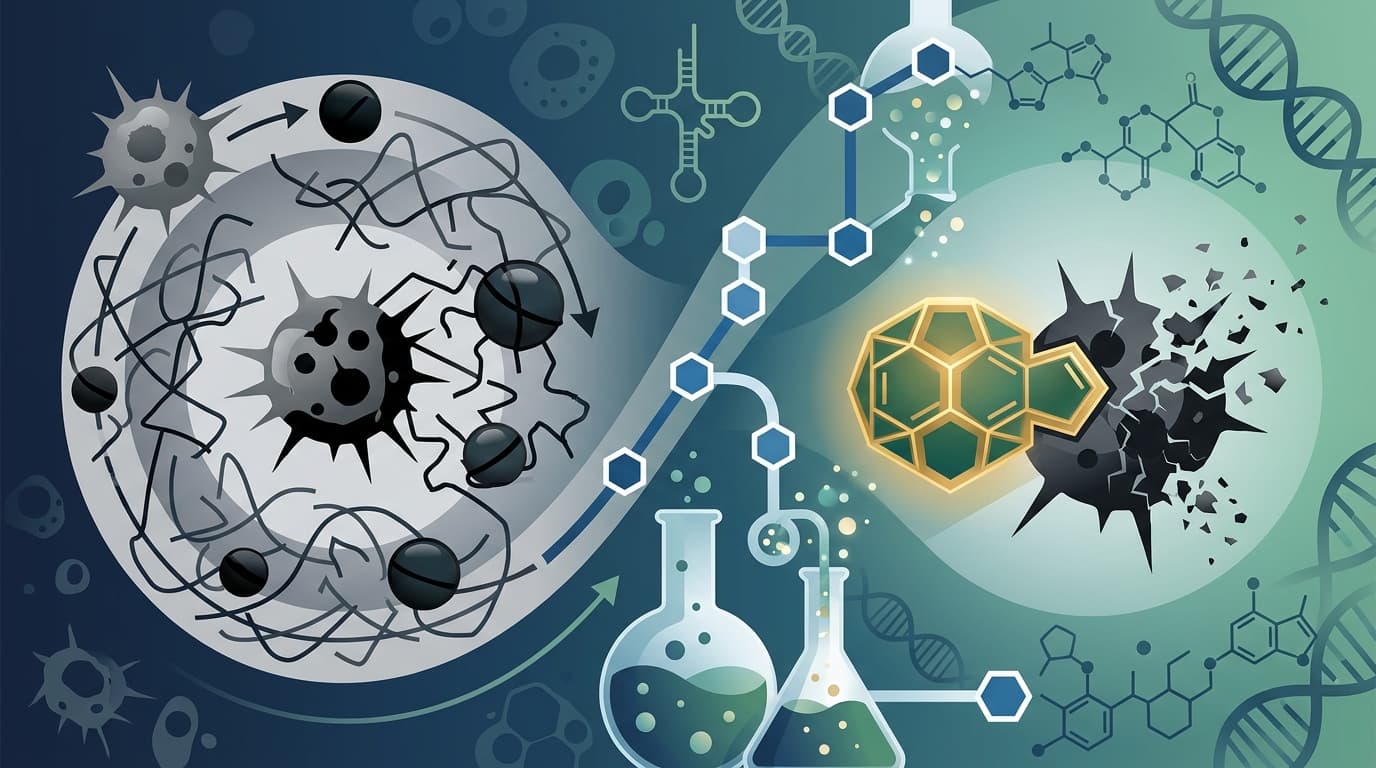
It pulls this off through a clever molecular trick. The drug first latches onto a helper protein called cyclophilin A that's naturally floating around inside cells. Together, the drug and cyclophilin A form a new surface that fits snugly over the spot where active RAS normally talks to its downstream partners. Think of it like a two-piece puzzle that, once assembled, plugs directly into RAS's communication port and blocks the signal.
Because the binding site involves highly conserved regions of RAS (not the specific mutation itself), daraxonrasib works across G12D, G12V, G12A, G13, Q61, and other variants. That's why Revolution Medicines calls it a "multi-selective RAS(ON) inhibitor": it targets the on state, across multiple mutations.
This is a fundamentally new category of cancer drug.
The FDA Is Moving Fast
The agency clearly agrees this is urgent. Daraxonrasib has already collected Breakthrough Therapy Designation, Orphan Drug Designation, and selection into the Commissioner's National Priority Voucher pilot program, which targets a review window of just one to two months instead of the standard six to ten.
Revolution Medicines also received a "safe to proceed" letter from the FDA for an expanded access program in late April 2026, meaning some patients are already receiving the drug outside of clinical trials. That kind of early access signal, combined with the compressed review timeline, tells you how seriously regulators are treating this.
Across the Atlantic, Europe's medicines agency has also started a phased review with high-priority status under its Cancer Medicines Pathfinder project.
Wall Street Smells a Blockbuster
The clinical data and regulatory momentum have pushed Revolution Medicines' market cap above $30 billion. Analysts see a textbook blockbuster setup: a devastating disease with terrible existing options, an oral drug with unprecedented survival data, orphan pricing potential, and a clear path to expand into first-line pancreatic cancer and other RAS-driven tumors like lung and colorectal cancer.
Early-line data presented at AACR 2026 already showed promising signals. As monotherapy in earlier-stage patients, daraxonrasib shrank tumors in 47% of cases. Combined with chemotherapy, the response rate jumped to 58%. Those numbers suggest the second-line approval could be just the opening act.
Reports have even surfaced about large pharma companies exploring acquisition talks, though nothing has materialized publicly. When a $30 billion biotech owns the only approved drug for oncology's most infamous "undruggable" target, the strategic logic writes itself.
What Comes Next
If all goes according to the accelerated timeline, daraxonrasib could become the first multi-selective RAS(ON) inhibitor to reach the market. For the roughly 67,000 Americans diagnosed with pancreatic cancer each year, and the many more worldwide, that would mark the most significant therapeutic advance in this disease in over a decade.
Forty years of "undruggable" just became a footnote in oncology textbooks. The real story is what happens now that the lock has been picked.
Clinical & Regulatory
5 min read
One Shot a Week: The Insulin That Could Change Everything for 100 Million Indians
Novo Nordisk just launched the world's first once-weekly insulin in a country with 100 million diabetics, and it's actually cheaper than the daily alternatives. India could be the ultimate test case for whether convenience can fix the global insulin adherence crisis.