
Revolution Medicines just dropped Phase 3 data showing its pancreatic cancer drug nearly doubled survival over chemo, a result almost unheard of in oncology's deadliest cancer. Now Merck reportedly wants to buy the whole company for up to $32 billion.
Pancreatic cancer doesn't lose. It has a five-year survival rate of just 3% once it spreads, making it the closest thing oncology has to a death sentence. Treatments buy patients weeks, maybe a couple of months. The best chemotherapy regimens on the market deliver a median survival of about 11 to 12 months in metastatic disease. Progress in this space is measured in inches.
So when Revolution Medicines dropped Phase 3 data showing its drug nearly doubled survival in previously treated metastatic pancreatic cancer, the reaction wasn't just positive. It was seismic.
The numbers from the RASolute 302 trial are hard to argue with. Patients taking daraxonrasib, an oral pill dosed once daily, lived a median of 13.2 months. Those on standard chemotherapy lasted 6.7 months. That's a 60% reduction in the risk of death.
To put that in perspective: the last time a pancreatic cancer drug moved the needle this much, it was FOLFIRINOX back in 2011. And that regimen only improved survival from about 6.8 months to 11.1 months in first-line patients (the healthiest group). Daraxonrasib just outperformed that benchmark in second-line patients, the sicker population that has already failed one round of treatment.
The trial enrolled 501 patients with metastatic pancreatic ductal adenocarcinoma (the most common and deadly form). Revolution announced topline results from an interim analysis and declared them final due to strong efficacy, though the trial itself remains ongoing. The drug also met all key secondary endpoints across the full study population, not just the primary mutation subgroup.
About 90% of pancreatic cancers carry a KRAS mutation. For decades, scientists called KRAS "undruggable" because the protein's surface was too smooth and featureless for a drug to grab onto. It was like trying to stick a Post-it note to a wet bowling ball.
Recent breakthroughs changed that, but with a catch. The first generation of KRAS drugs (sotorasib from Amgen, adagrasib from BMS/Mirati) only work on one specific mutation called G12C. That mutation shows up in about 13% of lung cancers but barely 1 to 2% of pancreatic cancers. So those drugs were basically useless for the vast majority of pancreatic patients.

For decades, patients with a rare kidney disease called FSGS had zero approved treatments. Travere Therapeutics just changed that with the first-ever FDA-approved therapy, and Wall Street thinks it could be worth $2 billion.


Join thousands of biotech professionals who start their day with our free, daily briefing.
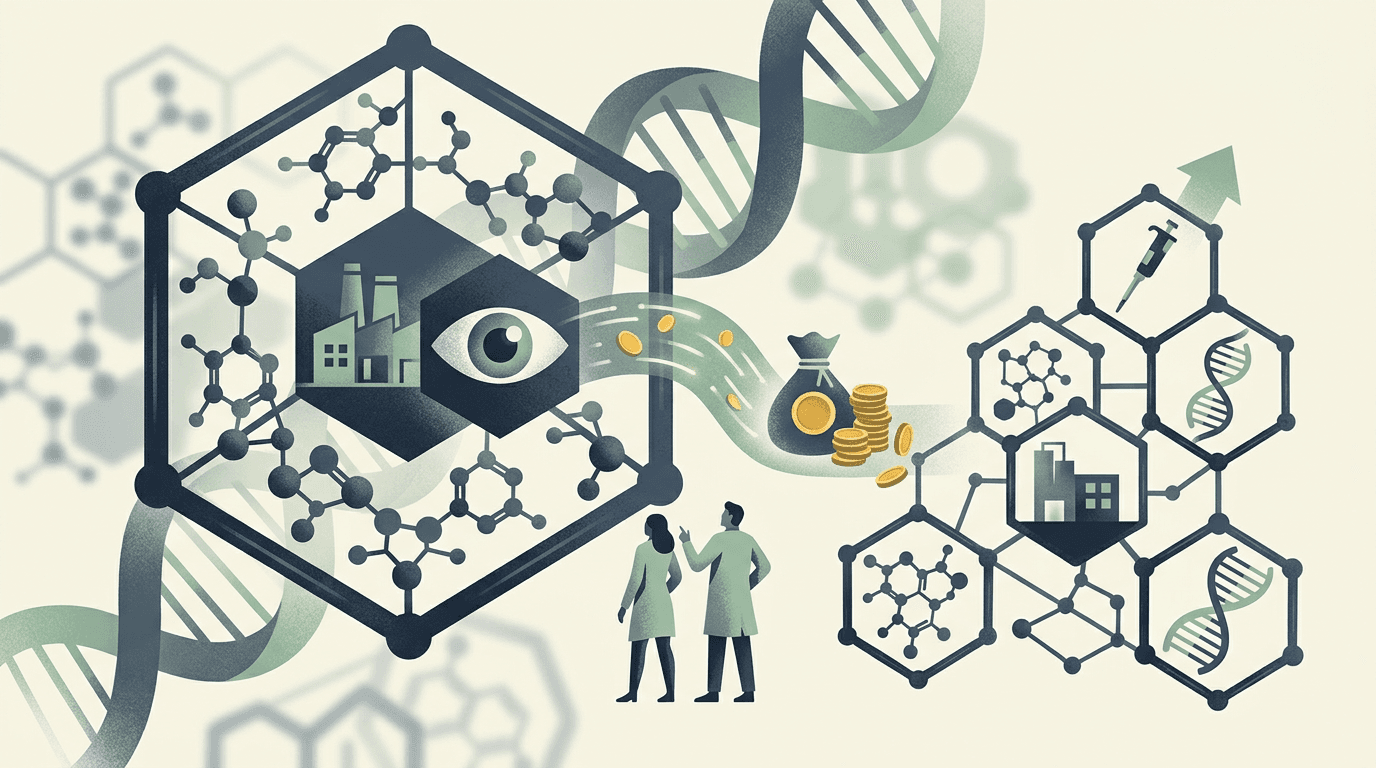
Daraxonrasib takes a fundamentally different approach. Instead of targeting the inactive "off" form of KRAS, it attacks the protein in its active, cancer-driving "on" state. The drug works like a molecular glue: it first binds to an abundant helper protein inside cells called cyclophilin A, changes that protein's shape, and then the newly formed complex latches onto active KRAS. This three-part structure (Revolution calls it a "tri-complex") physically blocks KRAS from sending the growth signals that fuel tumors.
The beauty of this mechanism is its breadth. Daraxonrasib hits multiple KRAS variants, including G12D, which accounts for roughly 45% of pancreatic cancers. That's not a niche therapy for a rare mutation. That's a drug built for the most common driver of pancreatic cancer.
Wall Street didn't wait for the full data presentation to start the rumor mill. Reports from the Financial Times and Wall Street Journal have placed Merck in acquisition talks with Revolution Medicines at a price tag of $28 to $32 billion. AbbVie was also mentioned as a potential suitor in early March 2026, though it denied involvement.
The timing makes strategic sense. Merck's blockbuster immunotherapy Keytruda is staring down a patent cliff, and the company desperately needs its next oncology franchise. A KRAS platform that works across pancreatic cancer, lung cancer, and colorectal cancer would be exactly that.
RBC Capital Markets named Revolution a top buyout target. Stifel analyst Laura Prendergast suggested that even the reported $28 to $32 billion range might be too low given the pipeline's potential. Revolution's stock has been on a rollercoaster accordingly; shares surged on early acquisition buzz in January 2026, then cratered 17% on January 26, 2026 when talks appeared to stall.
As of mid-April, fresh reports indicate Merck discussions have resumed and could be "several weeks away" from resolution. Other pharma bidders may also be circling.
Daraxonrasib in second-line pancreatic cancer is just the opening act. Revolution has three Phase 3 programs running for this single drug: RASolute 302 (the one that just read out), RASolute 303 testing it as a first-line therapy for metastatic pancreatic cancer, and RASolute 304 evaluating it after surgical removal of tumors.
If those trials show similar results, the implications are staggering. First-line data could establish daraxonrasib as the new standard of care for the most common form of pancreatic cancer. Adjuvant data (treating patients after surgery to prevent recurrence) could potentially push five-year survival rates meaningfully higher for the 15 to 20% of patients whose tumors are caught early enough to operate.
Beyond pancreatic cancer, Revolution's pipeline includes elironrasib, a KRAS G12C-specific drug showing a 42% response rate in patients who already failed earlier KRAS inhibitors, plus combination trials across lung and colorectal cancers.
Revolution plans to present the full RASolute 302 dataset at the American Society of Clinical Oncology (ASCO) meeting in May 2026. The company is also pursuing FDA approval through a national priority review voucher, which could accelerate the timeline.
The competitive landscape is filling up quickly. Chinese companies like Jiangsu Hengrui and Jacobio are running their own KRAS programs. But nobody else has Phase 3 survival data in pancreatic cancer. Not yet.
For a disease where oncologists have spent decades celebrating tiny improvements measured in weeks, a drug that nearly doubles survival feels like it belongs in a different era entirely. Pancreatic cancer is still a brutal diagnosis. But for the first time in a long time, the outlook just changed in a way that matters.
Storm Therapeutics just raised $56 million and dosed the first patient in a Phase 2 sarcoma trial, all for a drug targeting an enzyme most people have never heard of. It's the biggest clinical milestone yet for epitranscriptomics, a therapeutic field that literally didn't exist a decade ago.