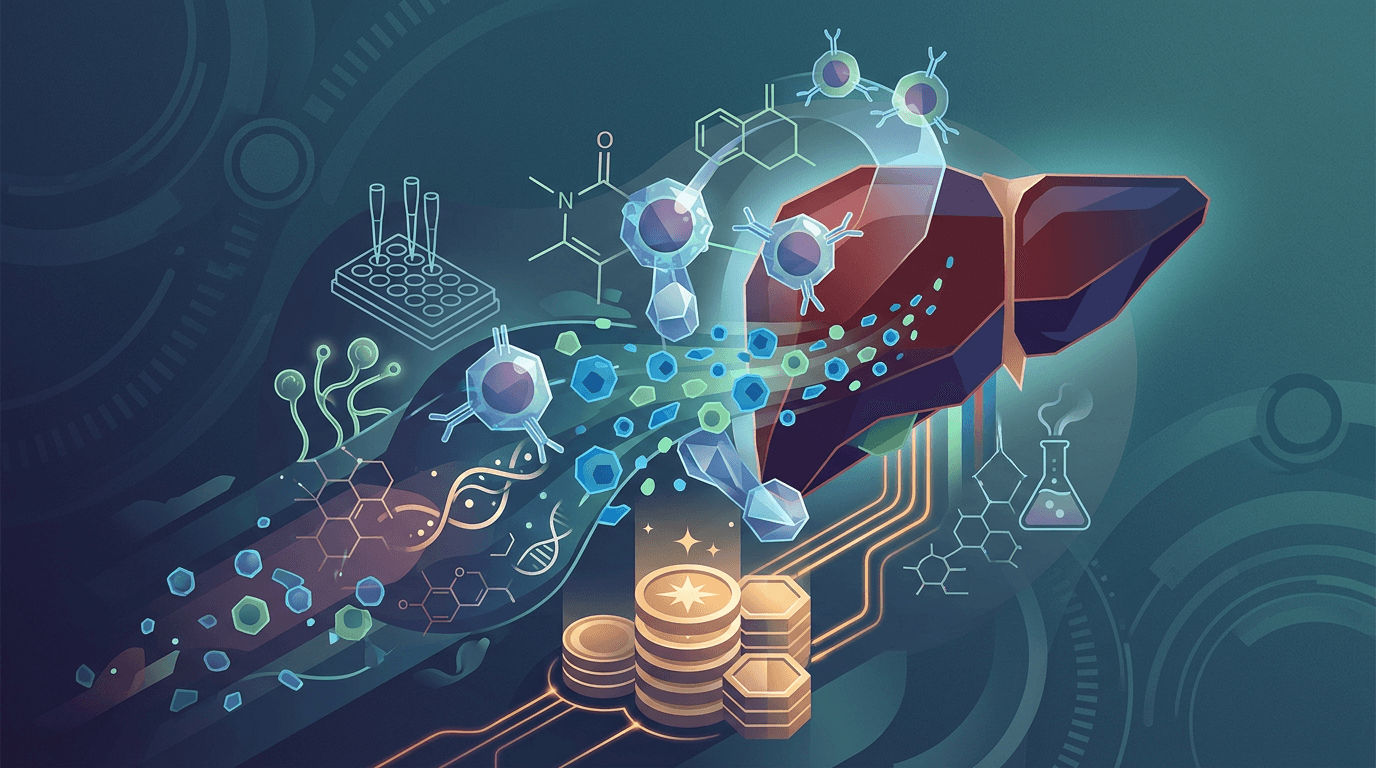

A Shanghai biotech just raised $110 million to chase what nobody has achieved: a CAR-T therapy that actually works against solid tumors. Oricell Therapeutics is betting it can crack liver cancer and IPO on the other side.
CAR-T cell therapy has conquered blood cancers. Liver cancer? That's been a fortress nobody can breach. One Shanghai company just raised $110 million betting it has the key.
Oricell Therapeutics closed a massive pre-IPO financing round on April 10, banking over $110 million to push its lead CAR-T therapy toward pivotal trials in hepatocellular carcinoma (HCC), the most common form of liver cancer. If it works, Oricell's Ori-C101 could become the world's first approved CAR-T therapy for liver cancer. That's not corporate hype; it's the actual clinical gap the company is racing to fill.
If you've heard of CAR-T therapy, it was probably in the context of leukemia or lymphoma. The basic idea: doctors extract a patient's immune cells, genetically reprogram them to hunt cancer, then infuse them back in. Think of it like upgrading your body's security system from a house cat to a German Shepherd.
The catch? CAR-T has been phenomenally successful against blood cancers but has largely flopped against solid tumors. Solid tumors are surrounded by a hostile microenvironment that suppresses immune cells. Getting CAR-T to work in liver cancer is like sending that German Shepherd into a house filled with tranquilizer darts.
Oricell thinks it's cracked the code. Its lead program, Ori-C101, targets a protein called GPC3 that's found on the surface of liver cancer cells. The company has completed both Phase 1 investigator-initiated trials and Phase 1 IND studies, presenting data at ASCO (the Super Bowl of oncology conferences) that showed what the company describes as "far-leading-industry efficacy and safety."
Now it's entering the big leagues: registrational pivotal trials, the final step before seeking approval.
The $110 million round was co-led by Vivo Capital, Beijing Medical and Health Care Industry Investment Fund, Qiming Venture Partners, and a leading global healthcare fund. The investor list reads like a who's who of smart healthcare money, and it gets more interesting from there. An international sovereign wealth fund participated, along with E-Town Capital, Luxin Venture Capital, Australian pension fund NGS Super, Elikon Investment, and Talon Capital.

Analysts are calling lipoprotein(a) inhibitors biotech's next blockbuster category, with comparisons to the GLP-1 obesity gold rush. With 65 million eligible U.S. patients and zero approved treatments, the first definitive trial results are expected this summer.


Join thousands of biotech professionals who start their day with our free, daily briefing.
When a sovereign wealth fund and a pension fund show up in the same biotech round, that tells you something. These aren't spray-and-pray venture capitalists. They're institutions that move slowly, do exhaustive diligence, and don't chase hype.
The round actually built on a $70 million Series C1 tranche that closed back in January 2026. This latest closing brought the cumulative total past $110 million. No valuation was publicly disclosed, which is standard for pre-IPO rounds where both sides prefer to keep their cards close.
Shan Fu, Managing Partner at Vivo Capital, praised Oricell's "best-in-class data" and its roadmap for next-generation therapies, including in vivo CAR-T (a technique where the genetic reprogramming happens inside the patient's body, skipping the complicated extraction step). Qiming's William Hu, who has backed Oricell since its Pre-A round, said the company has evolved "from technology exploration to global expansion."
Ori-C101 is the headliner, but Oricell isn't a one-product shop. The company has built out a pipeline that hedges its bets across multiple approaches:
OriC902 is a next-generation "secreting" CAR-T that delivers cytokines (immune-boosting molecules) directly into the tumor microenvironment. Early results in late-stage, hard-to-treat solid tumor patients have reportedly shown "groundbreaking efficacy and durability." If Ori-C101 is the battering ram, OriC902 is the siege weapon designed to dismantle the fortress walls from the inside.
OriCAR-017 targets a different disease entirely: relapsed or refractory multiple myeloma, a blood cancer. It scored FDA Orphan Drug Designation in October 2022 and FDA IND approval in January 2024, with follow-up data published in The Lancet Haematology. This gives Oricell a U.S. regulatory foothold that many Chinese biotechs lack.
The company has also kicked off an investigator-initiated trial for a dual-targeted in vivo CAR-T approach, which could eventually eliminate the need for the complex, expensive manufacturing process that makes current CAR-T therapies cost hundreds of thousands of dollars per patient.
Let's address the elephant in the room. Chinese biotech companies face real headwinds when it comes to Western investors and regulators. Geopolitical tensions, data security concerns, and regulatory scrutiny have all created friction.
But the numbers paint a different picture. In 2025, 73 Chinese biotech and med-tech companies filed for IPOs on the Hong Kong Stock Exchange. HKEX raised a staggering $23.9 billion across 66 IPOs by Q3 of that year, up 192% year over year. Hong Kong has essentially become a safe harbor for Chinese biotechs that want access to international capital without the Nasdaq headaches.
China's CAR-T ecosystem is also maturing fast. Eight CAR-T therapies have already won NMPA approval (China's equivalent of the FDA). Companies like Legend Biotech, which co-developed the blockbuster Carvykti with Janssen, have proven that Chinese cell therapy innovation can compete on the global stage.
Oricell fits neatly into this trend, but with a twist: its solid tumor focus puts it in a lane with far less traffic. The global CAR-T market is projected to hit $13.78 billion by 2031, and the vast majority of that is still concentrated in blood cancers. Whoever cracks solid tumors first opens up a massive, underserved market.
Oricell hasn't disclosed specific IPO timing or a target exchange, but the pre-IPO label on this round makes the intention clear. With over $110 million in fresh capital, a lead asset entering pivotal trials, and a diversified pipeline spanning solid tumors and blood cancers, the company is assembling the pieces that public market investors want to see.
The real question isn't whether Oricell can IPO. It's whether Ori-C101 can deliver the pivotal trial data that would turn this story from "promising startup" into "category creator." CAR-T therapy for solid tumors has been the industry's white whale for over a decade. If a Shanghai company with $110 million and a decade of GPC3 research is the one to finally harpoon it, that would reshape the entire cell therapy landscape.
No pressure, Oricell.
About 6,000 women enter menopause daily in the U.S., and the market opportunity tops $120 billion. So why does the pharmaceutical industry keep stumbling on drugs for it? The answer involves ghost studies, broken trial designs, and a system that still treats half the population's health as a niche.