Novo Nordisk Just Torched 4,000 Jobs. Wall Street Still Wasn't Impressed.
Novo Nordisk showed up to its Capital Markets Day with a sweeping new strategy, a DTC push, and plans to cut 4,000 jobs. The stock dropped 7%. Here's why investors wanted more from the GLP-1 giant losing ground to Eli Lilly.
When your stock drops 5% during the CEO's opening remarks, you know the room isn't buying what you're selling.
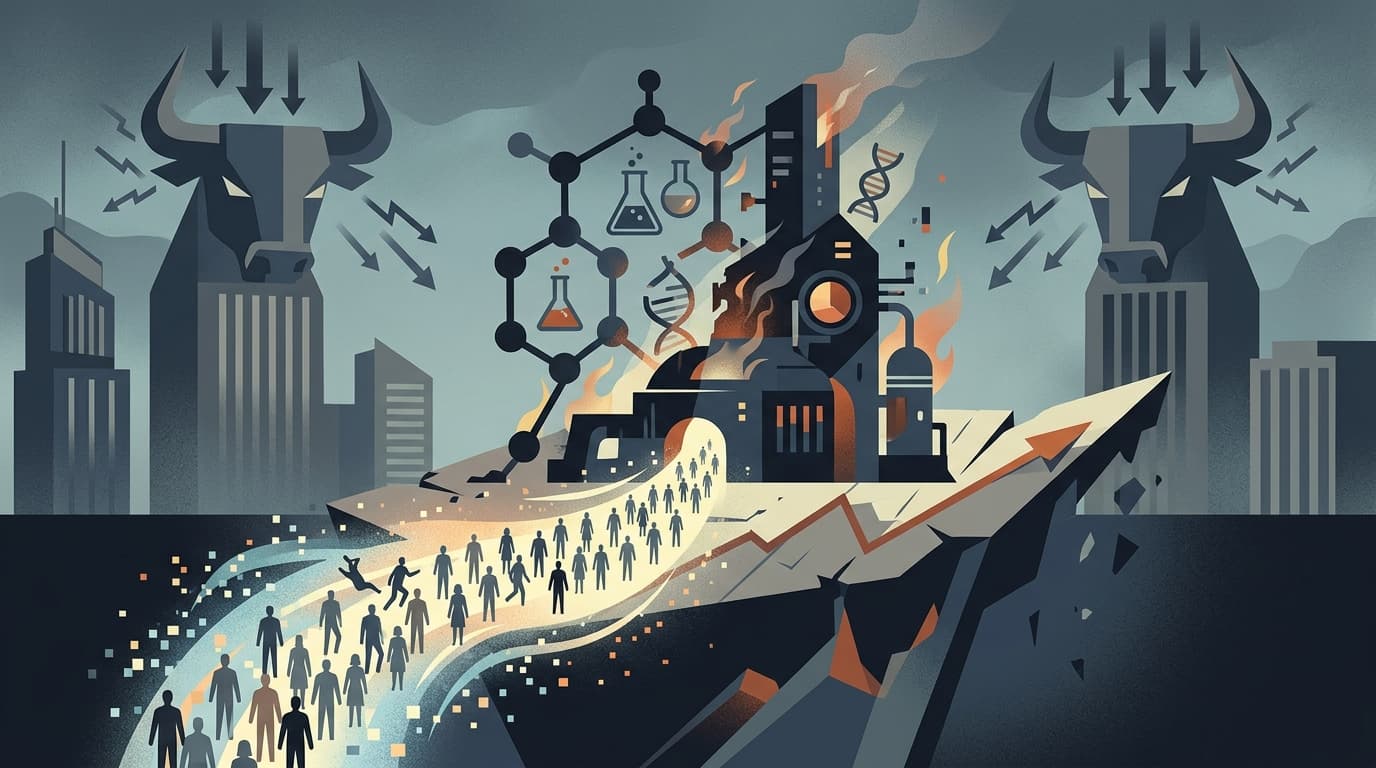
Novo Nordisk rolled into London last week for its Capital Markets Day with a shiny new strategy, a promise to launch more than five blockbuster drugs, and plans to slash roughly 4,000 additional jobs. The goal was to win back investors who've watched the Danish pharma giant lose ground to Eli Lilly in the biggest drug market of the decade. Instead, shares fell as much as 7.7% in Copenhagen trading. The message from Wall Street was blunt: show us more.
The Kingdom That Semaglutide Built (and Lilly Is Raiding)
To understand why Novo just overhauled its entire playbook, you need to understand the scoreboard. And the scoreboard is ugly.
Novo Nordisk built a dynasty on semaglutide, the molecule behind Ozempic, Wegovy, and Rybelsus. For years, it was the undisputed king of GLP-1 drugs (the class of medicines that help control blood sugar and, famously, melt body fat). Then Eli Lilly showed up with tirzepatide, sold as Mounjaro and Zepbound, and started eating Novo's lunch.
By Q2 2026, Lilly controlled roughly 60.9% of the U.S. obesity and diabetes drug market. Novo held just 38.8%. Think of it like a pickup basketball game where you used to own the court, and now the other guy is scoring on you at will. Novo's quarterly diabetes and obesity sales came in around $9.16 billion; Lilly's overall quarterly revenue hit a staggering $22.97 billion, with obesity and diabetes drugs making up nearly two-thirds of that total.
Novo isn't broke. Far from it. But the momentum has clearly shifted, and investors can smell it.
The Grand Plan: Five Blockbusters, 60 Million Patients, One Rebrand
So what exactly did Novo promise in London? A lot, actually. The problem is that investors wanted even more.
The company laid out a 2026–2030 roadmap with some genuinely ambitious targets. It wants to launch more than five multi-blockbuster drugs by 2030 and generate over DKK 150 billion (roughly $23 billion) in risk-adjusted pipeline sales by 2035. It's building at least five Phase 3 programs in obesity and diabetes, plus another five in entirely new therapeutic areas. And it's targeting by the end of the decade.
Get tomorrow's biotech intelligence before your competitors.
Join thousands of biotech professionals who start their day with our free, daily briefing.
60 million patients globally
Perhaps the most interesting move is the company's pivot toward selling drugs more like consumer products. Novo is leaning hard into direct-to-consumer channels, with self-pay and cash purchases now accounting for approximately 30–35% of Wegovy's injectable prescriptions. For the Wegovy pill specifically, a whopping 90% of demand comes from direct cash purchases. The company has been offering prices as low as $149 to $299 per month through self-pay programs, and it's pushing distribution through more than 70,000 U.S. pharmacies and select telehealth providers.
The company is even rebranding itself simply as "Novo" and talking about a "Novo Way" culture. It's a play straight out of the consumer tech handbook: if you can't beat your competitor on molecule alone, beat them on access, branding, and convenience. Think of it as the Netflix strategy for pharmaceuticals: get the product in front of as many eyeballs (or stomachs) as possible, as frictionlessly as possible.
13,000 People Out the Door
Behind the glossy strategy slides, there's a human cost that's hard to ignore.
Novo announced 9,000 job cuts as part of a broader restructuring, and by 2026 the cumulative reductions had swelled to roughly 13,000 departures. About 5,000 of those jobs are in Denmark; the remaining 4,000-plus are spread across global operations.
The cuts are concentrated in middle management, back-office functions, and headquarters support roles. The company didn't name specific divisions publicly, but the pattern is clear: Novo is trying to strip away organizational fat so it can pour resources into its diabetes and obesity businesses.
The savings target? DKK 8 billion in annualized cost reductions (approximately $1.25 billion) by the end of 2026, with roughly the same amount expected in one-time restructuring charges. In corporate-restructuring math, that's essentially paying a dollar now to save a dollar every year going forward. Whether that trade-off actually accelerates growth is the billion-dollar question.
The Pipeline: Can These Drugs Actually Compete?
Novo's post-semaglutide pipeline is where the real drama lives. Two drugs in particular will determine whether this company can claw back market share or keep watching Lilly pull away.
CagriSema is the nearest-term bet. It combines cagrilintide (an amylin analog) with semaglutide, essentially stacking two weight-loss mechanisms into one injection. The pivotal Phase 3 program for obesity is complete, and the FDA decision on the weight management application is expected in Q4 2026. In a late-stage diabetes trial, CagriSema produced an estimated 12.4% average weight loss, which is solid but not the kind of jaw-dropping number that gets investors off their seats.
Then there's amycretin, which might be the more exciting long-term play. It's a GLP-1/amylin co-agonist (meaning it hits two biological targets at once) available in both oral and injectable forms. Early data showed the oral version delivering 13% weight loss at just 12 weeks, while the subcutaneous version produced 24.3% at 36 weeks. Those are the kinds of numbers that make obesity researchers sit up straight. Phase 3 trials are being initiated, but it'll be a while before this one reaches the market.
Beyond those two headliners, Novo has cagrilintide as a standalone obesity candidate heading into Phase 3, plus zenagamtide in the AMAZE and AMBITION Phase 3 programs for obesity and diabetes. There are also earlier-stage, non-incretin programs acquired from Kallyope, but those are still years from maturity.
The pipeline isn't empty. The question is whether any of these drugs can match or beat tirzepatide's efficacy data. Because in the GLP-1 wars, second-best might not be good enough.
Wall Street's Verdict: "Prove It"
The investor reception was, to put it diplomatically, chilly.
BMO analyst Evan Seigerman noted that the guided 3.6% revenue growth was essentially already priced into the stock, leaving management with what he called the "burden of proof" to show they can actually execute. Union Investment's Markus Manns echoed a similar sentiment: the outlook simply didn't impress.
J.P. Morgan and Goldman Sachs both maintained Hold ratings after the event. Across 24 analysts tracked by MarketScreener, the consensus sits at Hold with an average target price around DKK 310.17. Nobody is pounding the table.
The core concern? Semaglutide's patent cliff. Analysts pressed management on whether next-generation drugs can still command premium pricing once semaglutide loses exclusivity. It's the pharma equivalent of asking a restaurant if people will still come when the celebrity chef leaves. The new menu might be great, but you have to prove it first.
The Lilly Problem Isn't Going Away
Lilly isn't just winning on market share. It's winning on narrative. LillyDirect, its patient-access platform, was already up and running before Novo launched its DTC push. Lilly's tirzepatide has been preferred in prescribing trends and head-to-head comparisons. And Lilly's growth rate is simply outpacing Novo's, quarter after quarter.
Novo's DTC strategy is a smart counter-move, but it's also a tacit admission: the company can't win on drug efficacy alone right now. By expanding access, lowering prices for self-pay patients, and pushing into telehealth, Novo is trying to compete on distribution and convenience while its pipeline catches up. It's a land grab for patients, betting that once someone starts on a Novo obesity drug, they'll stick around for the next generation.
The Bottom Line
Novo Nordisk's Capital Markets Day was supposed to be a turning point. A moment where the company could show investors it has a credible plan to fight back against Lilly and reclaim its position atop the obesity market. The strategy itself is logical: cut costs, diversify the pipeline, go direct to consumers, and bet big on next-generation drugs like amycretin.
But logic and conviction aren't the same thing. Investors wanted bold, and they got reasonable. They wanted a knockout punch, and they got a solid jab. The 7%-plus stock drop tells you everything: the market is pricing in doubt, not confidence.
Novo has the pipeline, the manufacturing scale, and the cash to pull this off. What it doesn't have, at least not yet, is proof. The CagriSema FDA decision in Q4 will be the first real test. Amycretin's Phase 3 data will be the next. Until those readouts land, Novo's grand strategy is just a PowerPoint deck with a very expensive price tag.
Clinical & Regulatory
4 min read
Sarepta's Worst Week Just Rewrote the Gene Therapy Playbook
Sarepta slapped a black box warning on its Duchenne gene therapy Elevidys and cut 36% of its workforce in one brutal announcement. The fallout raises hard questions about the commercial future of accelerated-approval gene therapies in rare disease.