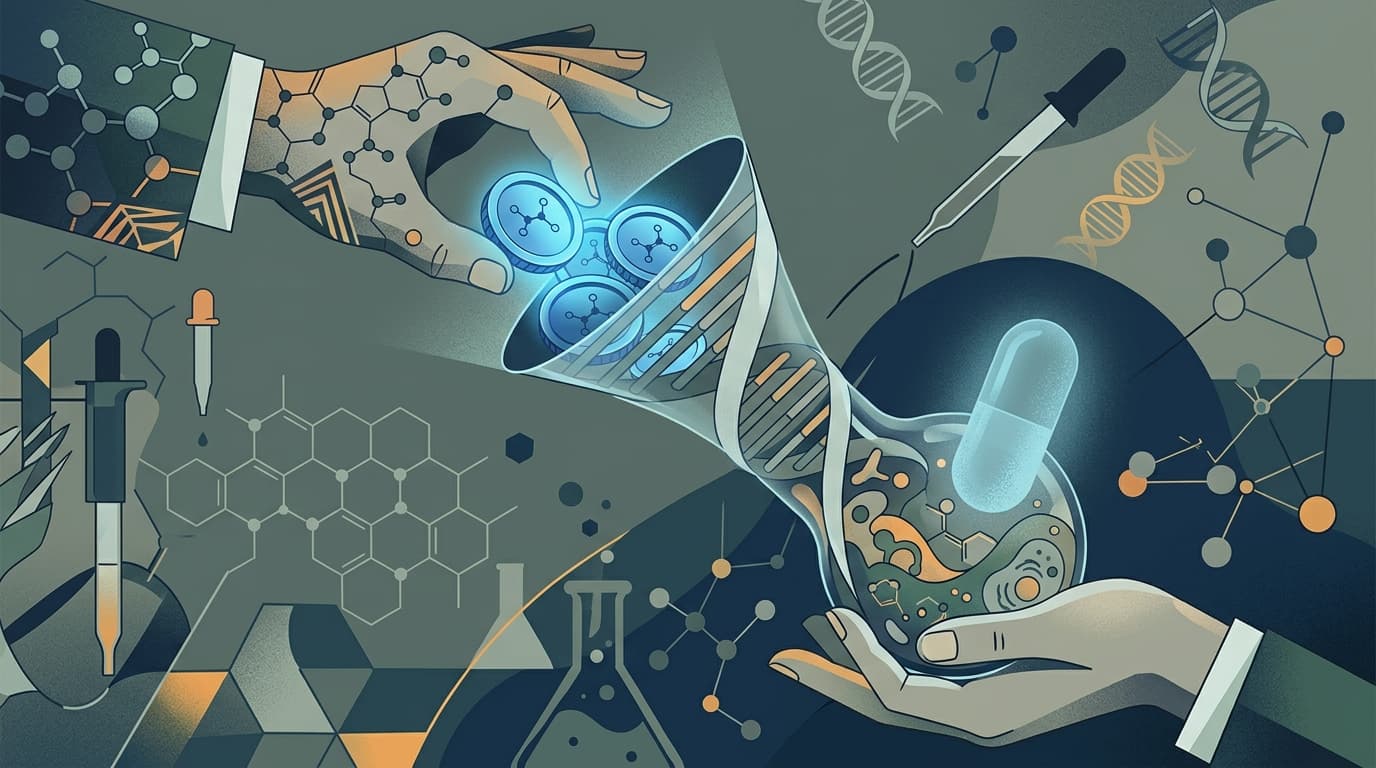

Novo Nordisk just dropped $300 million on a pill that hasn't been tested in a single human. The Hengrui deal tells you everything about how desperate the obesity drug race has become, and why oral therapies are the new battleground.
Imagine paying $300 million for a house that hasn't been built yet. No foundation poured, no blueprints approved, just a really promising plot of land. That's essentially what Novo Nordisk just did in the obesity drug race.
The Danish pharma giant announced it's paying $300 million upfront to China's Hengrui Pharma for global rights (excluding Greater China) to HRS-1596, a once-weekly oral pill that activates both GLP-1 and GIP receptors. Those are the two hormonal pathways that tell your brain you're full and your body to burn fat. The total deal could hit $2.6 billion when you stack development milestones, regulatory wins, and royalties on top.
The catch? HRS-1596 is only phase 1-ready. It hasn't been tested in a single human being yet.
So why is Novo writing nine-figure checks for a drug that's barely left the lab bench?
To understand this deal, you need to understand the battlefield. The obesity drug market is worth tens of billions, and right now it's dominated by injectable drugs: Novo's own Wegovy and Eli Lilly's Zepbound. Patients stick a needle in their belly once a week and watch the weight melt off.
But needles are a problem. Lots of people hate them. Some refuse treatment entirely because of them. And for a condition that affects hundreds of millions worldwide, that's a massive commercial limitation. The next frontier isn't a better injection; it's a pill that works just as well.
Every major player knows this, and they're all scrambling. Eli Lilly's orforglipron, an oral small-molecule GLP-1 drug, reached FDA approval in 2026, making it the front-runner. AstraZeneca's elecoglipron moved into Phase III after solid mid-stage data. Viking Therapeutics is planning a Phase 3 start for its oral candidate VK2735 in late 2026.
Novo has oral semaglutide (the Wegovy pill), which delivered about 16.6% weight loss in Phase 3 studies. It also has , a next-gen asset in Phase 3. But both are based on peptide technology, not the newer small-molecule approach that Lilly and AstraZeneca are pursuing.

BioNTech's mRNA cancer vaccine just missed its main goal in a Phase 3 head and neck cancer trial, raising tough questions about whether the technology that conquered COVID can take on tumors. With Moderna already posting a Phase 3 win in melanoma, the mRNA oncology race has a clear frontrunner.


Join thousands of biotech professionals who start their day with our free, daily briefing.

In other words, Novo has a decent hand. But the table is getting crowded, and its competitors are playing cards it doesn't hold yet.
Hengrui isn't some unknown startup. It's one of China's largest pharmaceutical companies, and it's been building a serious metabolic disease portfolio. The company already has human data on a related oral GLP-1/GIP dual agonist called ribupatide, which showed up to 12.1% mean weight loss at 26 weeks in a Phase 2 obesity trial in China. For context, that puts it in competitive territory with several major branded drugs on the market.
HRS-1596 is a different molecule, a once-weekly oral version rather than the once-daily ribupatide. Weekly dosing would be a meaningful convenience upgrade; think about how much easier it is to remember one pill on Sunday versus one pill every morning. If HRS-1596's clinical data even comes close to ribupatide's, Novo would have something genuinely differentiated in its arsenal.
The deal also reflects a broader licensing boom. Chinese biotechs signed roughly $136 billion in cross-border out-licensing deals in 2025 across about 157 transactions. And 2026 is running even hotter: by mid-February, 38 deals had already been announced with average deal sizes up 76% from the prior year. AstraZeneca's blockbuster deal with CSPC, worth up to $18.5 billion for eight weight-loss and diabetes programs, set the tone. Novo's Hengrui deal is part of the same wave.
China isn't just a manufacturing hub anymore. It's becoming a genuine source of competitive pipeline assets, and global pharma is willing to pay up for access.
Let's be honest about what $300 million buys you at the phase 1 stage: optionality.
Novo isn't buying a product. It's buying the right to be first in line if HRS-1596 works. Clinical development will take years. The drug still needs to prove it's safe, effective, and better (or at least different enough) than what's already on the market. Plenty of promising preclinical assets never make it through that gauntlet.
But from Novo's perspective, the math makes sense. If you're defending a franchise worth billions annually, spending $300 million to lock up a potentially differentiated oral asset is insurance, not recklessness. The deal still needs U.S. antitrust clearance and other closing conditions, with Novo expecting it to wrap in Q4 2026.
The strategic logic is essentially layered defense. Oral semaglutide covers the near term. Oral amycretin covers the mid-term. And HRS-1596, if it works, could be the long-term play that keeps Novo competitive into the 2030s when today's blockbusters face generic and biosimilar pressure.
This deal tells you two things about where obesity treatment is headed.
First, oral is the future. Every major pharma company is investing heavily in pills over injections. The convenience factor isn't a nice-to-have; it's going to determine who wins the next decade of the obesity market. Patients who won't use a needle will happily swallow a pill, and that's a massive untapped population.
Second, the GLP-1 gold rush is forcing companies to shop globally. Novo didn't find HRS-1596 in its own labs. It found it in Jiangsu, China. Lilly didn't build its oral lead internally either (orforglipron came from a small-molecule chemistry program that drew on external innovation). When the stakes are this high, nobody cares where the drug was invented. They care whether it works.
For Novo shareholders, the $300 million upfront is a rounding error on the company's balance sheet. The real question is whether HRS-1596 can deliver clinical data strong enough to justify the remaining $2.3 billion in milestones. That answer is probably three to four years away.
Until then, Novo has done what any smart player does in a high-stakes poker game: paid to see the next card.
BMS's admilparant just became the first LPA1 antagonist to hit a Phase 3 endpoint in IPF, validating a brand-new mechanism for a brutal lung disease. But a high-dose miss and a patient death are complicating what should have been a clean win.