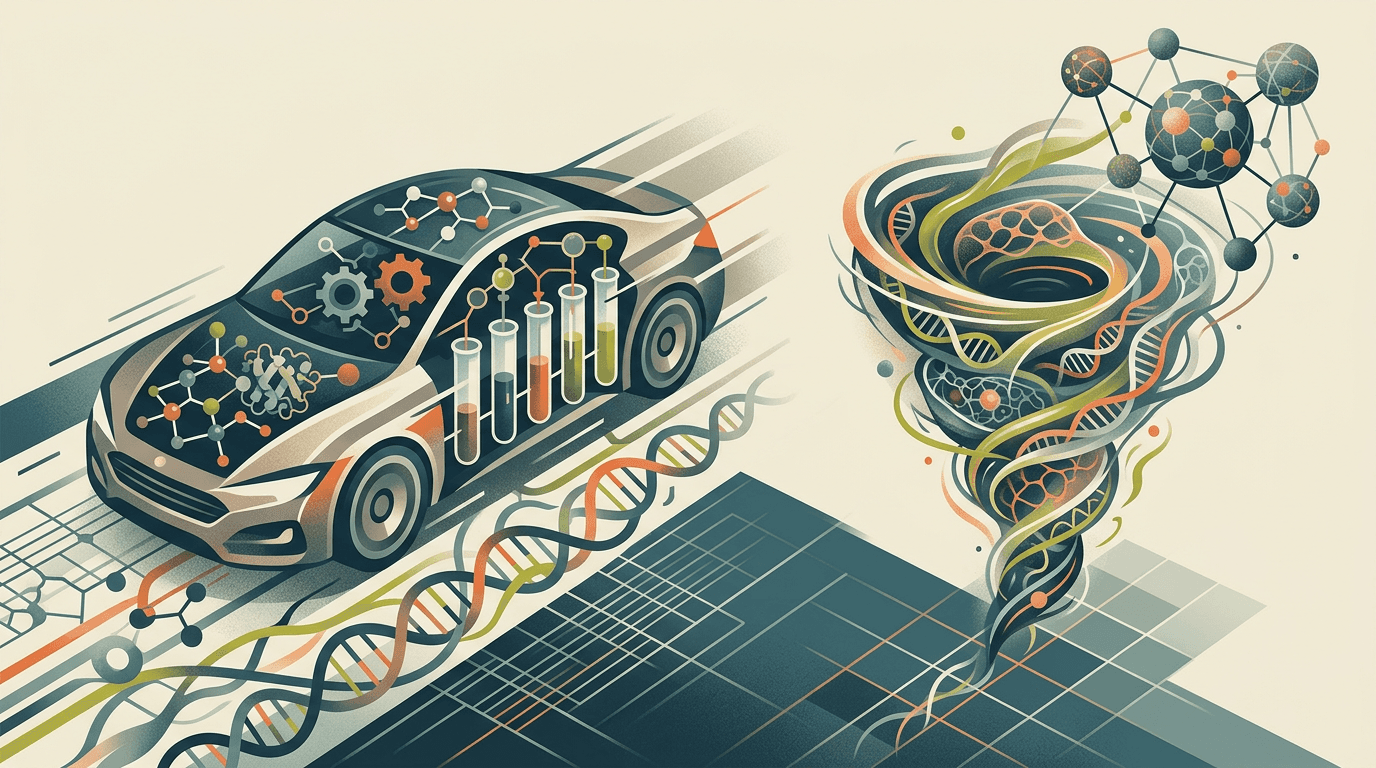

Novartis spent years perfecting T-Charge, a platform that compresses CAR-T manufacturing from weeks to under two days. But five major pharma companies just spent billions buying technology that could skip the factory entirely. The race between faster manufacturing and no manufacturing at all is the biggest bet in cell therapy.
CAR-T therapy is one of the most powerful cancer treatments ever invented. It's also one of the most logistically painful. Doctors pull a patient's immune cells out, ship them to a specialized factory, genetically reprogram them to hunt cancer, grow billions of copies, ship them back, and infuse them. The whole process takes four to eight weeks and costs north of $400,000.
For patients with aggressive blood cancers, those weeks can be the difference between treatment and a funeral. Novartis knows this. It built a platform called T-Charge to compress that timeline from weeks to less than two days. But while Novartis was speeding up the assembly line, a wave of competitors started asking a different question entirely: what if we just skip the factory?
That's the promise of in vivo CAR-T, and it's forcing a reckoning across the cell therapy landscape.
Think of traditional CAR-T manufacturing like baking a cake from scratch at a professional kitchen across town. You send the ingredients (the patient's T cells), wait for the chef to bake and decorate, then have it delivered back. T-Charge is Novartis saying: "What if we just did a quick mix, sent the batter home, and let it rise in your own oven?"
The platform keeps T cells in the lab for less than two days instead of the usual week-plus. During that brief window, the cells get their cancer-targeting instructions but barely expand. The real growth happens inside the patient's body. This preserves what scientists call "stemness": the cells stay young, energetic, and less prone to burning out.
The early results are genuinely impressive. In a Phase 1 trial for aggressive lymphoma (DLBCL), T-Charge's lead product, rapcabtagene autoleucel, delivered a 62% complete response rate at six months among evaluable patients at the recommended Phase 2 dose. That's on par with, or slightly better than, first-generation CAR-Ts. And it did so at doses roughly than Novartis's original CAR-T product, Kymriah.

The FDA decides on May 29 whether kids as young as four can trade mealtime insulin needles for an inhaler. If approved, Afrezza would be the first needle-free insulin ever cleared for children, and the clinical data is raising eyebrows for all the right (and a few tricky) reasons.


Join thousands of biotech professionals who start their day with our free, daily briefing.

Another T-Charge product, PHE885, targets BCMA (a protein on myeloma cells) and posted a 100% best overall response rate in the higher-dose cohorts of its Phase 1 trial, though the patient numbers were small. Novartis is also testing T-Charge in autoimmune diseases like lupus and in solid tumors through a partnership with Legend Biotech.
Now here's where it gets interesting. While Novartis refined its factory, at least four companies pushed in vivo CAR-T programs into Phase 1 clinical trials. Their pitch: inject a specially engineered delivery vehicle (a virus or a tiny fat particle called a lipid nanoparticle) directly into the patient. That vehicle finds the patient's T cells, hands them the genetic instructions, and turns them into cancer killers on the spot. No leukapheresis. No cleanroom. No FedEx.
Interius BioTherapeutics (acquired by Gilead for ~$350 million in August 2025) is testing a CD20-targeting in vivo CAR in B-cell cancers. Kelonia Therapeutics landed the first multi-center U.S. trial for a BCMA in vivo CAR-T in myeloma. EsoBiotec (scooped up by AstraZeneca for $425 million) is running its own BCMA Phase 1. And Umoja Biopharma has an early oncology program in the clinic.
Big pharma isn't watching from the sidelines. It's buying tickets to the show. AbbVie paid $2.1 billion for Capstan Therapeutics and its lipid nanoparticle platform. Lilly acquired Orna Therapeutics (circular RNA delivery) in February 2026. BMS grabbed Orbital Therapeutics for $1.5 billion. Five major acquisitions in under a year, all betting that the future of CAR-T might not involve a factory at all.
To its credit, Novartis isn't ignoring the threat. Executives have framed T-Charge and in vivo CAR-T as sequential steps on the same innovation ladder, not as competing visions. Mark Rutstein, Novartis's Global Head of Oncology Development, has acknowledged that in vivo data are "encouraging, but early," while emphasizing that T-Charge already has real clinical proof behind it.
The company's quiet hedge? A 2024 partnership with Vyriad to develop a viral vector for in vivo CD19 CAR-T delivery. It's early-stage, preclinical work, but it signals that Novartis knows it can't afford to sit this out entirely.
The strategy has been described as stepwise innovation: first-generation Kymriah, then T-Charge, then in vivo when the science matures. The implicit bet is that T-Charge buys Novartis five to seven years of competitive relevance while in vivo technologies prove themselves.
Here's the catch that keeps in vivo CAR-T from being a slam dunk. When you build CAR-T cells in a lab, you can measure them, count them, and characterize their fitness before infusing them. With in vivo delivery, the "product" is whatever happens inside the patient after injection. You're trading control for convenience.
Will in vivo-generated CAR-T cells persist long enough to prevent relapse? Will they expand to sufficient numbers in patients whose immune systems are already battered by chemotherapy? Can you avoid accidentally reprogramming the wrong cells (like tumor cells themselves)? These aren't hypothetical worries; they're active research questions with no definitive human answers yet.
There's also the regulatory puzzle. In vivo CAR-T blurs the line between gene therapy and cell therapy. Regulators will likely require up to 15 years of follow-up for integrating viral vectors, given concerns about insertional mutagenesis (the vector accidentally switching on a cancer gene). That's a long regulatory tail, even if the science works.
The honest answer: both platforms will probably coexist for a long time. Analysts project that the first in vivo CAR-T approval won't come before 2030 at the earliest, and mainstream disruption of ex vivo manufacturing is unlikely before the mid-to-late 2030s.
That gives T-Charge a meaningful runway. If Novartis can convert its promising Phase 1 and 2 data into approvals across lymphoma, myeloma, and autoimmune diseases, the platform could anchor Novartis's cell therapy business for the better part of a decade.
But the acquisitions tell a story that's hard to ignore. When five of the world's biggest pharma companies collectively spend billions buying in vivo platforms within a single year, the market is sending a signal. The factory model isn't dead, but the industry is clearly preparing for a world where it's optional.
Novartis built a faster car. It's a really good car. The question is whether the rest of the industry just broke ground on a teleporter.
A Paragon Biosciences spinout just raised $290 million to go after migraine prevention with a totally different approach. The bet: current drugs leave half of patients undertreated, and a protein called PACAP could be the missing piece.