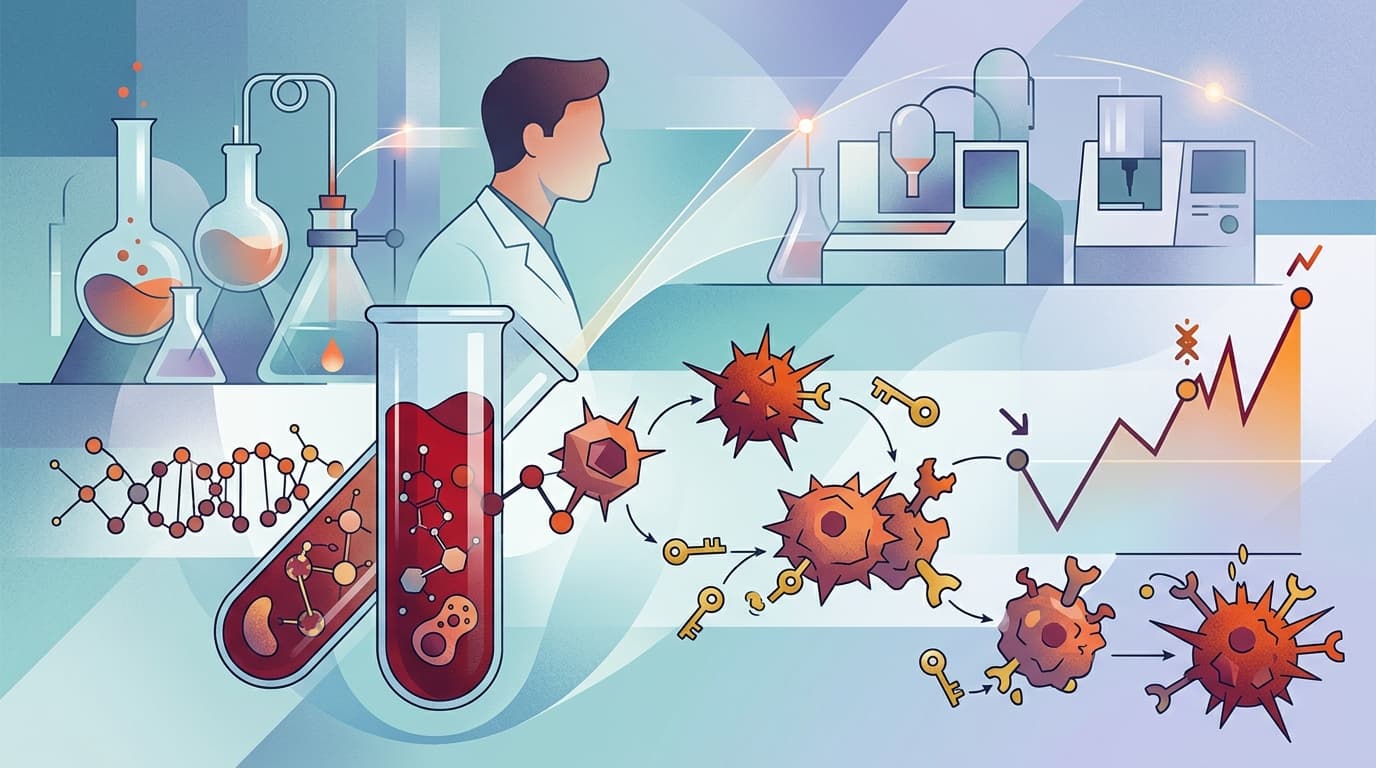

Novartis' $12 billion RNA drug acquisition just hit a wall. Del-desiran failed its Phase III trial in myotonic dystrophy type 1, torching billions in market value across the neuromuscular space and raising hard questions about the company's bet-the-farm strategy.
Imagine spending $12 billion on a house, only to find out the foundation is cracked.
That's roughly where Novartis finds itself after its RNA drug delpacibart etedesiran (mercifully nicknamed "del-desiran") failed the Phase III HARBOR study in myotonic dystrophy type 1. The stock dropped more than 10% in Swiss trading and about 13% in U.S. pre-market. And the ripple effects didn't stop there: competitors Dyne Therapeutics fell sharply, while Sarepta Therapeutics slid about 7% in sympathy.
For a trial that was supposed to validate a massive acquisition strategy, this is about as bad as it gets.
Myotonic dystrophy type 1 (DM1) is a rare genetic disorder that slowly robs patients of muscle function. It affects roughly 1 in 5,000 to 1 in 20,000 people worldwide, though many cases go undiagnosed for years. The disease doesn't just attack muscles; it hits the heart, lungs, hormones, gut, and brain. Think of it as a wrecking ball that swings through nearly every system in the body.
The current standard of care? Basically symptom management. Mexiletine can ease the muscle stiffness (called myotonia). Methylphenidate can help with the crushing daytime sleepiness. But there is no approved treatment that actually changes the course of the disease. Patients and their families have been waiting decades for something that goes after the root cause, not just the symptoms.
That's what made del-desiran so exciting. It was designed to silence the faulty RNA that drives DM1 at a molecular level, like cutting the power to a malfunctioning machine instead of just taping over the warning lights.
The HARBOR trial enrolled about 150 patients with DM1 across multiple countries. It ran for 54 weeks, randomized and placebo-controlled: the gold standard of clinical testing. The primary endpoint was something called video hand opening time (vHOT), which measures how quickly patients can open a clenched fist. It sounds simple, but for DM1 patients whose muscles lock up involuntarily, it's a meaningful gauge of daily function.

The FDA just approved a blood test that catches breast cancer outsmarting its own treatment, months before a scan would. Paired with AstraZeneca's new drug camizestrant, it could reshape how oncologists fight treatment resistance in real time.


Join thousands of biotech professionals who start their day with our free, daily briefing.
Del-desiran missed that endpoint. The drug didn't beat placebo on hand opening time.
Novartis tried to cushion the blow, noting "evidence of clinical activity" in secondary endpoints and exploratory analyses. Translation: the drug may have done something, but not the thing the trial was designed to prove. In drug development, that's like acing extra credit but failing the final exam. It doesn't get you a passing grade.
The company says it's reviewing the full dataset and plans to discuss next steps with regulators. That's standard language, but it's hard to spin a Phase III miss into a path forward without significant new data or a redesigned study.
This is where the story gets really uncomfortable for Novartis.
Del-desiran wasn't some small internal bet. Novartis acquired the drug by buying Avidity Biosciences outright in a deal announced in October 2025 and closed in February 2026. The price tag: $72 per share, valuing Avidity at roughly $12 billion on a fully diluted basis (about $11 billion enterprise value).
The acquisition wasn't just about del-desiran, to be fair. Novartis picked up Avidity's entire antibody oligonucleotide conjugate (AOC) platform, which is essentially a delivery system that uses antibodies to ferry RNA drugs directly into muscle cells. Think of it as a GPS-guided missile versus a dumb bomb: the technology is supposed to get the drug exactly where it needs to go.
Along with del-desiran for DM1, Novartis gained del-brax for facioscapulohumeral muscular dystrophy. All three programs sit within the same AOC technology. Novartis had talked about launching products before 2030 and building an "industry-leading pipeline" in neuromuscular disease.
But HARBOR was the most advanced program, and it was the proof of concept for the whole thesis. UBS reportedly had peak sales estimates of up to $2 billion for del-desiran before the miss. Some analyst firms have already stripped those forecasts from their models entirely.
When a high-profile trial fails, it doesn't just hurt the sponsor. It sends shockwaves through every company working on a similar approach, like one restaurant getting a health violation and suddenly the whole block loses foot traffic.
Jefferies acknowledged the miss could "negatively impact the space" but maintained a Buy rating on Dyne Therapeutics, calling it the frontrunner in DM1 with its own clinical candidate, DYNE-101 (Z-basivarsen), which had already advanced into a Phase 3 trial. Stifel took a gloomier view, noting that many investors had assumed HARBOR would succeed. Analysts also warned that Sarepta's own DM1 program, SRP-1003 (currently in Phase 1/2), could face a higher bar going forward.
The competitive landscape in DM1 is actually surprisingly crowded for a rare disease. Vertex has VX-670 in a Phase I/II trial. Dyne and Sarepta are both advancing programs. Each uses a different delivery strategy or chemistry, which means a failure for one approach doesn't necessarily doom the others. But investor confidence is fragile, and HARBOR's miss has clearly spooked the market.
Novartis has spent the last two years building an RNA therapeutics empire through acquisitions. It bought Kate Therapeutics in 2024 for preclinical neuromuscular gene therapy. It made RNAi licensing deals with Argo Biopharma for cardiovascular programs. And then it went all-in with the Avidity purchase, framing the deal as the cornerstone of a broader "xRNA" strategy across rare disease.
The HARBOR failure doesn't kill that strategy outright. Novartis still has two other late-stage AOC programs, and the delivery platform itself could prove valuable in other indications. But this was supposed to be the flagship readout, the one that showed Wall Street the $12 billion was money well spent.
Instead, it showed something much less reassuring: that even the most promising science, backed by billions in capital, can fall flat when it meets the unforgiving reality of a Phase III trial.
For DM1 patients who've been waiting decades for a real treatment, the wait continues. For Novartis shareholders watching billions in value evaporate, the questions are just beginning.
Roivant's inhaled lung drug just posted Phase 2 data strong enough to send the stock up 20% in a day. One analyst thinks it could be a $10 billion-a-year drug. Here's why the numbers have Wall Street losing its mind.