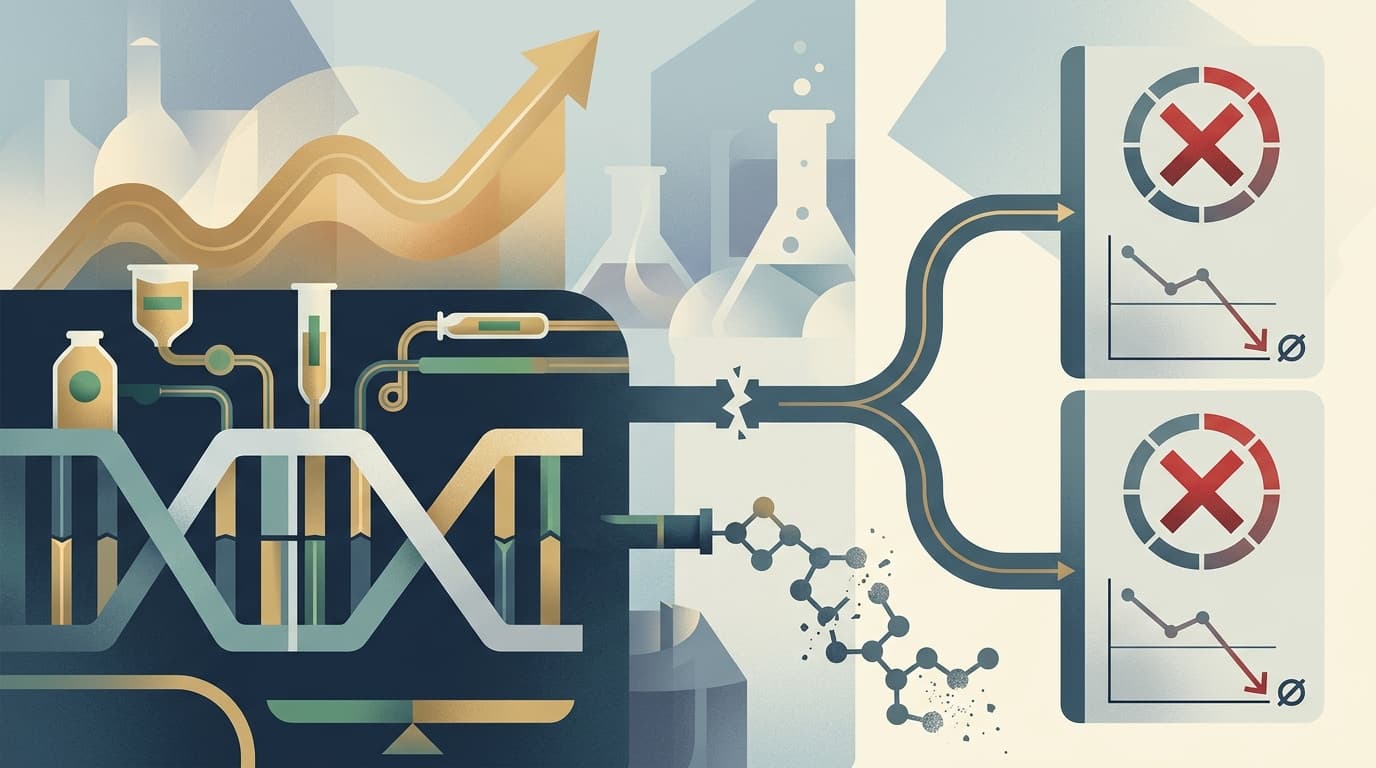
Novartis Paid $12 Billion for a Platform. Now It's 0-for-2.
Novartis's $12 billion acquisition of Avidity Biosciences was supposed to unlock a revolutionary drug platform. Two clinical trial failures later, analysts are questioning the deal, the technology, and the future of pharma's acquisition playbook.
Imagine buying a house for $12 billion, only to discover the foundation has cracks. Then imagine finding more cracks a few months later. That's roughly where Novartis finds itself after its second clinical trial failure tied to the Avidity Biosciences acquisition, and Wall Street is starting to wonder whether the whole structure is sound.
The $12 Billion Bet That Keeps Missing
In October 2025, Novartis announced it would acquire Avidity Biosciences for $72 per share in cash, valuing the company at roughly $12 billion. The deal represented a 46% premium over Avidity's closing price, which is the kind of number that signals supreme confidence. Novartis wasn't just buying a drug. It was buying a platform: Avidity's antibody-oligonucleotide conjugate (AOC) technology, a system designed to hitch RNA-based medicines onto antibodies so they can reach muscles that other drugs can't.
Think of it like a GPS-guided delivery truck. The antibody knows exactly where to go; the oligonucleotide payload knows exactly what to do once it arrives. In theory, it's elegant. In practice, it keeps crashing before it reaches the destination.
The centerpiece of the deal was del-desiran (also known by its tongue-twisting full name, delpacibart etedesiran), a drug targeting myotonic dystrophy type 1 (DM1). DM1 is a progressive muscle-wasting disorder with zero approved treatments, which made it both a huge unmet need and a huge commercial opportunity. Del-desiran was supposed to be the proof that Avidity's platform could deliver.
It didn't.
Strike One: The HARBOR Trial Misses the Mark
The first blow came when del-desiran failed its Phase 3 HARBOR trial. The study enrolled roughly 150 to 160 patients and ran for 54 weeks, testing whether the drug could improve something called "video hand opening time" (vHOT), essentially a standardized measure of how well patients could open and close their hands. For people with DM1, whose grip slowly freezes up over time, this is a meaningful metric.
Get tomorrow's biotech intelligence before your competitors.
Join thousands of biotech professionals who start their day with our free, daily briefing.
But del-desiran didn't beat placebo on that primary endpoint. The drug wasn't statistically better than a sugar pill at improving hand function. Novartis pointed to some encouraging signals in secondary and exploratory measures, the kind of consolation prize that drug companies love to highlight when the main result disappoints. The company said it would review the full dataset and talk to regulators about next steps.
That was bad enough on its own. A Phase 3 miss in the lead program of a $12 billion acquisition is the kind of thing that makes investor relations teams earn their salaries. But what happened next turned a setback into a pattern.
Strike Two: Same Platform, Same Problem
The second failure, flagged by Endpoints News as one of the most consequential negative pharma developments of the period, hit in September 2026. And it wasn't a different drug from the Avidity portfolio stumbling in a different disease. This was another miss from the same acquired pipeline, reinforcing the worry that the problem isn't just one unlucky trial. It might be the platform itself.
When one drug fails one trial, you can chalk it up to bad luck, a flawed endpoint, or patient selection issues. When an acquired platform delivers two failures in sequence, the conversation shifts. People stop asking "what went wrong with this trial?" and start asking "what's wrong with this technology?"
That's a much scarier question when you've already written the $12 billion check.
How AOCs Were Supposed to Change Everything
To understand why this matters beyond Novartis, you need to understand why the AOC platform was so exciting in the first place.
RNA-based therapies have a delivery problem. They work beautifully in the liver because the liver is basically a biological sponge that absorbs everything. But getting RNA therapeutics to muscles, the brain, or other tissues has been one of biotech's great unsolved puzzles. Avidity's AOC technology was supposed to be the skeleton key. By conjugating (fancy word for "attaching") oligonucleotide drugs to antibodies that home in on muscle tissue, the company claimed it had cracked extra-hepatic delivery: getting RNA drugs to work outside the liver.
Avidity wasn't just running one experiment. It had three clinical programs in rare muscle diseases: DM1, facioscapulohumeral muscular dystrophy (FSHD), and Duchenne muscular dystrophy (DMD). It described its work as the "first-ever successful targeted delivery of RNA into muscle," a bold claim that attracted not just Novartis but the attention of the entire pharma industry.
Competitors like Dyne Therapeutics are building their own versions of antibody-oligonucleotide conjugates, each with slightly different chemistry and targeting strategies. The whole field was riding a wave of optimism that AOCs could do for muscle diseases what mRNA did for vaccines: unlock an entirely new category of medicine.
Novartis's repeated failures don't just dent its own portfolio. They cast a shadow over every company in this space.
Wall Street's Patience Has a Limit
The analyst reactions tell you everything about the mood. Vontobel's Stefan Schneider said the setback "has not helped our confidence" in other therapies obtained through the Avidity deal, which is polite analyst-speak for "we're worried." He kept a hold rating on Novartis, the financial equivalent of a shrug emoji.
Jefferies' Michael Leuchten went further, saying Novartis's growth targets will now "likely be perceived as unattainable without further M&A." Read that again carefully. He's saying the market thinks Novartis needs to buy more companies to hit its numbers, right after its biggest recent purchase started falling apart. That's like telling someone whose last Tinder date was a disaster that their only option is to get back on Tinder.
Reuters' Breakingviews made the case that shareholders may now be less willing to support more large acquisitions, creating a catch-22: Novartis needs deals to grow, but its track record just made those deals harder to justify. Investors were repricing the entire pipeline.
The Due Diligence Question Nobody Wants to Ask
Every major pharma acquisition involves months of due diligence. Armies of scientists, lawyers, and consultants pore over clinical data, manufacturing processes, intellectual property, and competitive landscapes. Novartis presumably did all of this before agreeing to pay a 46% premium for Avidity.
So what did they see that made them so confident? And what did they miss?
Multiple analysts and reporters have raised questions about Novartis's due diligence in the wake of these failures. Bloomberg reported that the trial results cast doubt on the quality of the company's deal-making at a particularly vulnerable moment: Novartis is staring down what's been described as its biggest patent cliff in history. When your blockbuster drugs are about to lose exclusivity and your replacement pipeline keeps stumbling, the math gets uncomfortable fast.
The SpinCo structure of the deal adds another wrinkle. When Novartis bought Avidity, the cardiology-related programs were separated into a standalone entity called SpinCo, with Avidity shareholders receiving one SpinCo share for every ten Avidity shares. Novartis kept the neuromuscular franchise and the broader platform rights outside cardiology. In hindsight, focusing on the neuromuscular side looks like a bet that landed on the wrong number.
What This Means for the AOC Field
It would be premature to declare the entire AOC concept dead. Plenty of groundbreaking technologies stumbled before they succeeded; the history of gene therapy is littered with failures that preceded eventual triumphs. And Avidity's competitors, particularly Dyne Therapeutics, are pursuing their own clinical programs with different approaches to the same fundamental challenge of getting RNA drugs into muscle.
But the narrative has undeniably shifted. Before the Novartis failures, the AOC field was in its "proof of concept moving toward validation" phase, with big pharma interest confirming the technology's potential. Now it's back in the "prove it" phase, where every data readout will face heightened skepticism.
For other pharma companies considering similar platform acquisitions, the lesson is stark. Buying a platform technology is fundamentally different from buying a late-stage drug with clean Phase 3 data. Platforms are bets on a principle, not a product. When the principle works, you get a pipeline factory. When it doesn't, you get a very expensive lesson in humility.
The Bigger Picture
Novartis isn't going anywhere. It's still one of the largest pharmaceutical companies on earth, with a diversified portfolio that extends far beyond one acquired platform. But the Avidity saga will follow the company for years, shaping how investors evaluate its next big deal and how the market prices platform-based acquisitions across the industry.
The pharma world runs on acquisitions. Companies like Novartis, Pfizer, and Roche regularly spend billions to buy what they can't build internally. Most of the time, it works well enough that nobody questions the model. But every so often, a deal goes sideways in a way that makes the whole industry pause and recalibrate.
Novartis just provided that moment. And at $12 billion, it's a pause that reverberates.
Deals & M&A4 min read
Novartis Just Paid Up to $900M for a Drug That Doesn't Exist Yet
Novartis just committed up to $900 million for a preclinical radioligand therapy from China's Boomray Pharmaceuticals, and nobody even knows what the drug targets. With Big Pharma's radioligand arms race heating up and geopolitical tensions simmering, this mystery deal says a lot about where oncology is headed.