The Nobel Prize Just Went to Scientists Who Learned to Control the Brain With Light
Three scientists just won the Nobel Prize for figuring out how to control brain cells with light, a technique born from studying pond algae. The technology is already in late-stage clinical trials for blindness and reshaping how we understand Alzheimer's.
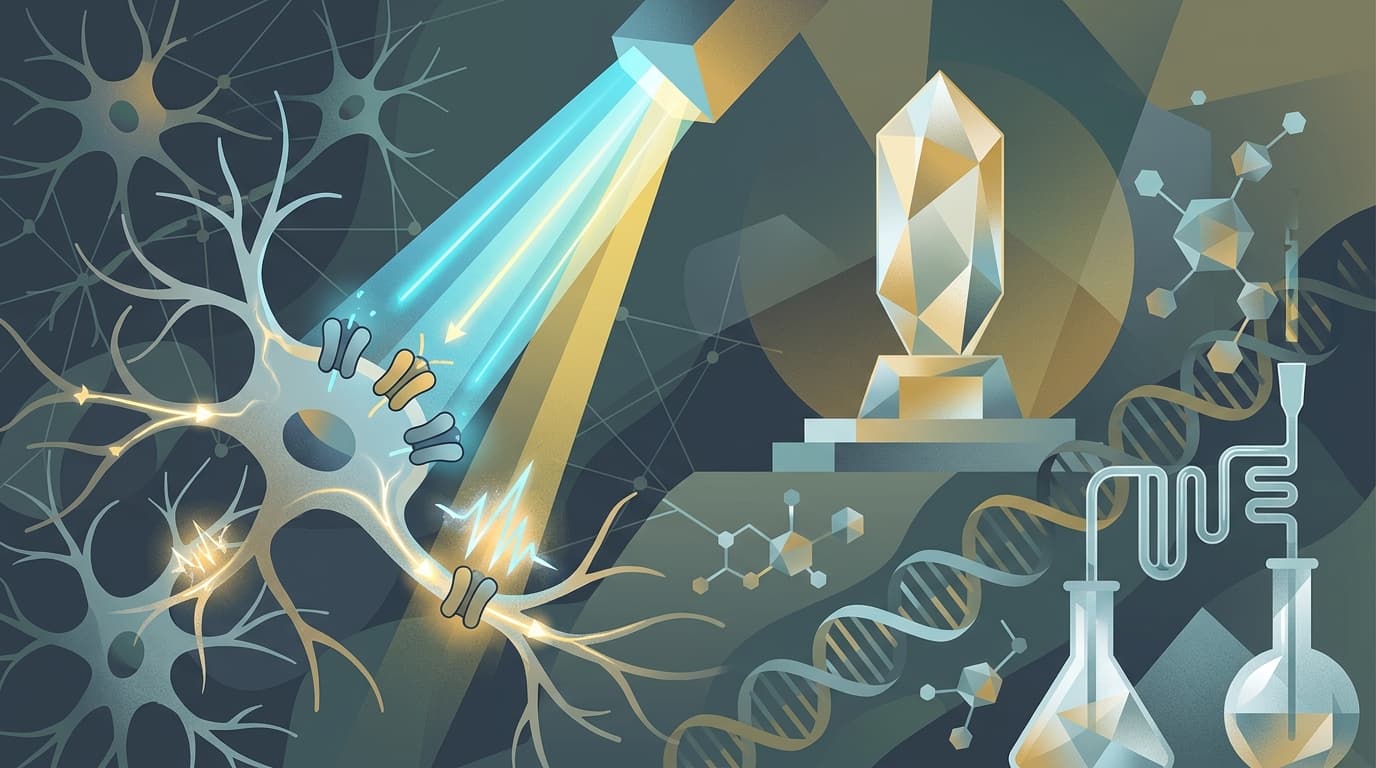
Imagine flipping a light switch and turning a single brain cell on or off. Not a metaphor. Not a thought experiment. An actual beam of light, controlling an actual neuron, in a living brain.
That's optogenetics. And it just won the Nobel Prize.
From Algae to the Nobel Stage
The 2026 Nobel Prize in Physiology or Medicine was awarded jointly to Karl Deisseroth (Stanford/HHMI), Peter Hegemann (Humboldt University of Berlin), and Georg Nagel (University of Würzburg) for their discoveries concerning light-gated ion channels and optogenetics. The Nobel Assembly at Karolinska Institutet said the prize recognizes work that made it possible to control individual nerve cells in a living brain using light.
The origin story is wonderfully weird. It starts with pond scum.
In 2002 and 2003, Hegemann and Nagel identified a protein called channelrhodopsin in Chlamydomonas, a tiny green alga. This protein acts like a miniature gate on the cell's surface: when light hits it, the gate swings open and ions rush through. In algae, this helps the organism swim toward light. Nobody was thinking about brains yet.
Then Deisseroth's lab at Stanford had an idea. What if you could put that algal protein into a neuron? In 2005, his team (including collaborator Ed Boyden) published the landmark paper showing that channelrhodopsin-2 could drive neurons to fire using pulses of light. By 2006, Deisseroth had coined the term "optogenetics" to describe this fusion of optics and genetics.
Think of it like this: neuroscientists used to study the brain the way you'd study traffic by looking at satellite photos. You could see congestion, but you couldn't tell which cars were causing it. Optogenetics gave them the ability to pull over one specific car and watch what happens to the whole highway.
Neuroscientist Patrick Forcelli captured it perfectly, saying the technique took neuroscience "from a 'Rand McNally' road atlas ... to something more akin to 'Google Earth.'"
Get tomorrow's biotech intelligence before your competitors.
Join thousands of biotech professionals who start their day with our free, daily briefing.
Nobel Committee chair Per Svenningsson said optogenetics offers "opportunities for mapping the brain in a way that we could once only dream of." Committee member Abdel El Manira noted the technology has moved beyond healthy brains to reveal how circuits go haywire in blindness, depression, addiction, and dementia.
But perhaps the most telling quote came from Anna Wedell, who called it "a new era in neuroscience" while emphasizing it is "only the beginning." That phrase, "only the beginning," is doing a lot of heavy lifting. Because while optogenetics has been a revolutionary lab tool for two decades, turning it into medicine for actual patients is a different game entirely.
So where does that translation stand?
Restoring Sight, One Photon at a Time
The most advanced clinical applications are in ophthalmology, specifically treating inherited retinal diseases like retinitis pigmentosa (RP), where photoreceptors gradually die and vision fades to black.
The concept is elegant: if the eye's natural light-sensing cells are gone, make other retinal cells light-sensitive by giving them optogenetic proteins. It's like losing your TV antenna and rewiring the cable box to pick up the signal directly.
Nanoscope Therapeutics leads the pack. Its therapy, MCO-010, completed a randomized Phase 2b/3 trial called RESTORE in retinitis pigmentosa, reporting clinically meaningful vision improvement with no serious adverse events. Long-term follow-up data from the REMAIN extension study showed durable vision improvements lasting three years, and the company has moved into FDA review with its application. Nanoscope also holds FDA RMAT (Regenerative Medicine Advanced Therapy) designation for MCO-010 for Stargardt disease.
GenSight Biologics is running another notable program, GS030, which pairs an AAV gene therapy vector with light-amplifying goggles. The goggles are necessary because the optogenetic proteins GenSight uses need stronger light signals than natural daylight provides. GS030 was in Phase I/II clinical development with clinical-scale manufacturing scale-up in 2025.
Several smaller players are also in the mix. Ray Therapeutics has a Phase 1 trial of RTx-015 for retinitis pigmentosa and choroideremia. Restore Vision dosed its first patient in Japan in 2025. Bionic Sight and Zhongmou Therapeutics round out a growing field.
No optogenetic therapy has received regulatory approval yet, in any country. But the pipeline is deeper than it's ever been.
The Alzheimer's Connection (It's Complicated)
When the Nobel announcement mentioned Alzheimer's, it wasn't referring to an optogenetic treatment you could give a patient today. The connection is more indirect, but potentially more important.
In mouse models of Alzheimer's, researchers have used optogenetics to activate hippocampal neurons at 40 Hz, inducing a specific brain rhythm called gamma oscillations. This rhythm-based stimulation appears to modify disease-relevant network activity. Other teams have shown that optogenetically stimulating dopamine-producing neurons in the midbrain can rescue synaptic plasticity (the brain's ability to strengthen connections) in Alzheimer's mouse models.
Even astrocytes, the brain's support cells, have gotten the optogenetic treatment. Chronic light stimulation of astrocytes in lab-grown Alzheimer's tissue partially preserved neuronal networks that would otherwise degrade.
None of this is ready for a clinic. But it's producing a roadmap. A 2026 review paper described the translational strategy clearly: you don't necessarily need to implant optogenetic hardware in a patient's brain. Instead, you use optogenetics to figure out which circuits matter, then target those circuits with more practical tools like drugs, gene therapies, or noninvasive brain stimulation (think 40 Hz light or sound delivered externally).
Optogenetics, in this context, is less like a medicine and more like the world's most precise diagnostic flashlight.
A Nobel for the Long Game
The biotech industry loves to celebrate when the FDA approves something. Ribbons get cut. Press releases fly. Stock prices move.
This Nobel celebrates something quieter: a basic science discovery that began with curiosity about how algae swim toward sunlight. It took over 20 years to go from the first characterization of channelrhodopsin to the cusp of regulatory approval for a blindness treatment. The Alzheimer's applications could take another decade, or longer.
Karl Deisseroth told the Nobel committee that optogenetics is opening up "the mysteries of the brain." Peter Hegemann and Georg Nagel both expressed surprise that the award came now, tying it to the long arc of basic research.
The optogenetics market remains fragmented, with a mix of therapeutic developers and research tool companies (Thorlabs, Coherent, Bruker, and others sell the hardware that makes lab work possible). Growth forecasts extend into the 2030s, but this is still a field built more on promise than revenue.
Which is exactly the kind of story a Nobel Prize is designed to tell. The algae protein found a brain. The brain found a treatment. The treatment might, someday, find a cure. And three scientists who followed their curiosity into a pond got a phone call from Stockholm.
Sometimes the most important breakthroughs start with the smallest organisms.
Clinical & Regulatory
4 min read
The Drug That Could Rewrite How We Treat the Most Common Blood Cancer
AbbVie and Genmab's epcoritamab just delivered a 51% reduction in disease progression when added to frontline chemo for the most common aggressive lymphoma. After 30 years of the same standard of care, the first-line DLBCL playbook may finally be getting a rewrite.