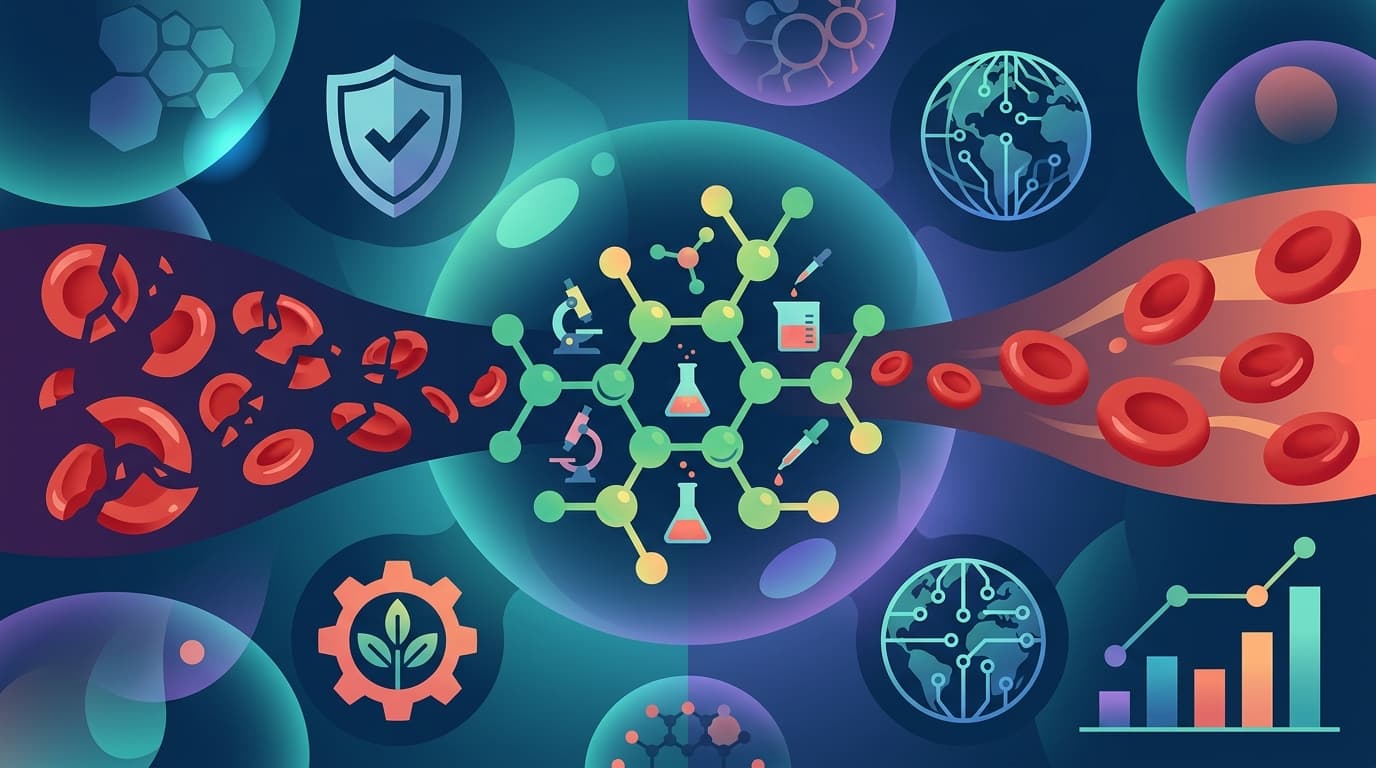

J&J's nipocalimab just nailed its Phase 2/3 trial in a blood disease with zero approved treatments. The data show rapid, durable hemoglobin responses, less fatigue, and steroid sparing — and an FDA decision could come by late 2026.
Imagine your immune system decides your red blood cells are the enemy. It starts making antibodies that tag them for destruction. Your hemoglobin drops. You're exhausted. You can barely climb a flight of stairs. And when you go to the doctor, they tell you there's no FDA-approved treatment for what you have.
That's been the reality for roughly 40,000 Americans living with warm autoimmune hemolytic anemia, or wAIHA. For decades, doctors have been managing this disease with borrowed tools: steroids that wreck your bones, rituximab that wasn't designed for this, and sometimes literally removing your spleen. All off-label. All imperfect.
Johnson & Johnson just dropped Phase 2/3 data suggesting those days might be numbered.
The drug is nipocalimab, branded as IMAAVY, and J&J's pivotal ENERGY trial hit its primary endpoint with statistical significance (p=0.015). Patients on the 30 mg/kg dose achieved durable hemoglobin responses at roughly three times the rate of those on placebo.
That's not some squishy biomarker endpoint, either. "Durable response" meant patients had to hit hemoglobin above 10 g/dL, gain at least 2 g/dL from baseline, and hold it for at least 28 days across three consecutive visits. No rescue therapy allowed. No sneaking in extra steroids. By Week 24, nearly two-thirds of patients on the drug met those hemoglobin thresholds.
The speed was striking, too. Patients saw hemoglobin climb by at least 1 g/dL within the first week. The placebo group? Flat line.
Here's what makes this data especially compelling: hemoglobin wasn't the only thing that improved.
Patients reported meaningful fatigue improvement starting at Week 2, and those gains held through Week 24. The fatigue scores (measured by a validated questionnaire called FACIT-Fatigue) weren't just riding on better hemoglobin levels; the improvements appeared somewhat independent of the blood count changes. That matters because wAIHA patients will tell you the crushing exhaustion is often worse than what the lab numbers suggest.

A genetically engineered pig kidney kept a man off dialysis for 271 days, setting a new record for xenotransplantation. Now the FDA has cleared eGenesis to try it in 30 more patients, marking the biggest bet yet that pig organs could solve the kidney shortage crisis.


Join thousands of biotech professionals who start their day with our free, daily briefing.
On the steroid front, more patients on nipocalimab were able to cut their corticosteroid doses compared to placebo. For a disease where chronic prednisone is basically the default, and where long-term steroid use brings its own parade of side effects (weight gain, bone loss, diabetes, mood swings), steroid sparing is a huge deal.
Safety looked clean. No new signals beyond what J&J already saw in myasthenia gravis. And notably, no cases of hypogammaglobulinemia, the antibody depletion that haunts broader immunosuppressive approaches.
Nipocalimab's mechanism is elegant in its simplicity. Your body has a protein called FcRn (neonatal Fc receptor) that works like a recycling plant for IgG antibodies. Normally, FcRn grabs IgG molecules inside cells before they can be broken down and sends them back into circulation. It's why antibodies last weeks in your bloodstream instead of hours.
Nipocalimab jams that recycling machinery. When FcRn can't do its job, IgG antibodies (including the rogue ones attacking your red blood cells) get routed to the cellular garbage disposal instead. Think of it like blocking the return slot at a library: the books pile up in the discard bin instead of going back on the shelf.
The drug doesn't stop your immune cells from making antibodies. It just makes sure fewer of them survive long enough to cause damage.
Nipocalimab isn't the only FcRn blocker on the market. Argenx's efgartigimod (VYVGART) has been the class leader since 2021, commanding roughly 65% of the $2.4 billion FcRn inhibitor market in 2025. UCB's rozanolixizumab (Rystiggo) holds a secondary position.
But in wAIHA specifically? The field is wide open. Neither efgartigimod nor rozanolixizumab has an approval here. No drug does. J&J is sprinting toward what would be the first-ever FDA-approved therapy for this disease, having already filed a supplemental BLA that received Priority Review from the FDA.
Combined with nipocalimab's existing approval in generalized myasthenia gravis (granted April 2025), the wAIHA filing extends what J&J calls its "pipeline in a pathway" strategy. The company is running nipocalimab through trials in multiple autoantibody-driven diseases, including gMG, wAIHA, CIDP, hemolytic disease of the fetus and newborn, Sjögren's disease, and systemic lupus erythematosus.
Each new indication adds clinical credibility, physician familiarity, and leverage in payer negotiations. It's the pharmaceutical equivalent of opening franchise locations: every new store makes the brand stronger.
Let's be honest about the numbers. wAIHA affects roughly 1 to 3 people per 100,000 each year. This is a small market. It won't single-handedly make nipocalimab a blockbuster.
But small markets with zero approved competition and orphan drug designation tend to support premium pricing. J&J already has a hematology sales force calling on the same academic centers (thanks to DARZALEX and TALVEY in multiple myeloma), so the commercial infrastructure is already in place.
Analysts at firms like Stifel and Wells Fargo have maintained bullish stances on J&J's FcRn franchise. The consensus view treats wAIHA less as a standalone revenue driver and more as a high-margin proof point that validates the broader nipocalimab platform. Every approved indication makes the next filing easier and the next payer conversation smoother.
J&J plans to present the full ENERGY dataset at EHA 2026, which should give us granular subgroup data and longer-term follow-up from the open-label extension. With Priority Review in hand, a U.S. approval decision could come as early as late 2026 or early 2027.
For the tens of thousands of wAIHA patients currently cycling through steroids, rituximab, and sometimes the surgeon's knife, the timeline can't move fast enough. After decades of borrowing treatments from other diseases, they might finally get one that was actually built for theirs.
The FDA just moved Gilead's Trodelvy from last-resort to first-choice in triple-negative breast cancer, the deadliest breast cancer subtype. It's a seismic shift for patients, a multi-billion-dollar opportunity for Gilead, and a surprisingly friendly outcome for Merck's Keytruda.