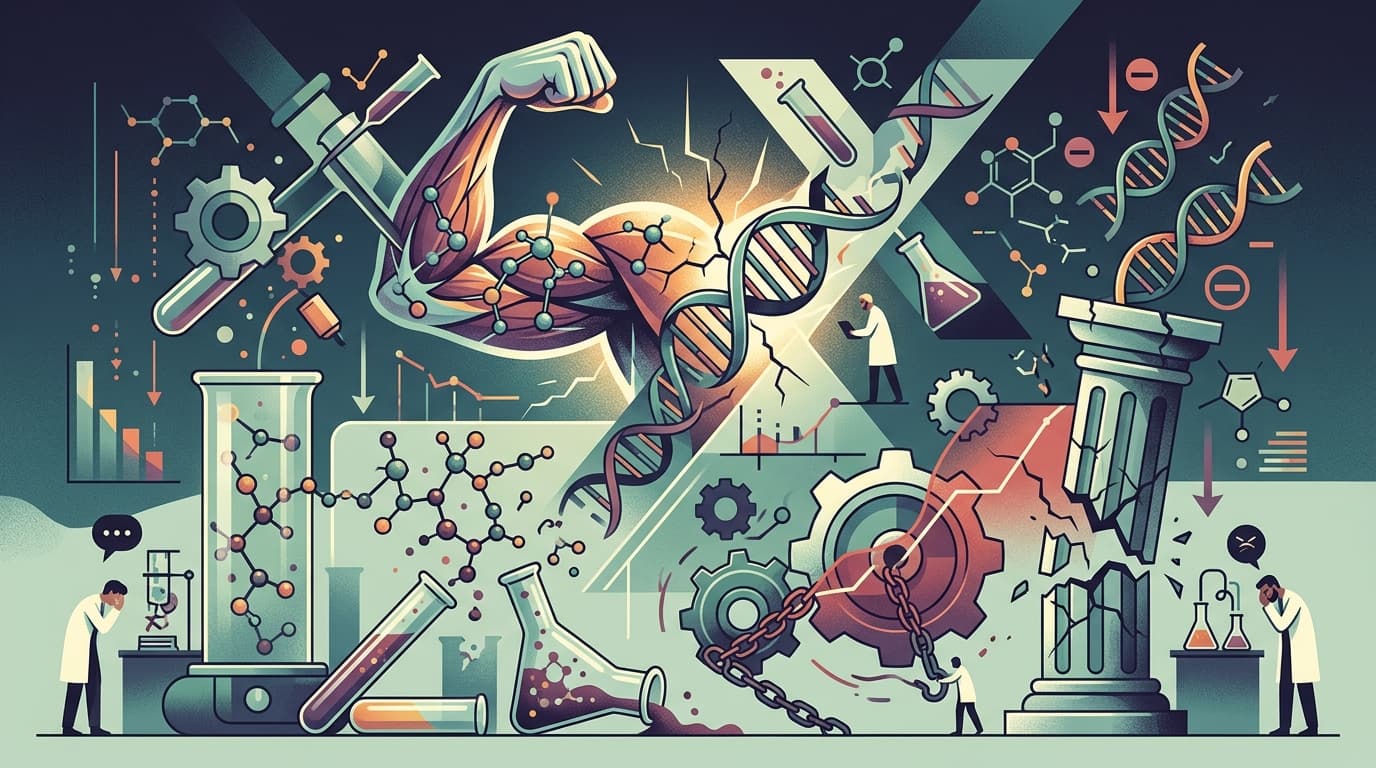

Genentech killed its anti-myostatin antibody emugrobart after Phase 2 trials in two muscle-wasting diseases came up empty. The failure extends a two-decade losing streak for the entire drug class, and it raises pointed questions about whether the obesity pivot investors are banking on will fare any better.
For decades, scientists have chased the same dream: block a protein called myostatin, and muscles will grow bigger, stronger, and more resilient. It's a beautiful idea. Myostatin is essentially the body's brake pedal for muscle growth. Remove the brake, and you'd expect the car to fly.
Except the car keeps stalling. Genentech just pulled the plug on emugrobart, its anti-myostatin antibody, after Phase 2 trials showed no consistent improvements in muscle growth or motor function in two rare muscle-wasting diseases. The company won't advance the drug into Phase 3 for spinal muscular atrophy (SMA) or facioscapulohumeral muscular dystrophy (FSHD), a condition that progressively weakens muscles in the face, shoulders, and arms.
Genentech called it a "difficult" decision. That's corporate for "we really thought this one would work."
What makes this failure sting isn't just the setback for patients. It's the pattern. Emugrobart joins a remarkably long list of myostatin inhibitors that looked incredible in the lab and then flopped in humans. This field has been failing for the better part of two decades.
Wyeth's stamulumab was first. It entered clinical trials as a monoclonal antibody for muscular dystrophy, showed a clean safety profile, then produced zero meaningful improvements in muscle strength. Development died after Phase 1/2.
Acceleron's ACE-031 made it to Phase 2 for Duchenne muscular dystrophy before being killed by serious side effects, including nosebleeds and abnormal blood vessel formations. Pfizer's domagrozumab? Two Phase 2 studies in Duchenne, both terminated for lack of efficacy. Eli Lilly's landogrozumab? It added some lean mass in elderly patients but couldn't help pancreatic cancer patients. And Roche's own taldefgropbep-α (say that three times fast) was discontinued in Duchenne after a Phase 2/3 trial showed it simply didn't work.
The scoreboard is ugly: no myostatin inhibitor has ever been approved by the FDA for any disease. Not one.

Eric Topol, one of medicine's most influential voices on AI and prevention, just signed on as an advisor at Flagship Pioneering. The move signals Flagship's deepening commitment to preemptive medicine, and it tells you a lot about where biotech's smartest money is heading.


Join thousands of biotech professionals who start their day with our free, daily briefing.

The most painful chapter belongs to bimagrumab, now owned by Eli Lilly. Back in 2013, the FDA gave it breakthrough therapy designation for sporadic inclusion body myositis (a rare muscle disease). Hope surged.
Then the larger Phase 2/3 trial arrived. No improvement in walking distance. No improvement in muscle strength. No improvement in grip. The designation that signaled promise led straight to a dead end.
A frustrating pattern has emerged across the entire drug class. Myostatin inhibitors can nudge muscle mass upward (generally less than 5%), but those gains don't translate into patients actually moving better, feeling stronger, or living more functional lives. Researchers studying progressive muscular dystrophy found that blocking myostatin increased muscle size while simultaneously reducing oxidative capacity, the muscles' ability to use energy efficiently. It's like putting a bigger engine in a car but forgetting to connect the fuel line.
So if myostatin inhibitors keep failing in muscle-wasting diseases, why is anyone still paying attention? One word: weight loss.
GLP-1 drugs like Eli Lilly's tirzepatide (Zepbound) and Novo Nordisk's semaglutide (Wegovy) are reshaping the obesity market. But they come with a dirty secret: patients lose a lot of muscle along with their fat. Estimates suggest people shed roughly 1.5 to 2.5 kilograms of muscle for every 10 kilograms of weight lost. That's a problem, especially for older patients who can't afford to lose strength.
Myostatin inhibitors could, in theory, solve this. Pair them with a GLP-1, and maybe you get the fat loss without the muscle loss. Scholar Rock's apitegromab already showed promising early results: in its Phase 2 EMBRAZE trial, combining apitegromab with Zepbound preserved 54.9% of lean mass over 24 weeks compared to Zepbound alone. Bimagrumab showed a 20.5% reduction in fat mass and a 3.6% increase in lean mass after 48 weeks in obese patients with type 2 diabetes.
Genentech itself is keeping emugrobart alive in this space. A Phase 2 trial called GYMINDA is testing the drug alongside tirzepatide. So the muscle-wasting failure doesn't necessarily mean the obesity story is dead.
But it does raise uncomfortable questions.
If emugrobart can't boost muscle in diseases where muscle loss is the primary problem, why should we expect it to preserve muscle during weight loss? The mechanisms overlap significantly. Blocking myostatin should increase muscle mass regardless of context; the fact that it consistently doesn't is the whole issue.
Competitors are watching closely. Scholar Rock is positioning apitegromab as a potential first-in-class approved myostatin inhibitor, with FDA and EMA approvals being pursued for SMA in 2026.
Regeneron's trevogrumab is also in the mix, running a Phase 2 trial (the COURAGE study) combining its myostatin antibody with semaglutide for obesity.
For Roche, this is a contained setback rather than a crisis. Emugrobart was a mid-stage program in niche neuromuscular indications; the company's SMA franchise still has Evrysdi, which remains the backbone of its rare disease portfolio. No safety issues were flagged, and Genentech plans to present full data at upcoming medical conferences.
But for the broader field of myostatin inhibition, the failure is yet another data point in a trend that's becoming hard to ignore. The biology looks perfect on paper: block the brake, muscles grow. In practice, something keeps getting lost in translation between lab mice and human patients.
The obesity pivot offers a second chance. Different patient population, different goals, different combination strategy. Maybe myostatin inhibitors will finally find their niche not as standalone therapies for muscle disease, but as sidekicks to the GLP-1 blockbusters. The GYMINDA readout will tell us a lot.
Until then, the strongest theory in muscle biology remains exactly that: a theory.
Gilead Sciences just walked away from Assembly Biosciences' hepatitis B drug, returning a Phase 1b asset and $330 million in potential milestones. With 80+ companies chasing an HBV cure and GSK's bepirovirsen hitting Phase 3 endpoints, the rejection says more about the crowded field than it does about one drug.