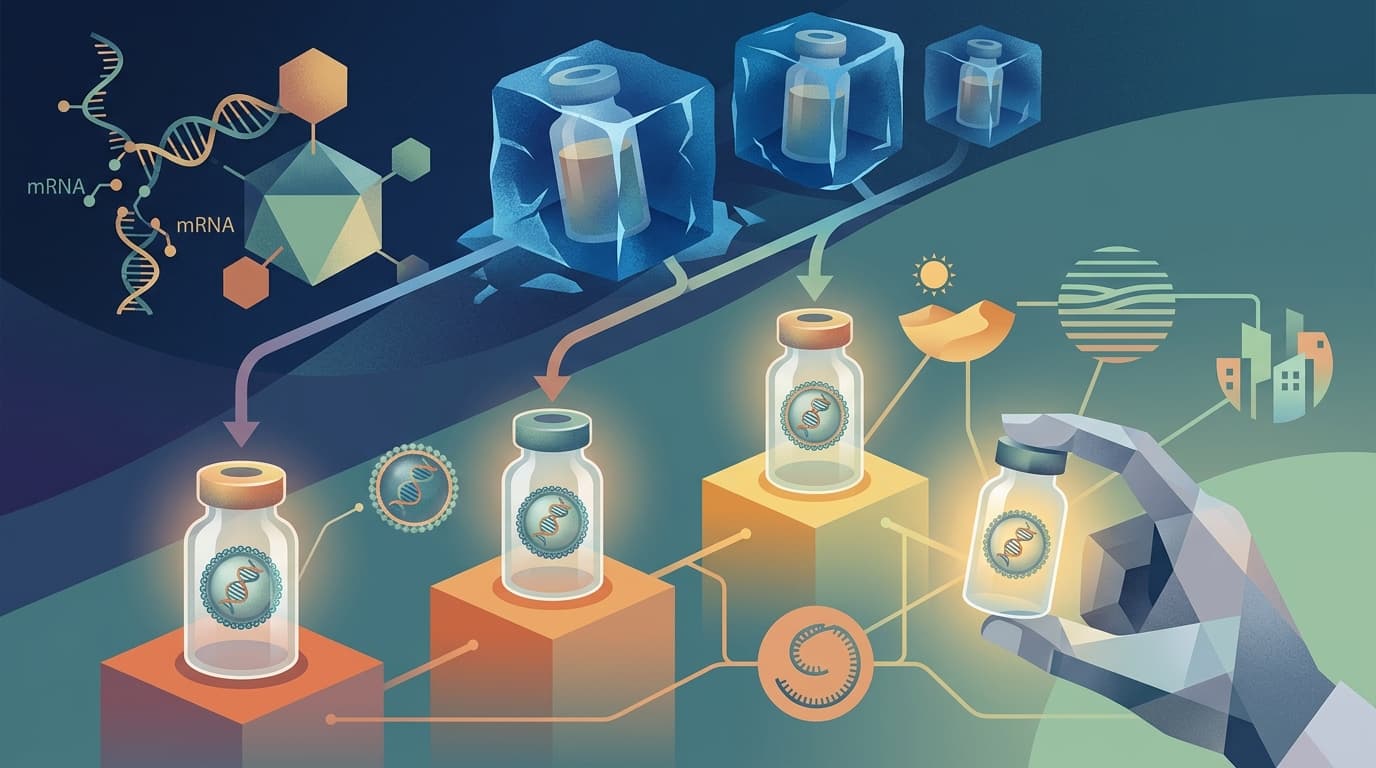

MIT researchers used an AI system to design mRNA vaccine packaging that stays stable at room temperature for a full year, no freezer required. If it works in humans, it could rewrite the rules of global vaccine distribution.
Imagine shipping ice cream across the Sahara without a cooler. That's basically what the world has been doing with mRNA vaccines since 2020.
Pfizer's COVID shot famously needed storage at around negative 70°C. Moderna's wasn't much better, requiring around negative 20°C. These temperatures aren't just inconvenient; they're deal-breakers for billions of people living in places without reliable electricity, let alone ultra-cold freezers. The cold chain (the unbroken line of refrigeration from factory to arm) is one of the most expensive, fragile links in global health.
A team led by Ana Jaklenec and Robert Langer at MIT just published a paper in Nature Biotechnology that could change all of that. Their AI-designed lipid nanoparticles kept mRNA vaccines stable at room temperature for up to a year. No freezer. No dry ice. No prayers.
Scientists have been chasing thermostable mRNA vaccines for decades. The problem isn't the mRNA itself, exactly. It's the tiny fat bubbles (lipid nanoparticles, or LNPs) that deliver it into your cells. Those bubbles are finicky. Heat degrades them; humidity wrecks them. Finding the right combination of lipids, stabilizers, and processing conditions to survive warm storage is like trying to crack a combination lock with thousands of dials.
Previous attempts made incremental progress. A Chinese candidate called ARCoV survived room temperature for about a week. Pfizer eventually extended its vaccine's fridge life to about ten weeks at standard refrigerator temps. But nobody cracked the code for long-term warm storage without sacrificing the vaccine's ability to actually work.
The MIT team took a different approach: they let an AI figure it out.
Their system, called AGENT, uses Bayesian optimization, a type of machine learning that's particularly good at finding needles in haystacks without testing every piece of hay. Instead of screening millions of possible formulations one by one, AGENT ran , each time learning from the previous batch to narrow in on the best candidates.

Kodiak Sciences failed three consecutive Phase 3 trials and was left for dead. Then its redesigned wet AMD study matched Eylea's efficacy while more than half of patients went six months between injections, nearly tripling the stock overnight.


Join thousands of biotech professionals who start their day with our free, daily briefing.
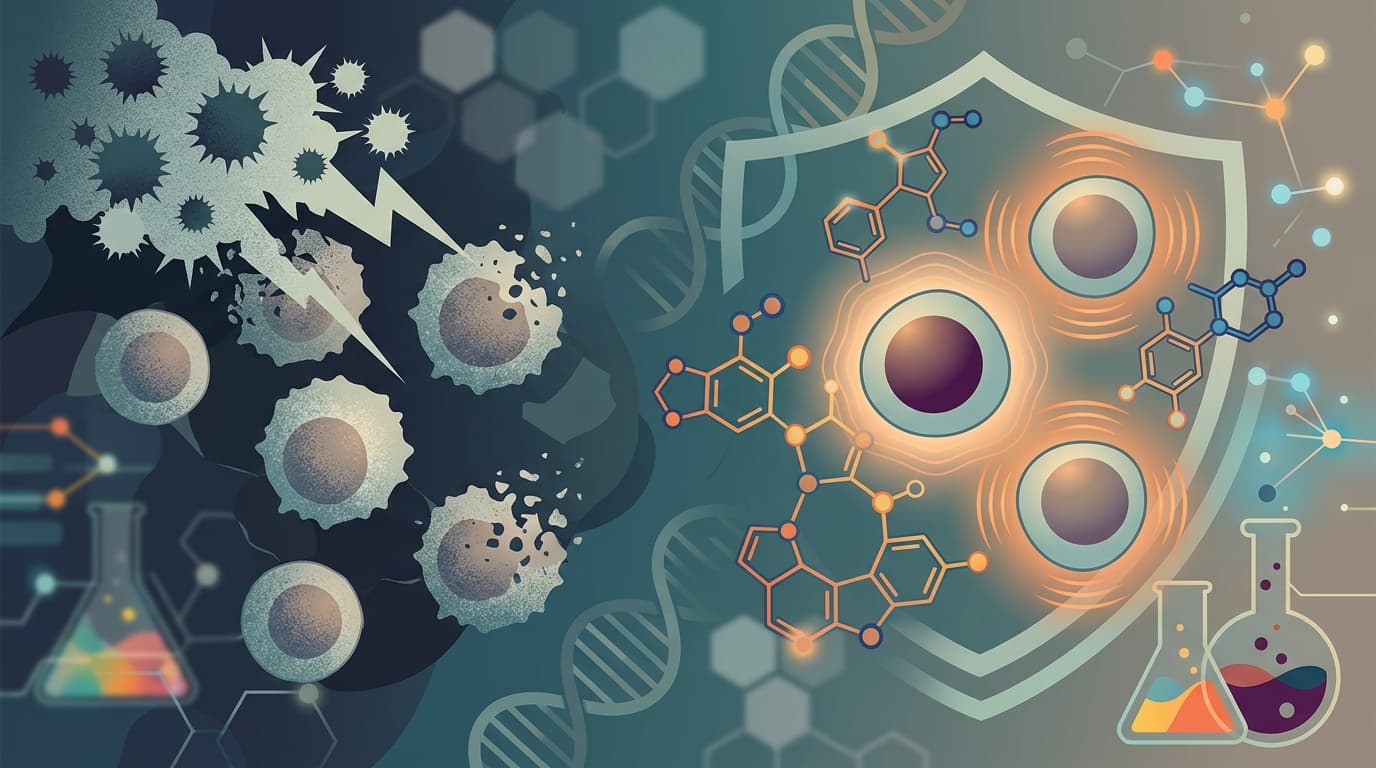
Think of it like a chef who tastes a dish, adjusts the seasoning, tastes again, and repeats. Except this chef evaluates hundreds of recipes simultaneously and never forgets what worked.
The optimized formulations survived storage at 37°C (about body temperature) for more than two months while retaining 100% bioactivity. At room temperature, they held up for a full year. For context, 37°C is roughly the average daytime temperature in parts of sub-Saharan Africa, South Asia, and the Middle East: exactly the places where cold-chain logistics fail most often.
The team tested their formulations against standard LNP systems similar to those used by Moderna (specifically the well-known lipids SM-102 and ALC-0315). And the AI-designed particles didn't just survive heat; they performed in living animals.
Mice vaccinated with the thermostable formulation generated immune responses comparable to mice given a standard, freshly prepared vaccine. Both antibody responses and T-cell responses (the two arms of adaptive immunity) were preserved. The redesigned particles weren't a consolation prize. They matched the real thing.
Let's put this in perspective. The global cold chain for vaccines costs an estimated tens of billions of dollars annually. Ultra-cold freezers are expensive and they need constant power. In rural clinics across low-income countries, a single power outage can spoil an entire shipment.
A room-temperature mRNA vaccine wouldn't just save money. It would fundamentally change who gets vaccinated. You could ship these doses like aspirin: in a box, on a truck, to a village health worker's shelf. No specialized equipment required.
It also has implications beyond infectious disease. mRNA technology is being developed for cancer vaccines, rare genetic conditions, and autoimmune disorders. If the delivery vehicle can survive without refrigeration, the entire platform becomes more portable, more stockpile-friendly, and more practical for emergency response.
This is still preclinical work. Mice are not humans, and a formulation that generates strong immune responses in rodents doesn't always translate to people. The history of vaccinology is littered with promising mouse data that fell apart in clinical trials. CureVac's thermostable COVID candidate, CVnCoV, looked reasonable on paper but underperformed badly in humans.
The path from here to an actual product involves scaling up manufacturing, running human safety trials, proving the formulation works across different mRNA payloads, and convincing regulators that a dried, room-temperature vaccine is equivalent to the frozen versions already approved. That's years of work, not months.
Experts seem cautiously optimistic. The commentary around this paper focuses less on the specific formulation and more on the methodology. If the AGENT platform can reliably optimize LNP formulations in a month with minimal wet-lab experiments, it could accelerate development across the entire mRNA field, not just for thermostability.
What's quietly revolutionary here isn't just the result; it's the process. Drug formulation has traditionally been a slow, expensive grind of trial and error. The idea that a Bayesian optimization loop can collapse months or years of formulation work into six rounds over four weeks suggests we're entering a new era of how medicines get designed.
The mRNA revolution promised to democratize vaccine development. But that promise rings hollow if the vaccines can only reach people with access to ultra-cold freezers. This paper doesn't solve the problem overnight, but it sketches a credible path toward a world where geography and infrastructure no longer determine who gets protected.
An mRNA vaccine that survives on a shelf, in a warm clinic, for a year? That's not just a formulation tweak. That's a whole new ballgame.
Merck just dropped $400 million on a Chinese biotech's preclinical cancer drug targeting a protein scientists called "undruggable" for 40 years. The KRAS G12D race is on, and Merck's gamble says everything about where Big Pharma is shopping for its next blockbuster.