Harvard scientists kept tiny human brain organoids alive for over five years, nearly tripling the old record. The mini-brains didn't just survive; they matured on a human developmental timeline, opening wild new possibilities for studying diseases like Alzheimer's and schizophrenia.
A Peppercorn With a Birthday
Imagine something the size of a peppercorn sitting in a lab dish. It has no eyes, no body, no heartbeat. But it knows how old it is.
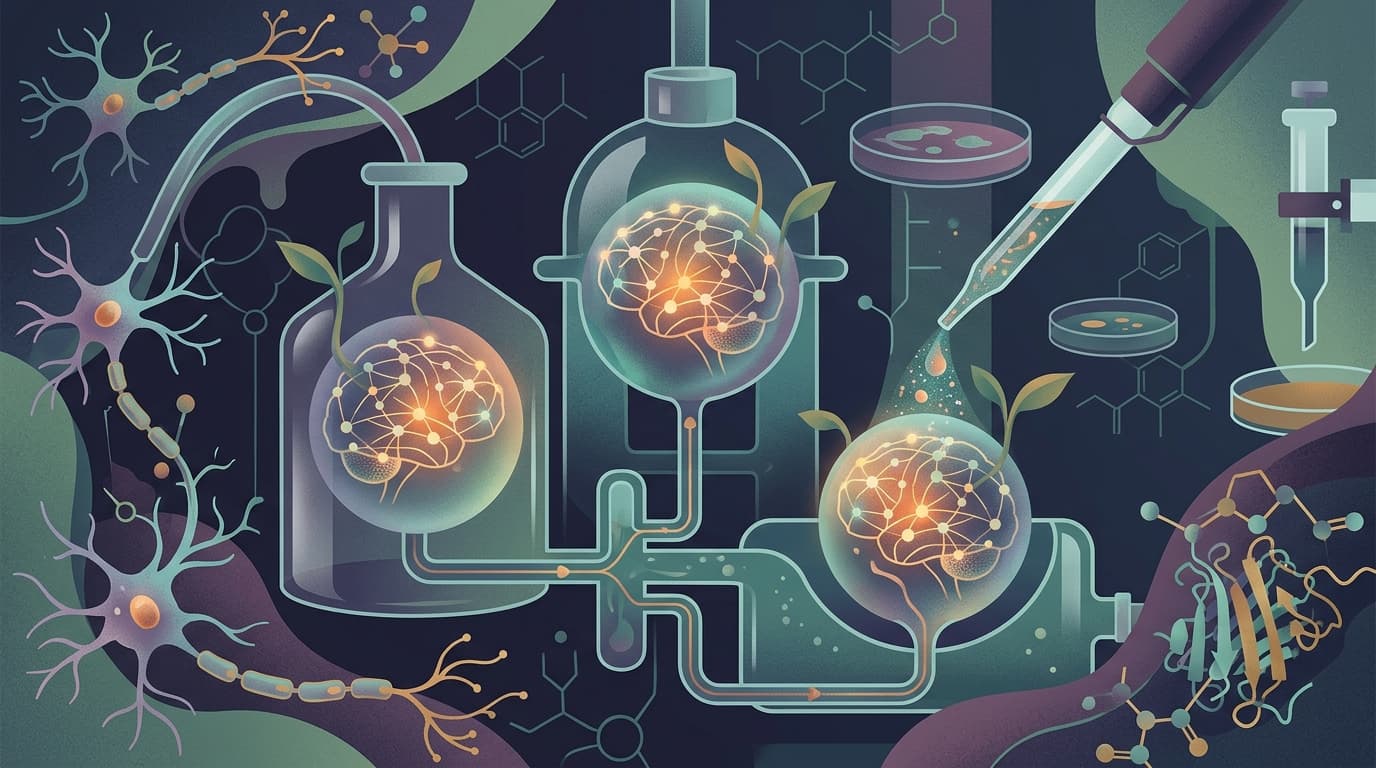
That's the bizarre reality described in a Nature paper published on August 19, 2026. A team at Harvard, led by senior author Paola Arlotta, kept human brain organoids alive in culture for more than five years. These tiny, 3D clumps of brain tissue didn't just survive; they matured on a schedule that mirrors actual human brain development. They tracked time like a biological clock ticking inside a Petri dish.
The previous record for keeping brain organoids alive? About 694 days, set in 2021. That's roughly 1.9 years. This new study nearly tripled it.
What Exactly Is a Brain Organoid?
Think of a brain organoid as a rough draft of a brain. Scientists take cells from a human donor, coax them into stem cells, and then let those stem cells self-organize into a tiny ball of neural tissue. They naturally develop different cell types (neurons, supporting cells, the works) in roughly the same order you'd see in a developing human brain.
They're not brains. They can't think. They can't feel. They're more like a scale model of a building: useful for studying architecture, but nobody's living inside.
Until now, the problem was that these models had a short shelf life. Most published brain organoid studies worked with tissue that was 120 to 150 days old. Some earlier experiments pushed past 200 or 300 days in special bioreactors. But the general rule was the same: organoids degraded, lost complexity, or just stopped developing after a few months.
This study shattered that ceiling.
Five Years of Growing Up in a Dish
The research was led by Noelia Antón-Bolaños and Irene Faravelli in Arlotta's lab. The team followed their organoids across eight timepoints, from six months all the way to five years, using advanced gene-sequencing techniques to watch what was happening inside each cell.
Get tomorrow's biotech intelligence before your competitors.
Join thousands of biotech professionals who start their day with our free, daily briefing.
What they found was striking. The organoids didn't just sit there passively surviving. They reproduced the normal sequence of human brain development. Different cell types appeared in the expected order. Gene activity, chemical markers on DNA (called epigenetic changes), and neuronal properties all shifted in ways that tracked developmental time.
After about one year in culture, some organoids started showing features that normally appear only after birth. That's a big deal. It means the tissue was following a prolonged developmental program, not just frozen in an embryonic state.
Perhaps the most fascinating finding: the organoids seemed to carry a "memory" of their developmental stage. When researchers took older organoids or older cells and gave them the chance to keep growing, those cells resumed development, but only along later-stage trajectories. They picked up where they left off, like bookmarking a page in a novel.
The Secret Sauce
The team didn't just wait five years and hope for the best. They developed a modified culture medium (the nutrient bath that keeps the cells alive) that actively improved survival and maturity. Organoids grown in this optimized environment produced more mature excitatory neurons, showed greater neuronal complexity, and generated stronger electrical activity compared to standard conditions.
In other words, the recipe mattered as much as the ingredient. Better food meant a healthier, longer-lived mini-brain.
Why Neuroscientists Are Paying Attention
So why does a five-year-old blob of brain cells matter?
Because the biggest mysteries in neuroscience play out over years, not weeks. Conditions like Alzheimer's, Parkinson's, autism, and schizophrenia involve slow-moving processes that unfold across long stretches of brain development and aging. If your model dies after four months, you're watching the opening credits and missing the entire movie.
Researchers have already been using brain organoids to study amyloid plaques (the hallmark of Alzheimer's), dopaminergic neuron loss (central to Parkinson's), and early developmental disorders like microcephaly. But those studies were always constrained by time. A system that lasts five years, while faithfully tracking human developmental milestones, opens the door to studying chronic, slow-developing diseases in a way that wasn't possible before.
It could also transform drug testing. Animal models of brain disease fail to predict human outcomes with frustrating regularity. A long-lived human brain organoid gives researchers a more relevant testing ground: human cells, human developmental timing, human biology.
The Elephant in the Petri Dish
Of course, when you tell people you're keeping tiny human brains alive for five years, the first question isn't scientific. It's philosophical.
Could these things be conscious?
The short answer, according to the current scientific consensus: no. Today's organoids lack sensory input, motor output, a body, and social context. They're isolated clumps of neural tissue, not sentient beings. Most experts treat the consciousness question as premature for current technology.
But the debate is getting louder. A 2026 paper in Nature Scientific Reports noted that bioethicists increasingly view consciousness as relevant to organoid research because it's tied to moral status. Some researchers advocate a precautionary approach: even a small chance of sentience justifies stricter oversight and welfare monitoring. Others remain skeptical, arguing the focus should stay on donor consent, governance, and responsible research practices.
The tension is real. As organoids become more complex, more mature, and longer-lived, the gap between "research tool" and "something that deserves protection" could narrow. Nobody thinks we're there yet. But the fact that the conversation exists at all tells you how far the field has come.
What Comes Next
Important limitations remain. Brain organoids still lack blood vessels and immune cells. They show batch-to-batch variability. They don't have the full organizational complexity of a real brain. Think of them as increasingly detailed blueprints, not finished buildings.
But the trajectory is clear. A few years ago, keeping an organoid alive for 200 days was noteworthy. Then 694 days set the record. Now we're at five years and counting.
The Arlotta lab hasn't just proven that brain organoids can survive for half a decade. They've shown that human developmental time can be captured in a dish, bookmarked, and studied at a level of detail that was previously impossible. For anyone working on diseases of the brain (which, for the record, affect more than one in three people worldwide), that's not just a cool lab trick. It's a new platform for understanding the most complicated organ we've got.
Those peppercorn-sized tissue balls aren't thinking about it. But the rest of neuroscience sure is.
Clinical & Regulatory
4 min read
An LSD Pill Just Aced a Late-Stage Anxiety Trial. Yes, Really.
An LSD-derived pill just posted the first positive Phase 3 result for any psychedelic-derived anxiety therapy, beating Wall Street expectations with a 5.4-point improvement over placebo. With a second pivotal trial reading out in weeks, the most stigmatized molecule in psychiatry is suddenly knocking on the FDA's door.