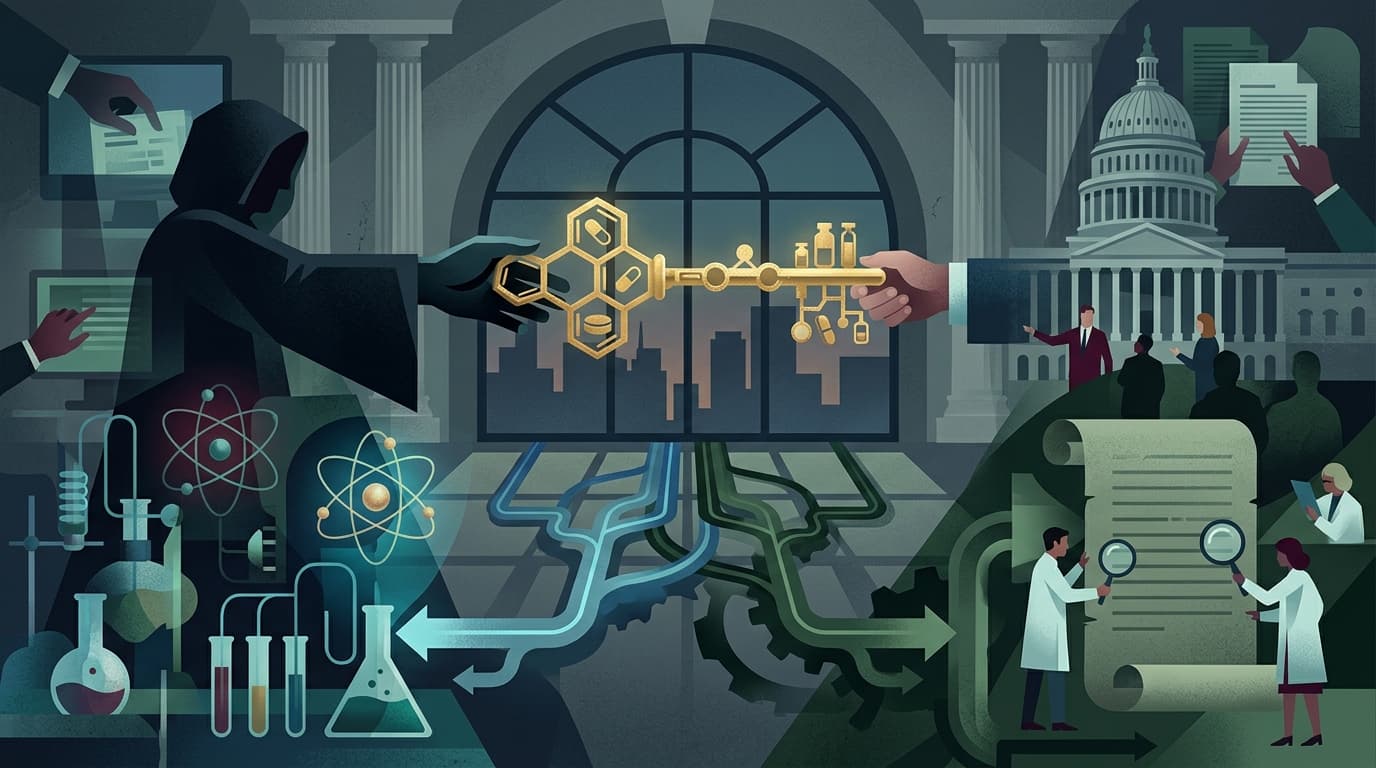

The White House sent its most-favored-nation drug pricing bill to pharma companies for feedback before Congress even got a look. The legislation could reshape how every American pays for prescription drugs, but there's a catch hiding in the fine print.
Imagine your landlord asking you to help write the lease. That's roughly what just happened in Washington: the White House shared its most-favored-nation (MFN) drug pricing bill with more than a dozen pharmaceutical giants, asking for feedback on legislation that would, in theory, force them to charge Americans less.
Congress, the body that would actually need to pass the thing, is still mostly on the outside looking in.
MFN drug pricing is a deceptively simple idea. The U.S. pays far more for prescription drugs than virtually every other wealthy country. An MFN policy would benchmark American prices to the lowest prices paid by comparable nations, essentially telling pharma: "Whatever deal you gave France or Japan, we want something at least that good."
The concept has been floating around Washington since the tail end of Trump's first term, when courts blocked an early version. Biden scrapped it entirely. Now, in Trump's second term, MFN is back with serious momentum.
The administration spent 2025 cutting voluntary deals with at least 16 major manufacturers, including AstraZeneca, Eli Lilly, Novo Nordisk, Pfizer, Merck, Novartis, and Johnson & Johnson. Those companies agreed to lower certain drug prices closer to international levels. In exchange, they got tariff exemptions, a featured spot on the government's new TrumpRx.gov pharmacy portal, and a seat at the table.
Now the White House wants to turn those handshake agreements into actual law.
The legislative text closely mirrors the voluntary deals already struck. It would codify MFN pricing by requiring that U.S. government prices (think Medicare and Medicaid) don't exceed what comparable countries pay, using benchmarks drawn from 6 reference nations: Canada, France, Germany, Italy, Japan, and the United Kingdom.
For patients on high-deductible plans or those buying drugs through TrumpRx.gov at discounted MFN prices, the portal could meaningfully change how they access affordable medication.

AstraZeneca's tozorakimab just nailed two Phase 3 trials in COPD, a disease that has been a graveyard for biologic drugs. The kicker? It worked across the board, not just in narrow patient subsets, potentially unlocking a $5 billion opportunity in a market everyone left for dead.


Join thousands of biotech professionals who start their day with our free, daily briefing.

You might wonder why drug companies are cooperating with a policy designed to cut their revenue. The answer is a cocktail of carrots and sticks.
The carrots: tariff exemptions, government support negotiating fairer prices in foreign markets, and the goodwill of staying on the administration's nice list. The sticks: mandatory CMS models like GUARD (for Part D drugs, starting January 2027) and GLOBE (for Part B biologics, starting October 2026) that would impose international benchmarks whether companies volunteer or not. Non-compliance penalties could reach 125% of the amounts owed.
So pharma's strategy looks a lot like the old dating advice: if you can't beat 'em, help write the terms. Companies like Eli Lilly have reportedly explored raising prices overseas to narrow the gap between foreign and U.S. prices, which would make the MFN benchmark less painful. It's a clever workaround, though one that faces obvious feasibility problems. Good luck telling Germany's health ministry you'd like to charge more.
The financial stakes are enormous. For biologics and specialty drugs, where the U.S. often pays two to four times what peer nations pay, the revenue hit could be staggering.
The White House clearly wants this codified before political winds shift. CMS official Chris Klomp has been working directly with lawmakers and pharma on legislative language. But Capitol Hill's reception has been, charitably, lukewarm.
Republicans are split. Some see MFN as a way to deliver on populist promises to lower drug costs. But other Republicans see price benchmarking as government overreach, uncomfortably close to the kind of centralized pricing they've spent careers opposing.
Senator Bill Cassidy of Louisiana drafted an MFN bill last year that would let Medicare claw back money from companies selling cheaper abroad. It never made it into the 2025 budget reconciliation package. That's a telling sign of how hard this is to move legislatively, even with a sympathetic White House.
Democrats, meanwhile, want receipts. Ranking members from four House and Senate committees sent a joint letter to the president demanding unredacted copies of all 16 MFN agreements. They want to know which drugs are covered, what prices were negotiated, and how the deals compare to existing Medicaid rebates. The push to share legislative text with pharma before satisfying those requests hasn't exactly calmed the skeptics.
Analysts have spotted what STAT News called a "major flaw" in the administration's approach: the real goal may not be lowering American prices so much as raising foreign ones. Chris Klomp himself has suggested the strategy involves pressuring other nations to pay more, using tariff threats and trade leverage.
That's a fundamentally different proposition than what most voters imagine when they hear "lower drug prices." If the benchmark rises because Europe starts paying more, U.S. prices could technically meet an MFN standard without actually dropping much. It's like grading on a curve where you move the curve instead of improving the scores.
Some analysts have expressed doubt that enough Republicans will ultimately sign on, noting that MFN pricing has a "left-leaning policy vibe" that makes the GOP caucus uncomfortable despite Trump's endorsement.
The voluntary deals are already live. TrumpRx.gov launched February 5, 2026, and participating companies are offering discounted prices through the portal. The mandatory GLOBE model for Part B biologics is set to kick in this October, with GUARD following in early 2027.
But without legislation, all of this lives and dies with the current administration. A future president could rescind the executive orders just as easily as Biden rescinded Trump's first MFN attempt. Pharma knows this, which is why they're playing ball now; a law on the books is more predictable than a policy that changes with every election.
The question isn't really whether MFN pricing is a good idea. Plenty of health economists think benchmarking to international prices makes sense. The question is whether this particular version, drafted with pharma's input, reviewed by pharma before Congress, and potentially designed to raise prices abroad rather than lower them at home, actually delivers what patients need.
Big Pharma got the first draft. Now we'll see if Congress rewrites it, rubber-stamps it, or lets it collect dust.
Otsuka Pharmaceutical just dropped $1.225 billion on a company built around an MDMA analog for PTSD, the biggest pharma deal the psychedelics space has ever seen. Two years after the FDA rejected Lykos' MDMA therapy, Big Pharma is betting the comeback will look very different.