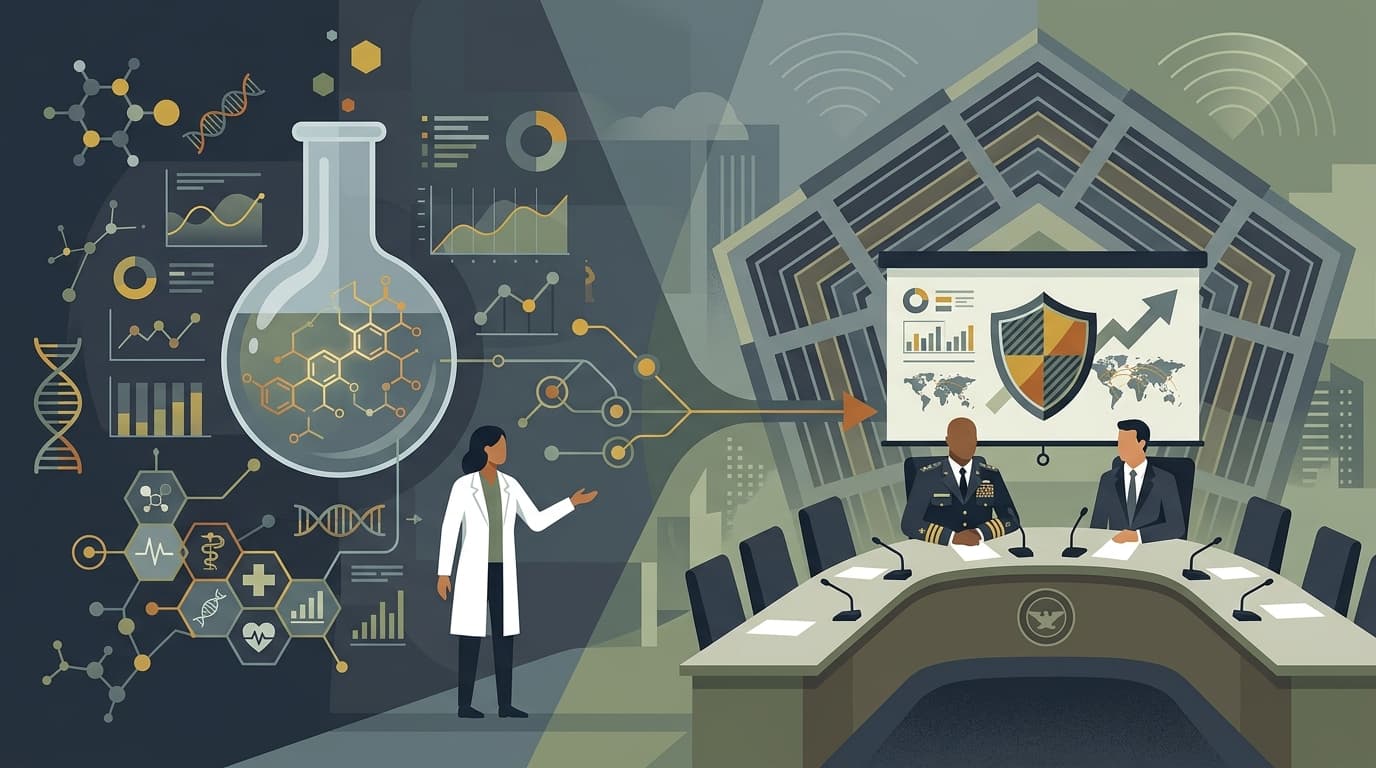
When Your Drug Trial Lands You in a Pentagon Briefing
Congress just opened a national security investigation into Merck and AbbVie's clinical trials at Chinese military hospitals. No one's alleging crimes yet, but the implications for how pharma picks trial sites could be massive.
Imagine you're a pharma executive. You've been running clinical trials in China for years because the patients enroll fast, the costs are low, and the regulators have streamlined the process. Then one morning, Congress sends you a letter. Not about drug pricing. Not about patent cliffs. About national security.
That's where Merck and AbbVie find themselves right now.
The Letter No One Saw Coming
The House Select Committee on China, led by Rep. John Moolenaar (R-Mich.) with bipartisan backing from Ranking Member Rep. Ro Khanna (D-CA), has opened a formal investigation into whether U.S. pharma companies ran clinical trials that could have exposed American biotech secrets to the Chinese military.
The targets: Merck, AbbVie, Eli Lilly, Pfizer, and Bristol Myers Squibb. But Merck and AbbVie are drawing the sharpest scrutiny, and the numbers explain why.
According to the committee, Merck has sponsored or collaborated on 224 clinical studies in China since 2005. At least 40 of those took place at hospitals affiliated with China's People's Liberation Army. Another 31 were conducted in Xinjiang, the region where the Chinese government has been accused of committing genocide against Uyghur Muslims.
AbbVie's footprint is smaller but still significant: more than 100 studies since 2007, with at least 16 at military-linked medical centers and 17 in Xinjiang.
Both companies have until July 17 to hand over detailed records on due diligence, data protection, and oversight at their China trial sites.
This Isn't About Stolen Pills
To be clear, the committee says there is no evidence that Merck or AbbVie broke any laws or did anything illegal. Nobody is alleging that these companies deliberately handed classified biotech to the PLA.
But that's not really the point. The concern is subtler, and in some ways scarier.
Think of it like this: running a clinical trial at a military hospital is a bit like letting someone watch over your shoulder while you cook your secret recipe. You didn't hand them the recipe card. But they saw every ingredient, every technique, every step. And China's National Security Law means the government can, in theory, compel any institution to share what it knows.
Get tomorrow's biotech intelligence before your competitors.
Join thousands of biotech professionals who start their day with our free, daily briefing.
When U.S. pharma companies test cutting-edge biologics and therapies at PLA-affiliated hospitals, local doctors, nurses, and officials gain access to proprietary data on drug mechanisms, trial designs, and patient responses. Lawmakers argue this creates a pathway (not a certainty, but a pathway) for critical intellectual property to flow toward military-linked institutions.
The Xinjiang angle adds an ethical dimension on top of the security one. Congress is "particularly focusing" on whether trials in that region involved biometric or genetic data collected from ethnic minorities without proper consent. The committee hasn't presented specific evidence that Merck or AbbVie trials were used this way, but the mere proximity to alleged human rights abuses is enough to trigger alarm bells on Capitol Hill.
Why China Became Pharma's Favorite Lab
To understand how we got here, you need to understand why China became so central to global drug development in the first place.
The pitch was irresistible. China offered patient enrollment speeds two to three times faster than other countries, according to AbbVie's own descriptions. Costs were lower. Regulatory reforms over the past decade made it easier to launch trials quickly. For a pharma company racing to beat competitors to market, those advantages were hard to ignore.
AbbVie leaned in hard. China now participates in 85% of AbbVie's global Phase III trials (the large, late-stage studies that determine whether a drug gets approved). The company has more than 40 oncology trials running there right now and plans to launch over 40 new products or indications in China by 2030.
Merck's 224 studies over two decades tell a similar story. China wasn't a side project for these companies; it was a core pillar of their R&D strategy.
The problem? Nobody was thinking about what happens when your favorite lab sits inside a geopolitical rival's backyard.
The Regulatory Avalanche Building Behind This Probe
If this were just one congressional letter, pharma executives might shrug it off. But this investigation is part of a much larger wave that's been building since 2024, and the momentum is only accelerating.
Consider what's already in motion:
In 2024, the same House committee wrote to the FDA raising concerns about hundreds of U.S. pharma trials at PLA hospitals. The Bureau of Industry and Security proposed expanding export controls to cover military end users, which could eventually touch clinical trial data.
By early 2025, the committee formally linked clinical trial data to export-control concerns in a letter to BIS. The COINS Act (Countries of Concern, Outbound Investment National Security) was enacted in late 2025, laying the groundwork for restricting U.S. investments into China in sensitive technology sectors.
Then 2026 brought a flurry of activity. In March, Senator Rick Scott called for the FDA to pause approvals of trial applications involving CCP or PLA-linked entities and to conduct a comprehensive audit of active trials involving Chinese entities. On June 2, Reps. Moolenaar and Debbie Dingell introduced BINSA (the Biotech Investment National Security Act), which would explicitly bring biotech licensing deals and joint ventures under Treasury's outbound investment screening. Two days later, new bills were introduced requiring patent applicants to disclose ties to foreign adversary entities.
And perhaps most consequentially, a draft from the House Appropriations Committee proposes banning the FDA from accepting clinical trial data generated in China, Russia, Iran, or North Korea to support new drug applications. If that language survives the legislative process and gets a one-year transition period as proposed, the FDA could be legally barred from using China-generated trial data by late 2027 or early 2028.
This isn't a single probe. It's a systematic effort to untangle American pharma from Chinese military and intelligence infrastructure.
What Pharma Does Next
The companies involved have responded carefully. Merck has publicly stated that "patient safety and ethical integrity are priorities" in its clinical research and that it follows all global guidelines and regulatory standards. AbbVie has largely declined to comment publicly.
But behind the scenes, the industry is almost certainly gaming out scenarios. Analysts and investors are watching for several signals in the second half of 2026:
First, what do the July 17 responses reveal? The committee wants complete lists of China trial locations, data-handling protocols, cybersecurity measures, and licensing deals with Chinese biotech companies going back years. Those disclosures could reshape how investors view China-related pipeline risk.
Second, will companies start shifting trials to other countries? Eastern Europe, Latin America, South Korea, Singapore, and Australia all offer clinical trial infrastructure without the geopolitical baggage. Moving first-in-human studies (where IP exposure is highest) out of China would be the most logical early step. Later-phase trials focused on market access might stay, since the IP sensitivity is lower.
Third, will this spread beyond the five named companies? AstraZeneca, Novartis, Roche, and Sanofi all have significant China trial portfolios. If the investigation's findings are damaging, expect a sector-wide reassessment. CROs (contract research organizations) in alternative geographies could see a surge in demand.
The Bigger Picture: When Science Meets Geopolitics
For decades, clinical trials existed in a kind of geopolitical neutral zone. The thinking was simple: sick people everywhere deserve access to experimental treatments, and science benefits when trials draw from diverse populations. That principle hasn't changed.
What's changed is the context. China's military-civil fusion strategy, its data localization laws, its treatment of ethnic minorities in Xinjiang: all of these have turned routine clinical partnerships into potential national security liabilities. The investigation into Merck and AbbVie isn't really about two companies making bad decisions. It's about an entire industry waking up to the fact that where you run a trial now matters as much as how you run it.
Historical precedent suggests this kind of scrutiny doesn't just blow over. When GSK got caught up in a bribery scandal in China years ago, it triggered a reassessment of emerging-market strategies across Big Pharma. This investigation carries even more weight because it frames the issue in national security terms, which are harder to dismiss and more likely to produce lasting legislative action.
The era of treating China as just another pin on the global trial map is ending. What replaces it will be more expensive, more complicated, and almost certainly slower. But Congress has made its position clear: when your drug trial lands you in a Pentagon briefing, the cost-benefit analysis has fundamentally changed.
4 min read
The FDA Just Gave 7 Companies a Backstage Pass to Drug Approval
The FDA selected seven companies for its first-ever PreCheck pilot, a program that lets the agency review drug factories while they're still being built. It could shave over a year off approval timelines and reshape how biotech thinks about manufacturing.