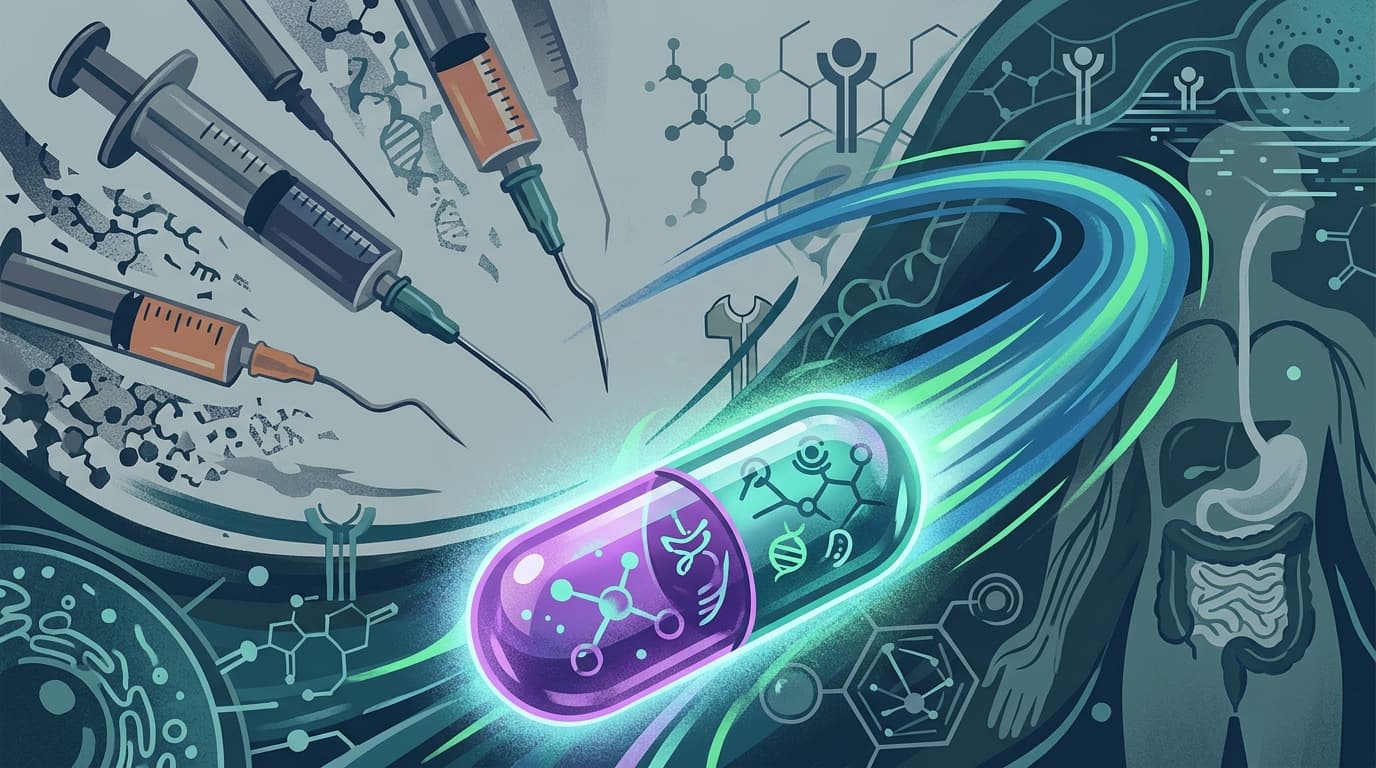

Eli Lilly just launched Foundayo, the first oral GLP-1 weight-loss pill in Europe, in the UK. It beat Novo Nordisk's oral semaglutide head-to-head in clinical trials, and it could reshape the entire obesity drug market by pulling in millions of patients who refuse to use needles.
For millions of people who want the benefits of Ozempic-class drugs but can't stomach the idea of weekly injections, the calculus just changed. Eli Lilly launched Foundayo, an oral weight-loss pill, in the United Kingdom on August 24, making Britain the first country in Europe where the drug is available.
No needles. No refrigeration. Just a daily tablet.
Foundayo (the brand name for orforglipron) is a GLP-1 receptor agonist, the same class of drugs behind Ozempic, Wegovy, and Mounjaro. But it's built differently. It's a small molecule, not a peptide, which means it can survive your digestive system as a simple pill. Think of it like the difference between mailing a fragile glass vase (injectable peptides, carefully packaged) and mailing a brick (small molecule, built to take a beating).
That distinction matters more than you might think.
The injectable GLP-1 market is already massive. Analysts peg the global obesity drug market somewhere between $30 billion and $92 billion in 2026, depending on how you measure it. JPMorgan thinks the broader incretin market could hit $200 billion by 2030. These are staggering numbers, and they're being driven almost entirely by injectable drugs.
But injectables have a ceiling. Some patients are needle-phobic. Others don't want the hassle of a cold-chain supply or weekly self-injections. In 2025, injectables still accounted for roughly 75% of anti-obesity drug revenue. The oral segment, meanwhile, is projected to grow at nearly 28% annually, far outpacing its injectable sibling.
When Novo Nordisk launched an oral version of Wegovy earlier this year, the early data was telling: about 36% of prescriptions went to patients who had never tried any GLP-1 drug before. These weren't people switching from injections. They were entirely new customers walking through the door for the first time. Oral formulations aren't just cannibalizing the existing market; they're expanding it.

For patients with a rare liver disorder, life means waking up every few hours to eat raw cornstarch or risk a medical emergency. Ultragenyx's gene therapy DTX401 cut that dependence by 61% in trials, and the FDA's decision could open the floodgates for a whole new class of metabolic gene therapies.


Join thousands of biotech professionals who start their day with our free, daily briefing.

Foundayo earned its launch through Lilly's ACHIEVE clinical trial program, and the results are solid. In the ACHIEVE-1 trial for type 2 diabetes, the highest dose of orforglipron produced about 16 pounds of weight loss compared to just 3 pounds with placebo. More than 65% of patients on the top dose hit an A1C level (a measure of long-term blood sugar control) of 6.5% or below.
But the real headline came from ACHIEVE-3, a head-to-head trial against Novo Nordisk's oral semaglutide (the active ingredient in Rybelsus). Orforglipron won on every major measure. Weight loss on the highest dose hit 19.7 pounds (9.2%), compared to 11 pounds (5.3%) seen with oral semaglutide — roughly 74% greater, according to Lilly.
That's the kind of data that turns a drug launch into a competitive earthquake.
Before anyone in Britain starts celebrating, there's a catch. Foundayo is launching through private prescriptions only. If you want it, you'll need to pay out of pocket, and Lilly hasn't disclosed the exact price yet. The company has said it will cost less than Mounjaro's £330 per month (roughly $420), but that's the only hint so far.
NHS availability for weight management is still months away. The MHRA (Britain's drug regulator) approved Foundayo on August 10, but that only opens the door. The drug still needs a thumbs-up from NICE, the body that decides whether the NHS will cover a treatment. A NICE committee meeting was held in July 2026, but the publication date for preliminary guidance has not yet been confirmed.
There's one exception: doctors can already prescribe Foundayo on the NHS for type 2 diabetes, since that indication doesn't require the same NICE weight-management review. So the diabetes market is live immediately, while the much larger obesity market sits in regulatory limbo.
It's a familiar pattern. Launch privately, build real-world evidence, then push for broader public coverage. Lilly is playing the long game.
Foundayo isn't just a product launch. It's the opening move in Lilly's strategy to build a multi-product obesity empire.
The company's current blockbusters, Mounjaro (for diabetes) and Zepbound (for obesity), are both injectable tirzepatide. They're printing money: strong demand helped Lilly forecast roughly 25% revenue growth in 2026. But Lilly knows that a single injectable franchise, no matter how dominant, has limits.
So the portfolio is diversifying. Orforglipron handles the oral segment. Retatrutide and eloralintide are further back in the pipeline, targeting different mechanisms. The goal is to segment the obesity market the way automakers segment the car market: something for every buyer, at every price point, through every channel.
Manufacturing is part of the calculus too. Small-molecule pills are dramatically easier (and cheaper) to produce at scale than injectable peptides. No specialized cold-chain logistics. No prefilled syringes. A pill factory can churn out millions of doses faster than an injectable facility, and that matters when your addressable market is potentially 1 to 3 billion people worldwide who are classified as overweight or obese.
Lilly isn't operating in a vacuum. Novo Nordisk has its own oral semaglutide on the market and amycretin, a dual GLP-1/amylin agonist, waiting in the wings. The oral formulation of amycretin showed 13% weight loss in a phase 1 study at 12 weeks, while the subcutaneous version demonstrated up to 24% weight loss at 36 weeks, hinting at even stronger efficacy down the road.
But Novo's oral semaglutide has a practical disadvantage: it's still a peptide crammed into a pill, which means patients need to take it on an empty stomach and wait before eating or drinking. Orforglipron has no food or water restrictions. You can pop it with your morning coffee and move on with your day. That convenience gap could be a meaningful differentiator when millions of patients are choosing between competing pills.
The 2026 obesity market is shaping up as a Lilly vs. Novo duopoly, with everyone else fighting for scraps. U.S. GLP-1 treatment users are expected to climb from about 10 million in 2025 to 25 million by 2030. Whoever captures the oral segment most effectively will own the next wave of growth.
Foundayo's UK launch is a small step in geographic terms but a big one strategically. It proves that an oral, small-molecule GLP-1 can clear regulatory hurdles in a major market. It gives Lilly a first-mover advantage in Europe's oral obesity space. And it sets the stage for what analysts are calling the "year of the orals."
The obesity drug wars just entered a new phase. For years, the question was whether GLP-1 drugs worked. Then it was whether supply could meet demand. Now the question is simpler, and more consequential: injection or pill?
Millions of patients are about to answer that question with their feet.
A cardiac drug startup that didn't exist two years ago just raised $440 million in its Nasdaq debut. Braveheart Bio's blockbuster IPO headlined a billion-dollar week for biotech, and it all rides on a single heart drug.