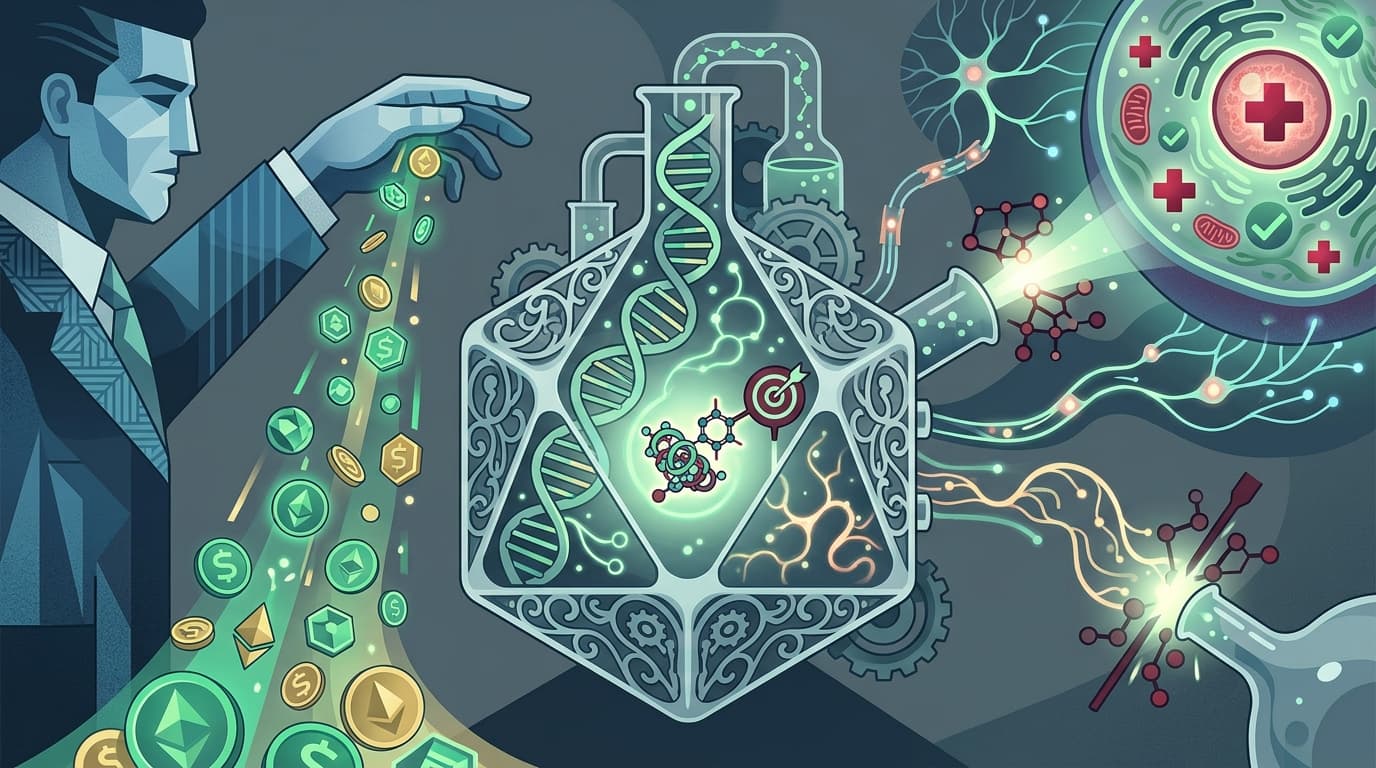

Eli Lilly is paying up to $2.3 billion for Ajax Therapeutics, a startup with a single Phase 1 drug and $143 million in total funding. The bet: a first-in-class JAK2 inhibitor that attacks blood cancer in a way no approved drug can.
Eli Lilly just agreed to pay up to $2.3 billion in cash for a company whose lead drug has never left Phase 1.
The target: Ajax Therapeutics, a small New York biotech with roughly 23 patients in a dose-escalation trial. The asset: a single experimental pill called AJ1-11095 that attacks blood cancer in a way no approved drug currently does. The structure: an undisclosed upfront payment plus milestone checks that could total $2.3 billion if everything goes right.
That's a lot of zeros for a company that raised just $143 million across its entire life. And it raises an obvious question: what does Lilly know that we don't?
To understand why this deal is so interesting, you need to understand the complicated history of JAK inhibitors.
JAK inhibitors are a family of drugs that block enzymes called Janus kinases, which act like switches for inflammation and blood cell production. The first generation of these drugs (think ruxolitinib, sold as Jakafi) became standard treatment for myelofibrosis, a rare blood cancer where scar tissue builds up in the bone marrow.
But JAK inhibitors also became infamous for something else. In September 2021, the FDA slapped class-wide black box warnings on oral JAK inhibitors used in inflammatory diseases. The concerns were serious: higher rates of heart attacks, strokes, blood clots, cancer, and death compared to older alternatives. Those warnings were driven by a massive safety trial of Pfizer's tofacitinib (Xeljanz), and the FDA extended them to the entire drug class as a precaution.
Now, those boxed warnings apply specifically to JAK inhibitors in autoimmune diseases like rheumatoid arthritis, not blood cancers. But the reputational damage was real. The entire JAK family got a scarlet letter, and investors learned to flinch at the three letters J-A-K.
So why is Lilly running toward this drug class with a $2.3 billion check?

The FDA just approved Vera Therapeutics' Trutakna for IgA nephropathy, a kidney disease that barely had any treatments three years ago. Now it has six approved drugs, Wall Street is projecting blockbuster sales, and the real competition is just getting started.


Join thousands of biotech professionals who start their day with our free, daily briefing.

Because Ajax's drug isn't just another JAK inhibitor. It's a fundamentally different kind.
Every approved JAK2 inhibitor on the market is what scientists call a Type I inhibitor. These drugs grab onto JAK2 when the enzyme is in its active shape, like tackling a quarterback mid-throw. They work, but cancer cells eventually figure out how to keep the enzyme active despite the drug. Patients lose response. The disease comes back.
AJ1-11095 is a Type II inhibitor, the first of its kind to enter clinical testing. Instead of targeting the active enzyme, it locks onto JAK2 in its inactive shape. Think of it as changing the locks on the door before the quarterback even gets to the field.
In preclinical studies, this approach did things that current JAK2 drugs struggle with. It reversed bone marrow fibrosis (the actual scarring that defines myelofibrosis). It reduced mutant allele burden, meaning it shrank the population of cancer-driving mutant cells rather than just managing symptoms. And critically, it worked in cancer cells that had become resistant to Type I inhibitors.
If those results hold up in humans, AJ1-11095 wouldn't just be another option. It could be the first drug to genuinely modify the disease rather than temporarily control it.
At the 2026 European Hematology Association meeting, Ajax presented Phase 1 data that caught Wall Street's attention. In pre-treated myelofibrosis patients, the drug showed strong spleen size reduction and symptom improvement. Perhaps more telling: 21 of 23 patients showed decreases in their driver mutation levels, suggesting the drug was actually hitting the underlying cancer clone.
Safety was manageable, with no dose-limiting toxicities reported. About 78% of patients in dose escalation were still on therapy as of the May 2026 data cutoff. But there was one notable wrinkle: anemia hit 65% of patients (52% at the more severe grade 3 or higher). Lilly itself once had a JAK2 inhibitor that failed, which adds a layer of irony to the whole affair.
This deal didn't happen overnight. Lilly was a founding strategic investor in Ajax and participated in the company's $95 million Series C round in 2024. The relationship goes back years, giving Lilly an insider's view of the science before it wrote the big check.
The acquisition also fits a clear pattern. Just weeks before the Ajax deal, Lilly signed a $7 billion agreement with Kelonia Therapeutics, another blood cancer play. Together, the two deals give Lilly a pair of clinical-stage hematology assets and signal a deliberate push into a therapeutic area where the company previously had little presence.
Lilly's broader strategy has been to diversify beyond its blockbuster obesity franchise (tirzepatide, a.k.a. Mounjaro/Zepbound) by building positions in oncology, immunology, and neuroscience. The $1.2 billion Ventyx Biosciences acquisition added inflammation assets. The Ajax deal adds a hematology anchor. Scotiabank analyst Louise Chen noted that it "builds Lilly's capabilities in cancers and helps broaden future commercial offerings beyond obesity."
The deal's milestone-heavy structure limits Lilly's downside. If AJ1-11095 stumbles in later trials, a big chunk of that $2.3 billion never gets paid. Lilly's shares dipped about 0.5 to 1.8% on the news, a shrug more than a panic, reflecting investor focus on the obesity franchise and the long timeline before Ajax contributes revenue.
But the upside scenario is tantalizing. Myelofibrosis patients who fail first-line JAK inhibitors have limited options. A drug that truly modifies the disease (reversing fibrosis, shrinking the cancer clone) could redefine treatment. And if AJ1-11095 eventually proves safe and effective in first-line settings or in polycythemia vera (another blood disorder Ajax is eyeing), the market opportunity grows substantially.
Lilly expects to select a dose for further development later this year, with plans to push rapidly into registrational trials after that.
For now, the deal is a calculated bet: pay a premium for a first-in-class mechanism, structure the payments to limit risk, and bank on the science delivering what preclinical models promised. It's the biotech equivalent of buying a lottery ticket with really, really good odds.
Whether those odds actually pay off depends on data that doesn't exist yet. But if there's one thing Lilly has shown over the past two years, it's that the company isn't afraid to write big checks on conviction. The question is whether the biology agrees.
Kailera Therapeutics' oral obesity pill just hit its goals in two late-stage China trials, delivering 11% weight loss and strong diabetes results. But the GI side effects are intense, and the real battle for the $22 billion oral obesity market is just getting started.