Lilly Just Bet $1.9B on a Shanghai Biotech. In This Political Climate.
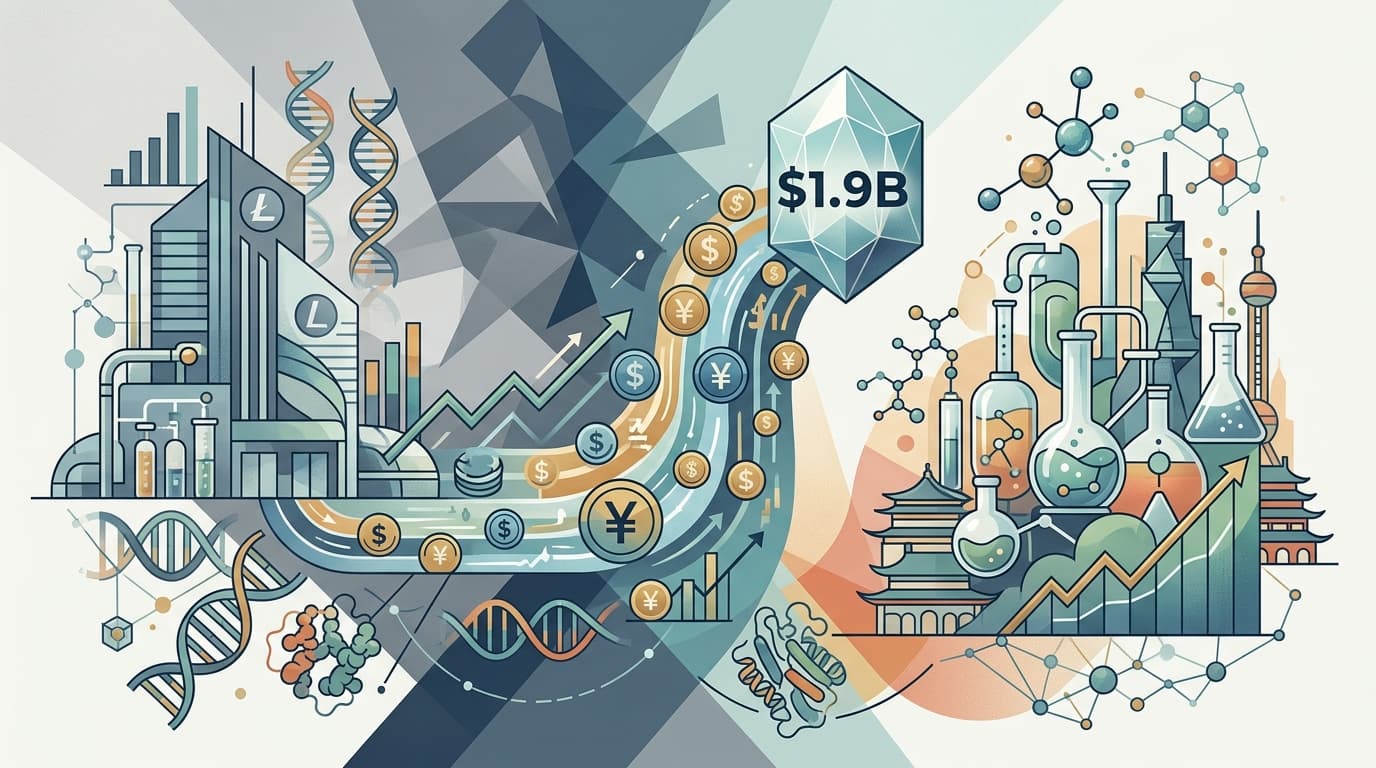
Eli Lilly just expanded a partnership with Shanghai-based Abbisko Therapeutics to the tune of $1.9 billion in potential payments, doubling down on Chinese oncology innovation while Congress tries to decouple U.S. and Chinese biotech. The deal reveals just how commercially irresistible China's drug discovery engine remains for Big Pharma.
The Deal Washington Doesn't Want to Talk About
While U.S. lawmakers are busy trying to cut ties with Chinese biotech, Eli Lilly just went the other direction. The Indianapolis pharma giant signed a deal worth up to $1.9 billion with Shanghai-based Abbisko Therapeutics, expanding a partnership that first began in 2022. The collaboration covers multiple undisclosed oncology targets, with Lilly gaining exclusive global rights to develop and sell whatever comes out of it.
The timing is, shall we say, interesting.
Congress passed the BIOSECURE Act to restrict U.S. companies from working with certain Chinese biotech firms. The FDA is scrutinizing cross-border clinical trials involving American patients' cells. Export controls now block some lab equipment from reaching Chinese shores. And yet here's Lilly, writing another very large check to a company headquartered in Shanghai's Zhangjiang High Tech Park.
So what gives?
Follow the Science (and the Money)
The short answer: China's oncology innovation is too good to ignore. Abbisko isn't some fly-by-night startup. The company was founded in 2016 by a team of seasoned drug hunters and has raised over $263 million in private funding from heavyweights like Carlyle Group, Warburg Pincus, OrbiMed, and Temasek. It went public on the Hong Kong Stock Exchange, raising another $226 million.
More importantly, Abbisko actually makes drugs that work. Its lead compound, pimicotinib (a CSF-1R inhibitor, which blocks a protein that fuels tumor growth), posted a 54% response rate in a Phase 3 trial for a rare tumor type, compared to just 3.2% for placebo. That drug has already been approved in China and is under FDA review with Breakthrough Therapy Designation.
Beyond pimicotinib, Abbisko has a pipeline stacked with early-to-mid-stage oncology candidates. Its FGFR4 inhibitor for liver cancer hit a 50%+ response rate in a Phase 2 combination study. An oral PD-L1 inhibitor (think: a pill version of drugs like Keytruda) is in multiple Phase 2 trials for lung cancer. And several first-in-class small molecules are climbing through Phase 1.
Get tomorrow's biotech intelligence before your competitors.
Join thousands of biotech professionals who start their day with our free, daily briefing.
Lilly isn't paying for one drug here. It's paying for access to an entire discovery engine.
How the Deal Actually Works
Think of it like hiring a world-class chef to develop your restaurant's secret menu. Abbisko runs early discovery and development on targets that Lilly selects, using its AI-driven drug discovery platform. Once candidates reach a certain stage, Lilly takes over everything: later-stage trials, regulatory filings, and global commercialization.
The financial structure is heavily back-loaded. Abbisko gets an undisclosed upfront payment (nobody's saying how much), plus up to $1.9 billion in development, regulatory, and commercial milestones. Tiered royalties on net sales sweeten the pot if anything actually reaches pharmacies.
Crucially, Abbisko keeps some rights in Greater China for certain programs. This territorial split is basically the standard playbook for Lilly's China deals: the Chinese partner retains its home turf, and Lilly gets the rest of the world.
Lilly's China Addiction
This deal doesn't exist in isolation. Lilly has been on an absolute tear in China-linked business development, and the numbers are staggering.
In February 2026, Lilly signed a $350 million upfront, up to $8.5 billion total strategic alliance with Innovent Biologics in Suzhou, covering oncology and immunology. It inked a deal worth up to $2.75 billion with Hong Kong-listed Insilico Medicine for a GLP-1 diabetes asset. There's the Regor Therapeutics metabolic deal (up to $1.5 billion in milestones). And it committed $3 billion to build out Chinese manufacturing over the next decade, primarily for its obesity pill orforglipron.
All told, Lilly has invested roughly $6 billion in China across R&D, manufacturing, innovation centers, and incubators. The Abbisko expansion is one tile in a very large mosaic.
By mid-2026, Lilly's total M&A and business development spending had already topped $25 billion for the year. China partnerships represent a meaningful chunk of that, but they sit alongside massive global moves: a $6.3 billion buyout of Centessa Pharmaceuticals, a $7 billion cell therapy deal with Kelonia, and several billion more across RNA editing, vaccines, and AI.
The Elephant in the Room
The geopolitical tension around U.S.-China biotech collaboration isn't going away. The BIOSECURE Act specifically targets Chinese companies that provide services to American pharma; about 79% of U.S. biotech companies had at least one active engagement with Chinese contract manufacturers in 2024, and that number is falling fast.
But there's a crucial distinction. The regulatory crackdown is aimed mostly at services and supply chain dependence: contract research organizations, contract manufacturers, genomic data handlers. Licensing deals for innovative drug assets occupy different territory. 32% of global pharma out-licensing in the first half of 2025 involved China-origin assets. That's up from 21% the year before.
Lilly seems to be making a calculated bet. Its China partnerships are structured around asset licensing, not operational dependence. Abbisko discovers the molecules; Lilly develops and manufactures them for global markets. The milestone-heavy economics limit upfront exposure. And the undisclosed nature of the specific targets means there's less for critics to latch onto.
What Wall Street Thinks
Analysts are treating the Abbisko deal as long-dated option value rather than a near-term catalyst. The bull case remains anchored in GLP-1 dominance and late-stage pipeline assets. The Abbisko collaboration adds depth to the oncology story, but nobody's rewriting their models over undisclosed early-stage targets.
Leerink's David Risinger recently raised his Lilly price target to $1,234, while Berenberg's Kerry Holford nudged his to $1,135. Both moves reflect broader confidence in Lilly's strategy rather than Abbisko-specific enthusiasm.
The Bottom Line
Lilly is playing a game that would make most corporate boards nervous. Deepening ties with Chinese biotech while the political winds blow toward decoupling requires conviction, and frankly, some nerve. But when you're generating enormous GLP-1 cash flows and need to diversify into oncology, the math is hard to argue with.
China produces innovative drug candidates at speed and scale that few ecosystems can match. Lilly clearly believes the scientific opportunity outweighs the political risk. Whether Washington eventually forces a reckoning remains the open question, but for now, the checks keep clearing.
4 min read
One Shot a Year: The Tiny Biotech That Just Embarrassed AbbVie's $18B Drug
A tiny biotech called Oruka just posted psoriasis clearance rates that numerically beat AbbVie's $17.6 billion juggernaut Skyrizi, and it might only need one shot a year. Wall Street is losing its mind.