Two Startups Say They Can Make Babies Without Sex. From a Blood Draw.
Two biotech startups claim they've grown human sperm from testicular stem cells and created early egg cells from a simple blood draw. If the science holds up, the future of human reproduction just got a radical rewrite.
A Vial of Blood, a Shot at Parenthood
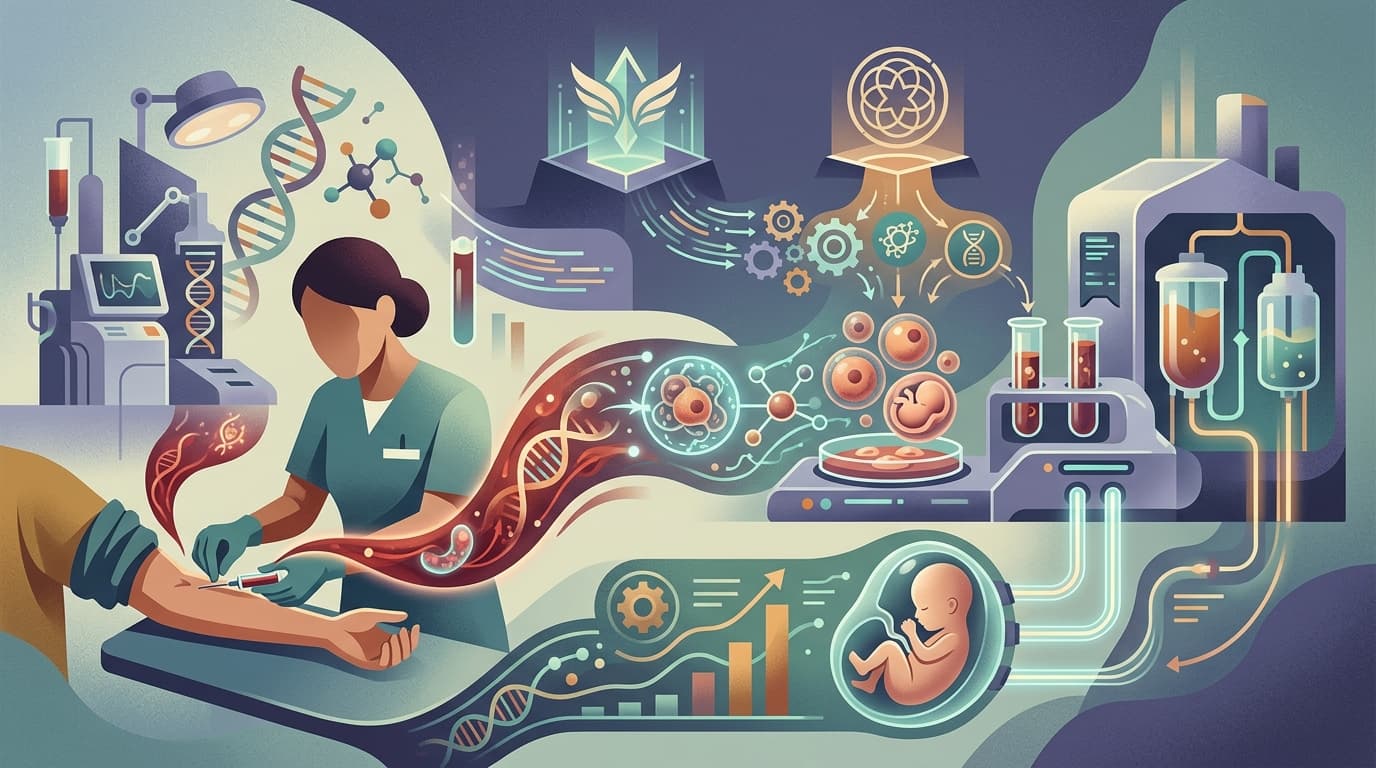
Somewhere in a Berkeley lab, scientists drew blood from an adult's arm and turned it into early-stage human egg cells. In Salt Lake City, another team took a tiny piece of testicular tissue and grew sperm from scratch in a petri dish. Both happened this month.
If these claims hold up, the implications are staggering. We're talking about a future where infertility as we know it could become obsolete, where same-sex couples could have children who are biologically both of theirs, and where the entire architecture of human reproduction gets rewritten. But we're getting ahead of ourselves. Let's start with what actually happened.
Sperm, Grown in a Dish
Paterna Biosciences says it has achieved the world's first in vitro human spermatogenesis. In plain English: they grew functional human sperm entirely outside the body.
The process starts with a small testicular biopsy, basically an office visit, not the multi-hour surgery that men with severe infertility currently endure. From that tissue, the team extracts spermatogonial stem cells (the earliest sperm-producing precursors in the testis) and places them into a proprietary cocktail of growth factors. Using computational biology to decode the molecular signals that normally guide sperm development inside the body, Paterna recreated those conditions in the lab.
The result, they say, is sperm with a normal head, tail, and motility that are "structurally and genetically indistinguishable" from the real thing. CEO Alex Pastuszak put it simply: "We've figured out the instructions that are needed to teach these stem cells to become mature, normal sperm."
Then came the big test. Paterna used its lab-grown sperm to fertilize human eggs and create early embryos. The company says those embryos look comparable to standard IVF embryos on early quality metrics. If true, that's not just a scientific curiosity; it's a potential lifeline for the roughly 10–15% of infertile men who produce zero sperm and currently have no biological path to fatherhood.
Paterna is raising a $12 million Series A and projects clinical trials as early as 2027, with a goal of entering international markets by 2029.
Get tomorrow's biotech intelligence before your competitors.
Join thousands of biotech professionals who start their day with our free, daily briefing.
Eggs, Made From Blood
On the other side of the reproductive equation, Conception Biosciences announced something arguably even wilder.
Founded by Matt Krisiloff (a former Director of Y Combinator Research and founding team member of OpenAI), the Berkeley-based startup says it generated the first early human egg cells from blood-derived stem cells. Think about that for a second: blood in, eggs out.
The process works like a biological relay race. First, blood cells get reprogrammed into induced pluripotent stem cells, or iPSCs. These are cells that have been "reset" to a state where they can become almost anything. (The technique was pioneered by Shinya Yamanaka in 2006 and won him a Nobel Prize.) Conception then coaxes these iPSCs down two parallel paths: some become primordial germ cells (egg precursors), while others become ovarian "helper cells" that provide the structural scaffolding and chemical signals an egg needs to develop.
When combined, these cells self-organize into three-dimensional "mini-ovaries": tiny balls of tissue that mimic a developing human ovary. Inside these structures, the germ cells form follicles and begin entering meiosis, the specialized cell division that halves the chromosome count to prepare for fertilization. That meiotic machinery is the gold-standard marker that tells scientists: yes, these cells are genuinely on the path to becoming eggs.
The Catch (There's Always a Catch)
Conception's oocytes are early-stage, not mature. They're at the primary oocyte phase, still far from the antral follicle stage where eggs are ready for ovulation and fertilization. No mature eggs. No embryos. No pregnancies. The company is refreshingly upfront about this, noting that the "threshold for clinical use is incredibly high."
Paterna's claims carry their own asterisks. As of this writing, no peer-reviewed paper has been published. No independent lab has replicated the results. Everything we know comes from press releases and media interviews. Reproductive scientists have cautioned that full validation requires comprehensive genetic and epigenetic analysis: things like aneuploidy rates (abnormal chromosome counts), imprinting patterns, and long-term offspring health data. None of that has been publicly shared.
Both breakthroughs, in other words, are still at the "trust us" stage. Promising? Absolutely. Proven? Not yet.
Why the Scientific World Is Paying Attention Anyway
To appreciate why these announcements matter, you need context. The field of in vitro gametogenesis (IVG), making eggs and sperm from stem cells, has been building momentum for over a decade, mostly in mice.
In 2011, researchers produced fertile mouse offspring from lab-derived sperm. By 2016, they'd made functional mouse eggs from iPSCs. In 2023, scientists created viable mice with two biological fathers by generating eggs from male cells. That was the moment the field went from "neat trick" to "wait, what?"
Humans, though, have been the hard part. The big milestone before this month was a 2024 study from Kyoto University, where Mitinori Saitou's team created egg and sperm precursors from reprogrammed human skin cells. Important, but still several steps short of actual gametes. Paterna and Conception are claiming to have pushed significantly further down that road.
The Ethics Are Going to Get Loud
If IVG works in humans, the societal questions are enormous. Same-sex couples having biological children together. Single people becoming parents without donors. Posthumous reproduction using stored cells. The American Society for Reproductive Medicine issued an ethics opinion saying IVG should not be used in humans until robust primate data are reassuring, and even then only under heavy regulation.
There are darker possibilities, too. What about creating gametes from someone's DNA without their consent? Mass embryo production and aggressive genetic selection? Existing family law wasn't built for a world where three or more people could be genetic parents of the same child.
Commentators warn about equity as well: if IVG becomes a premium fertility option, it could widen the gap between those who can afford cutting-edge reproductive technology and those who can't.
What Comes Next
Both companies face years of validation before anything reaches a clinic. Paterna needs to publish its data, get it replicated, and navigate FDA review. Conception needs to figure out how to mature its early oocytes into fertilization-ready eggs, a problem no one has solved in humans.
But the direction of travel is clear. We're watching the earliest chapters of a technology that could fundamentally reshape who gets to be a biological parent, and how. For now, the science is spectacular, the claims are unverified, and the ethical debates are just getting started.
Somewhere between a blood draw and a petri dish, the future of making babies is being rewritten. Whether the world is ready for it is another question entirely.
4 min read
Merck KGaA Just Dropped $11.3 Billion on a Company You've Probably Never Heard Of
Merck KGaA is spending $11.3 billion in cash to acquire Bio-Techne, a company most people outside the lab have never heard of. The deal is the largest life sciences tools acquisition of 2026 and a bold bet that owning the picks and shovels of drug discovery is just as valuable as the drugs themselves.