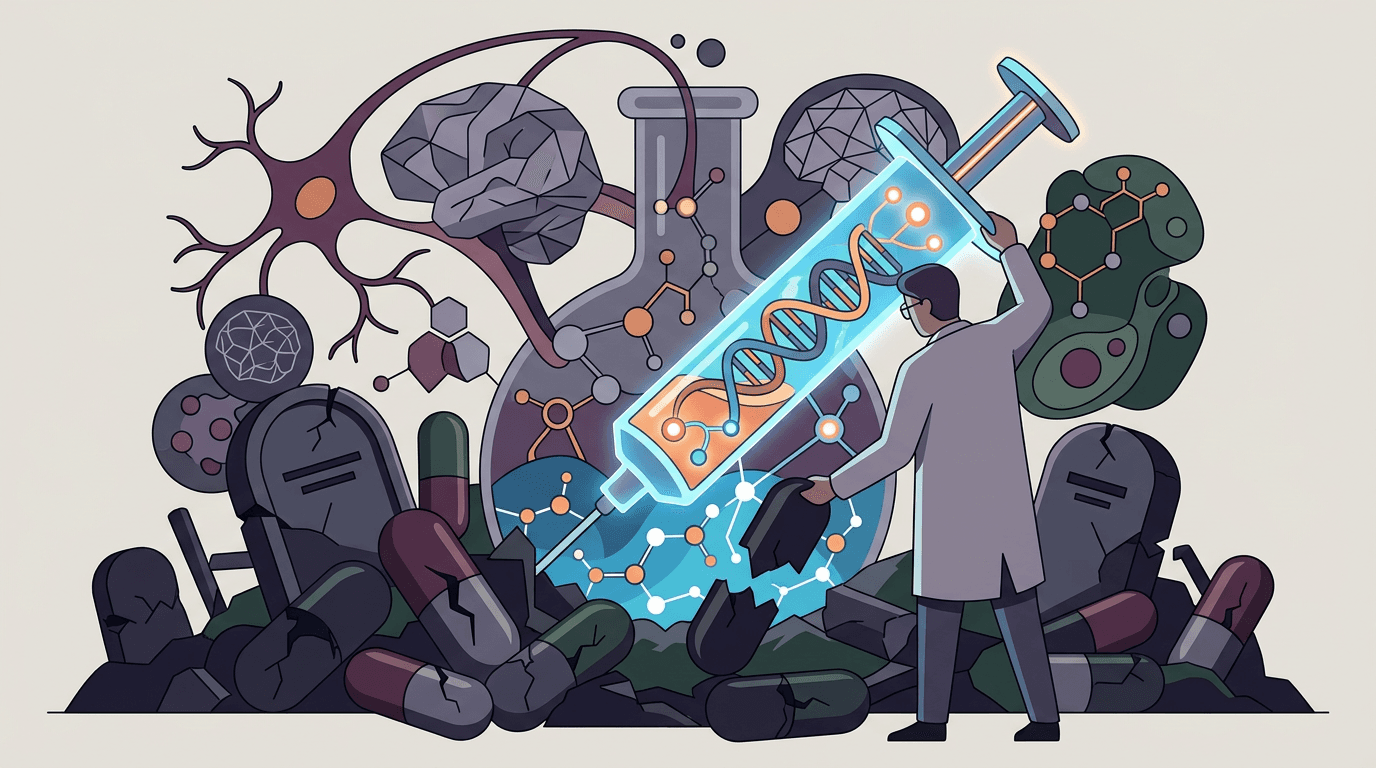
The Graveyard of Brain Drugs Just Got a New Gravedigger
A new startup thinks the real reason 94% of brain drugs fail isn't bad science; it's bad trial infrastructure. Kordata Dynamics just emerged from stealth with an AI platform built specifically for neural data, and it's starting in the last place you'd expect.
Roughly 94 out of every 100 brain drugs that enter clinical testing will never reach a pharmacy shelf. That's not a typo. CNS drug development has the worst success rate in all of medicine, and it's been stuck there for years. The reasons read like a horror movie script: we barely understand the biology, the endpoints are subjective, the placebo effect is enormous, and recruitment takes forever.
So when a startup claims it can fix neurology trials with AI, the natural response is skepticism. But Kordata Dynamics, which just emerged from stealth with a pre-seed round, is making a fairly specific bet: the problem isn't just bad science. It's bad infrastructure.
Building a GPS for the Brain's Black Box
Kordata is a spin-out from BIOS Health, a neural interface company that's spent years building technology to read and interpret signals from the nervous system. The new company's pitch is straightforward. Traditional clinical trial software (the systems that track patients, manage data, and keep regulators happy) was never designed to handle continuous streams of neural data. Think of it like trying to run a Formula 1 team's telemetry through an Excel spreadsheet.
At the center of Kordata's platform sits NeuroTune, an AI precision dosing engine inherited from BIOS. NeuroTune processes real-time neural signals from both invasive devices (like implanted neurostimulators) and non-invasive sensors, then generates insights about how a patient is actually responding to a drug or intervention. Instead of waiting weeks for a clinician to administer a rating scale and hope the patient remembers how they've been feeling, the system watches the nervous system's own feedback loop.
The goal is to enable something closer to adaptive, closed-loop trials: studies that can adjust in real time based on what a patient's biology is actually doing, not just what they report on a questionnaire.
Why Brain Trials Fail So Spectacularly
To appreciate what Kordata is attempting, you need to understand just how brutal CNS drug development really is. The overall success rate from Phase 1 to approval hovers around , according to IQVIA data. For context, oncology looks like a cakewalk by comparison.
Get tomorrow's biotech intelligence before your competitors.
Join thousands of biotech professionals who start their day with our free, daily briefing.
5 to 6 percent
The failure points are everywhere. Screen failure rates in neurology studies average 57%, meaning more than half of patients who show up don't even qualify. In preclinical Alzheimer's trials, that number climbs to a staggering 88%. A single Phase III Alzheimer's study can cost around $370 million and drag on for up to eight years.
Then there's the placebo problem. In psychiatric and neurological trials, patients often improve simply because they're getting attention and care. That inflated placebo response crushes the statistical separation between drug and sugar pill, killing otherwise promising compounds. The high-profile failure of ulotaront in schizophrenia trials in 2023 was partly blamed on exactly this phenomenon.
Subjective endpoints make everything worse. When your primary measure of success is a clinician's interpretation of a cognitive test, you're introducing noise at every step. Different raters score differently. Patients have good days and bad days. The signal gets buried.
The Bakersfield Experiment
Kordata's first move is interesting and a little unexpected. Rather than setting up shop at a major academic medical center in Boston or San Francisco, the company planted its flagship trial site in Bakersfield, California. That's deliberate.
Kordata's thesis is that its AI platform can simplify trial operations enough to bring the vast majority of hospitals that don't currently participate in research into the game. If you can turn complex neural data workflows into repeatable, manageable processes, community hospitals become viable research sites. That means access to patient populations that are typically underrepresented in neurology studies.
The company claims its model can compress recruitment timelines to 3 to 6 months instead of the years that large CNS trials typically require. That's an ambitious promise, and sponsors will want proof before betting their programs on it.
Who's Running the Show
The leadership pairing is worth noting. Emil Hewage, who also serves as CEO of BIOS Health, brings the neurotech and AI pedigree. He built the underlying neural data platform that Kordata is commercializing for clinical trials.
On the operational side, Dawn McCollough serves as president. Her résumé carries serious weight: roughly 30 years in clinical trials, involvement in more than 15,000 studies, and 27 drugs successfully brought to market. She previously held executive roles at both Biogen and Novartis, two companies with deep neuroscience portfolios. If Kordata's AI is the engine, McCollough is the driver who actually knows the track.
The pre-seed round (amount undisclosed) was backed by MAVRK Celestia Fund, Kern Venture Group, and Digital Neural Infrastructure Holdings, with strategic support from BIOS Health.
The $26 Billion Question
Kordata points to a $26 billion backlog in clinical trials for neuromodulation and neural therapies. The initial target indications include Alzheimer's, Parkinson's, epilepsy, and drug-resistant forms of cardiovascular and autoimmune conditions where neural circuits play a central role.
The timing aligns with a broader regulatory tailwind. The FDA recently launched a pilot program for real-time clinical trial data monitoring, which Kordata explicitly references as validation of its approach. Industry analysts tracking 2026 trends have noted that "platformization" (moving from one-off AI tools to integrated operating models) is becoming a primary competitive differentiator in trial execution.
The Catch (Because There's Always a Catch)
For all its promise, Kordata faces the same question every AI-in-trials startup must answer: does it actually work in practice?
Regulatory acceptance of AI-driven dosing decisions and novel neural biomarkers as trial endpoints will require extensive prospective validation. The FDA doesn't take kindly to black-box algorithms making decisions about drug doses in vulnerable patient populations. Transparent models, peer-reviewed evidence, and clear performance metrics will be non-negotiable.
Then there's the community hospital challenge. Asking a facility with limited research infrastructure to suddenly manage continuous neural data streams, even with a simplified platform, is a tall order. Staffing, IT governance, and clinician training could all become bottlenecks.
And the competitive landscape is getting crowded. Companies like Unlearn.ai (digital twins for smaller control arms), Phesi (trial simulation with 100 million patient profiles), and TriNetX (real-world data networks) are all attacking different pieces of the same problem. Kordata's neural-data specialization is a genuine differentiator, but it only matters if sponsors are willing to bet on a brand-new platform with no track record of completed trials.
The Bottom Line
Kordata is making a fascinating, focused wager: that the biggest bottleneck in brain drug development isn't the science itself, but the clinical trial machinery surrounding it. If NeuroTune can deliver on the promise of real-time, biologically grounded trial execution in neurology, it could meaningfully improve those dismal 5 to 6% success rates.
But "if" is doing a lot of heavy lifting in that sentence. The next 12 to 24 months will tell us whether Kordata is a genuine breakthrough or another ambitious pitch that couldn't survive contact with the messy reality of running clinical trials in American hospitals.
Clinical & Regulatory4 min read
A Tiny Korean Biotech Just Put Up MASH Numbers That Rival Novo Nordisk
A small Korean biotech just dropped MASH liver disease data that looks competitive with Novo Nordisk's blockbuster semaglutide. The catch? Only 35 patients were in the trial, and the competition is about to get fierce.