The Cancer Drug That Just Beat the World's Best-Selling Medicine
A Chinese biotech's drug just beat the world's best-selling medicine, Keytruda, in a head-to-head survival study for lung cancer. Merck's $32 billion franchise has a real challenger for the first time, and the implications are enormous.
A $32 Billion Empire Just Got Put on Notice
Keytruda is the best-selling drug on the planet. Not the best-selling cancer drug. The best-selling drug, period. Merck pulled in $29.5 billion in Keytruda sales last year, about 46% of the company's entire revenue. It dominates lung cancer treatment the way the Yankees dominated the '90s: so thoroughly that most competitors don't even bother showing up to fight.
So when a Chinese biotech called Akeso announced on September 2 that its drug, ivonescimab, beat Keytruda in overall survival in a head-to-head Phase 3 trial, the oncology world collectively spit out its coffee.
What "Overall Survival" Actually Means (and Why It's a Big Deal)
Cancer trials measure a lot of things. Tumor shrinkage. Time before the disease gets worse. Quality of life. But the metric that matters most is brutally simple: did patients live longer?
That's overall survival, or OS. It's the gold standard because you can't argue with it. A tumor can shrink and still kill you. Disease progression can be measured differently by different doctors. But alive versus dead? That's binary.
In the HARMONi-2 trial, ivonescimab delivered a statistically significant OS benefit over Keytruda in first-line treatment for PD-L1-positive non-small cell lung cancer (the most common type). Akeso hasn't yet disclosed the exact numbers publicly, but the company confirmed the result crossed the statistical threshold at a pre-specified interim analysis. That's not a fluke; it's a planned checkpoint that the trial passed.
For context, the earlier progression-free survival (PFS) data from the same trial were already striking. Patients on ivonescimab went a median of 11.14 months before their cancer worsened, compared to 5.82 months on Keytruda. The risk of progression was cut nearly in half, with a hazard ratio of 0.51.
Now that PFS advantage has translated into a survival benefit. That's the part that really matters.
Get tomorrow's biotech intelligence before your competitors.
Join thousands of biotech professionals who start their day with our free, daily briefing.
One Drug, Two Jobs
So how does ivonescimab outperform the reigning champ? The answer lies in its design, which is genuinely clever.
Keytruda does one thing well: it blocks a protein called PD-1 on immune cells, essentially removing the "brakes" that tumors use to hide from the immune system. Think of it like cutting the camouflage off a spy. Your immune cells can finally see the cancer and attack it.
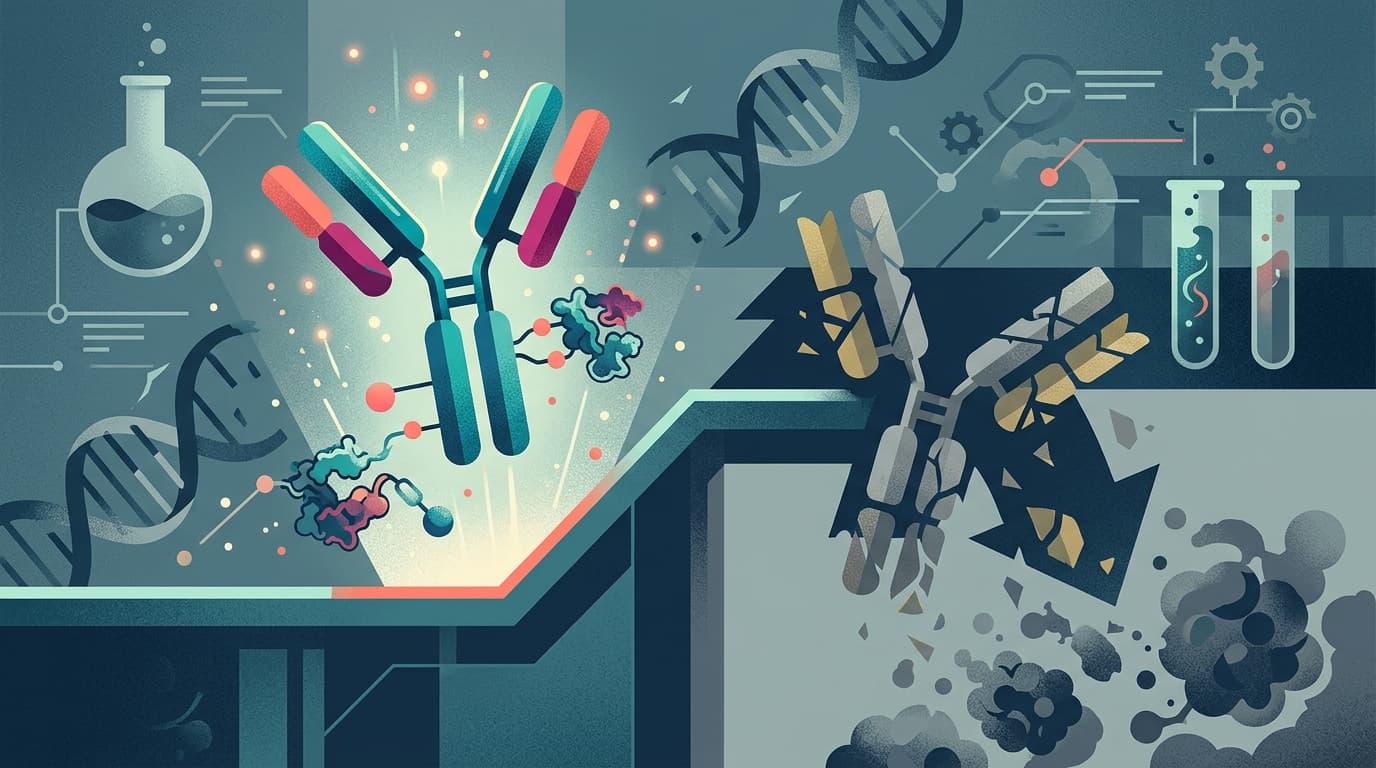
Ivonescimab does that and something extra. It's a bispecific antibody, meaning a single molecule engineered to grab two different targets simultaneously. One arm blocks PD-1 (just like Keytruda). The other arm grabs VEGF, a protein that tumors use to grow new blood vessels and feed themselves.
Imagine a bouncer who can simultaneously check IDs at the door and cut the power to the building. Ivonescimab shuts down immune evasion while also starving the tumor of its blood supply. Even better, the two arms appear to work cooperatively: when one binds its target, the other gets stickier. It's a molecular tag team.
55 Hospitals, One Country, and a Lingering Question
HARMONi-2 enrolled patients at 55 hospitals across China. It was randomized, double-blind, and well-designed: patients received either 20 mg/kg of ivonescimab or 200 mg of Keytruda intravenously every three weeks, with treatment lasting up to 24 months. Standard-issue rigorous oncology trial.
But the China-only enrollment is both the study's strength and its Achilles' heel. It means the data are clean and consistent, but Wall Street (and the FDA) will want to see the same results hold up in Western patients. Genetic backgrounds, treatment patterns, and healthcare systems all differ; what works spectacularly in Shanghai doesn't automatically translate to Chicago.
That's where Summit Therapeutics enters the picture. Summit licensed ivonescimab's rights for the U.S., Canada, Europe, Japan, Latin America, the Middle East, and Africa. The company already has a BLA (Biologics License Application) under FDA review for a different lung cancer setting (EGFR-mutated NSCLC after prior targeted therapy), with a decision date of November 14, 2026. Meanwhile, Summit is running HARMONi-3, a global Phase 3 trial that includes North American and European patients, specifically designed to address the "will it work here too?" question.
What Wall Street Is Saying (and Not Saying)
Analysts reacted with a mix of genuine excitement and measured caution. Akeso's shares jumped intraday after the announcement, and bullish notes called the OS result a major credibility boost for ivonescimab as a next-generation cancer backbone.
The more cautious camp pointed out that one China-only win doesn't dethrone a $32 billion franchise. Regulatory and commercial impact in the U.S. hinges entirely on whether HARMONi-3 delivers similar results. If it does, the conversation shifts from "interesting Chinese data" to "why are we still using Keytruda alone?"
Some analysts framed the long-term risk to Merck bluntly: the biggest threat isn't a single trial, but a sequence of positive readouts that forces oncologists and payers to reconsider pembrolizumab's role as the default standard of care. Keytruda also faces a patent cliff around 2028, with biosimilar competition looming. Pile an ivonescimab global approval on top of that, and Merck's crown jewel starts looking vulnerable from multiple angles.
The Bigger Picture: China's Biotech Coming-of-Age Story
For years, the knock on Chinese biotech was that it produced "me-too" drugs: copies of Western innovations sold cheaply in a domestic market. Ivonescimab flips that narrative on its head. This is a genuinely novel bispecific antibody, designed in China, that just beat the best cancer drug in the world in a head-to-head survival study.
It's a milestone moment for China-originated immuno-oncology, and it raises an uncomfortable question for Big Pharma: what happens when the innovation pipeline isn't a one-way street from West to East anymore?
What Comes Next
Three things to watch in the coming months. First, the full data package: when Akeso releases the actual hazard ratio and median OS numbers (likely at a major oncology conference), the market will re-price the opportunity accordingly. Second, Summit's FDA decision on November 14: an approval in the EGFR-mutated setting would give ivonescimab a U.S. beachhead. Third, HARMONi-3 readouts: global data confirming the China results would be the true game-changer.
Keytruda isn't dead. It's still a phenomenal drug that helps millions of patients. But for the first time, it has a rival that didn't just match it; it beat it on the metric that matters most. The king still wears the crown, but someone just proved it can be knocked off.
6 min read
The Cancer Therapy That Killed Three People Who Didn't Have Cancer
Three patients with autoimmune diseases died in Novartis CAR-T trials, forcing the company to pause eight studies and the entire field to confront an uncomfortable question: can cancer's most powerful therapy ever be safe enough for diseases that aren't trying to kill you?