Ipsen Just Dropped $1.75 Billion on a Drug Most People Have Never Heard Of
Ipsen just closed a deal worth up to $1.75 billion for a Phase III myelofibrosis drug that attacks cancer through a completely different mechanism than anything on the market. It's either a brilliant chess move into hematology or one of the most expensive poker bluffs in mid-tier pharma history.
A Mid-Tier Pharma Walks Into a Bloodfight
Imagine showing up to a poker table where four players have been sitting for years, they know each other's tells, and the pot is already split. Now imagine buying your chair for $450 million in cash with a promise to put up another $1.3 billion if things go well.
That's essentially what Ipsen just did. The French mid-tier pharma company completed its acquisition of Kartos Therapeutics on August 21st, picking up a Phase III drug called navtemadlin that targets myelofibrosis, a rare and serious bone marrow cancer. The total deal could be worth up to $1.75 billion if all the milestones hit. That's a massive bet for a company that, until recently, wasn't even playing in the hematology space.
So why would Ipsen wade into one of oncology's most crowded arenas? Because the current treatments, while helpful, leave a lot of patients behind.
The Problem With the Status Quo
Myelofibrosis is a blood cancer where scar tissue builds up in the bone marrow, wrecking the body's ability to make normal blood cells. It causes brutal symptoms: fatigue, an enlarged spleen, anemia, dangerously low platelet counts. Left unchecked, it can progress to acute leukemia.
The standard playbook for treatment revolves around a class of drugs called JAK inhibitors. Four are currently approved: ruxolitinib, fedratinib, momelotinib, and pacritinib. Ruxolitinib is the default first choice, and it does a decent job shrinking spleens and managing symptoms. The other three have carved out niches for specific patient profiles (momelotinib for anemia, pacritinib for severe low platelets).
But here's the catch: JAK inhibitors don't cure the disease. Many patients eventually stop responding to them. When ruxolitinib fails, your options get thin. Think of it like a four-restaurant town where every menu is some variation of the same cuisine. Patients who don't like the food (or whose bodies stop tolerating it) are left hungry.
That gap is exactly where navtemadlin is trying to squeeze in.
Get tomorrow's biotech intelligence before your competitors.
Join thousands of biotech professionals who start their day with our free, daily briefing.
A Completely Different Playbook
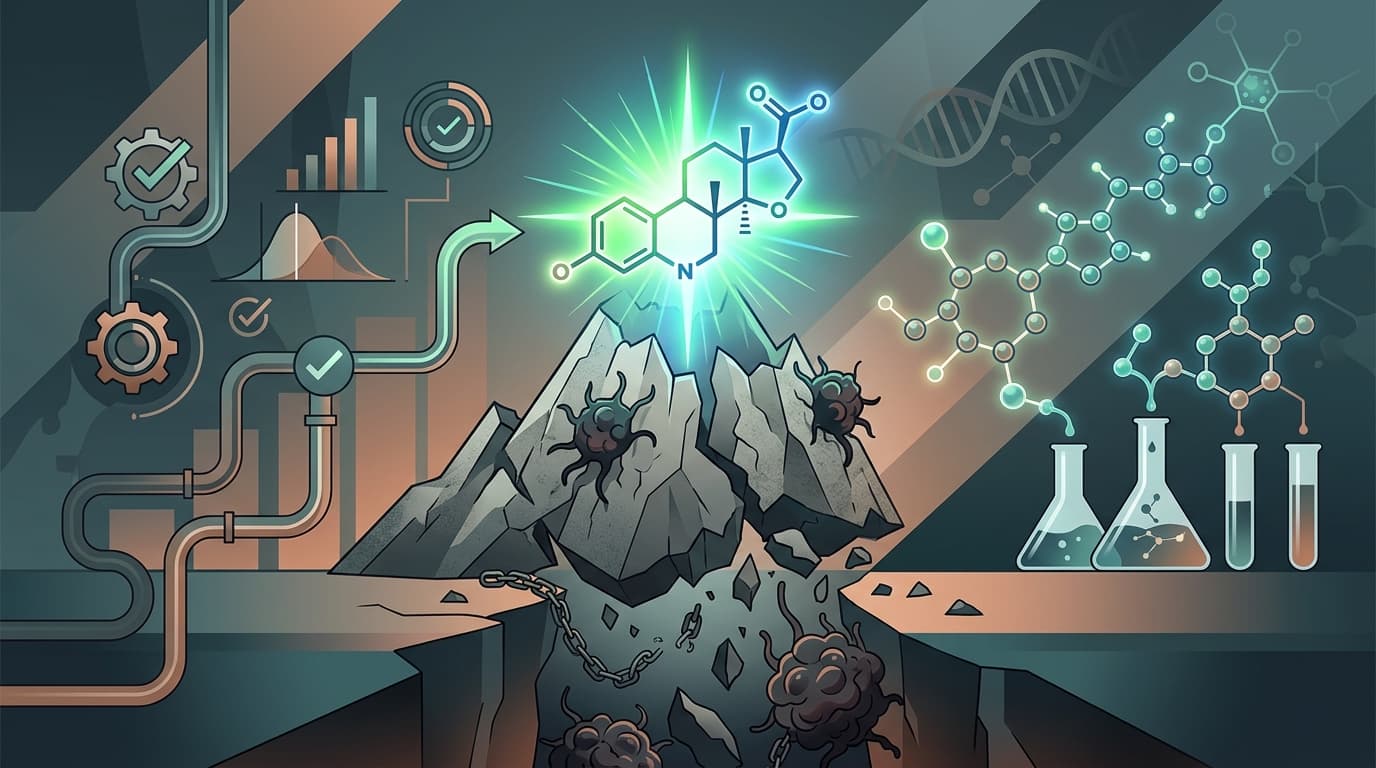
Navtemadlin doesn't touch JAK at all. Instead, it's an MDM2 inhibitor, which works through an entirely different mechanism. In plain English: your cells have a built-in self-destruct button called p53 that kills off damaged or cancerous cells. In myelofibrosis, a protein called MDM2 keeps hitting the mute button on p53, letting the bad cells survive. Navtemadlin blocks MDM2, essentially turning the self-destruct system back on.
It's a clever approach because it sidesteps the whole JAK inhibitor resistance problem. You're not competing on the same playing field; you're opening a new one.
Kartos originally licensed the molecule from Amgen back around 2016, and the company (co-founded by Wayne Rothbaum) spent years moving it through clinical trials. They raised at least $265 million across multiple funding rounds from heavyweights like SR One Capital Management, OrbiMed, Amgen, and Quogue Capital. A $150 million Series C in August 2023 helped fuel the late-stage push.
What the Data Actually Shows
Navtemadlin has two major Phase III trials running. The first, called BOREAS, targets patients whose myelofibrosis has relapsed or stopped responding after JAK inhibitor therapy. Data presented at the ASH 2024 conference (the biggest hematology meeting in the world) showed navtemadlin produced three-fold higher spleen volume reduction and two-fold higher symptom improvement compared to best available therapy at 24 weeks.
That's a meaningful signal, especially in a patient population with very few good options left.
The second trial, POIESIS, is testing navtemadlin combined with ruxolitinib in patients who haven't failed JAK therapy yet but aren't responding well enough. This trial is still ongoing, with no topline results reported as of mid-2026. POIESIS matters because it could position navtemadlin as a first-line combination partner, not just a rescue option.
If both trials deliver, Ipsen would have a drug relevant across the full myelofibrosis treatment journey. That's rare, and it's a big part of why the price tag is so high.
Ipsen's Hematology Shopping Spree
The Kartos deal isn't an isolated move. It's part of a deliberate, multi-year pivot by Ipsen into blood cancers. In December 2025, the company acquired ImCheck Therapeutics to get ICT01/IPN60340, a first-in-class antibody for acute myeloid leukemia (AML) that earned FDA Breakthrough Therapy Designation in January 2026. That same month, Ipsen signed a license deal with Simcere Zaiming for an antibody-drug conjugate and inked a research collaboration with the Université de Montréal.
Since 2020, Ipsen says it has brought in more than 30 programs through external deals, spending €687 million on R&D in 2024 alone. The company has been very public about its strategy: build a specialized hematology franchise through acquisition, not internal discovery. Buy the best assets, plug them into a global commercial infrastructure.
It's the "assemble the Avengers" approach to pipeline building.
Why Analysts Aren't Popping Champagne Yet
The reaction from Wall Street has been cautiously optimistic, which in analyst-speak means "we like the idea but we're not sure about the execution." The bull case is straightforward: navtemadlin addresses genuine unmet need, has a differentiated mechanism, and early Phase III data looks solid.
The bear case is equally clear. Navtemadlin is still investigational. Promising Phase II and early Phase III signals don't always translate into approval. The POIESIS trial hasn't read out yet. And $450 million upfront for an unproven drug is a lot of chips to push into the center of the table.
Consensus on Ipsen stock has hovered around "Outperform" through mid-2026, suggesting the Street thinks the broader strategy is sound even if individual bets carry risk. The milestone-heavy deal structure (only $450 million guaranteed, with $1.3 billion contingent on success) gives Ipsen some protection if navtemadlin stumbles.
The Bigger Picture
The myelofibrosis market is evolving fast. The next wave of competition isn't coming from yet another JAK inhibitor; it's coming from combination strategies and disease-modifying agents. Pelabresib plus ruxolitinib, for instance, is being studied as a potential new frontline combo. The question isn't "which JAK inhibitor wins?" anymore. It's "what can we add to JAK inhibitors, or use instead of them?"
That's exactly the question navtemadlin is designed to answer. If Ipsen got this right, they didn't just buy a drug. They bought a seat at the table for the next decade of myelofibrosis treatment. And unlike the poker metaphor from earlier, the pot is still growing: this is a space where patients desperately need better options, and payers are willing to fund them.
The cards are dealt. Now we wait for POIESIS to show its hand.
Deals & M&A4 min read
The Biotech Investor That Got Caught Peeking at the Answer Key
A federal court found RA Capital and Avilar Therapeutics guilty of willfully stealing a trade secret from Yale, awarding $4 million to Biohaven and the university. The verdict could reshape how biotech investors handle confidential academic science forever.