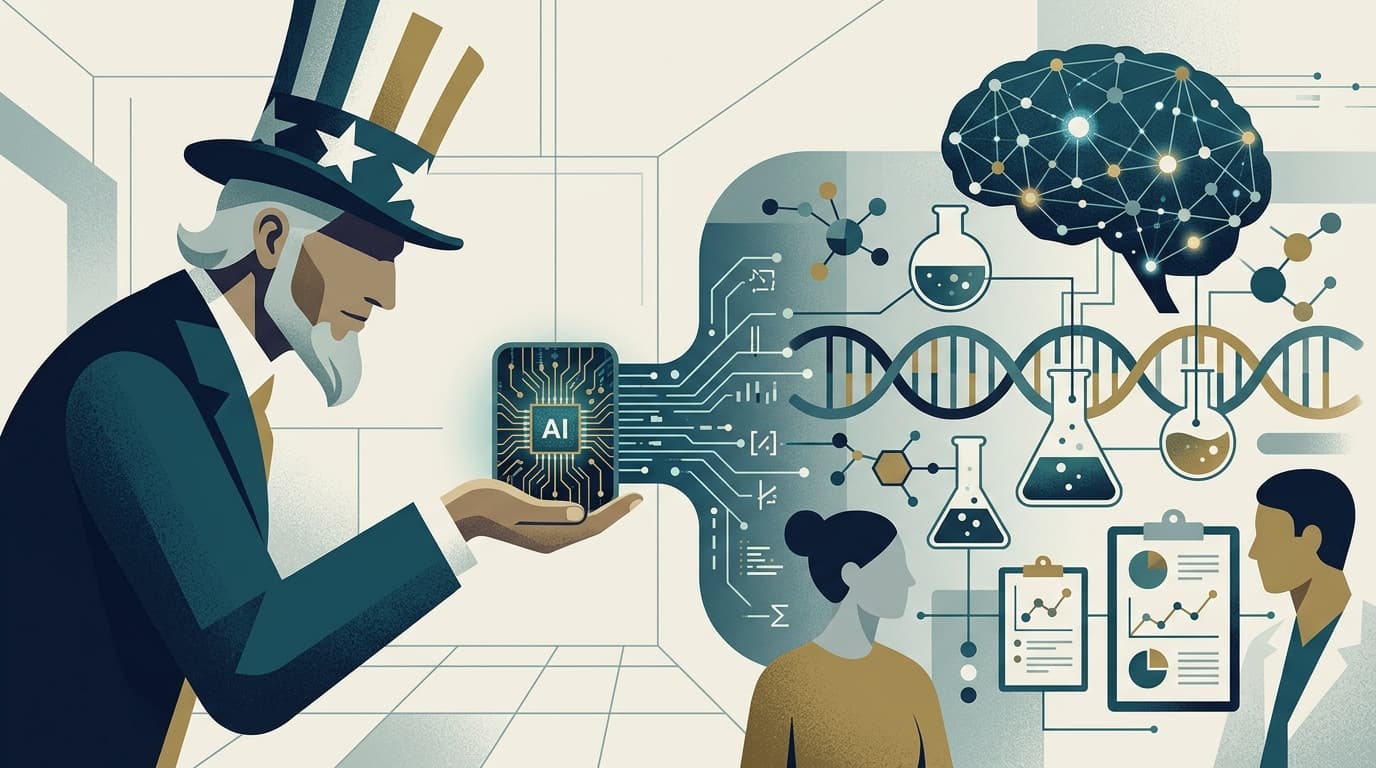
HHS just launched four ambitious AI programs through ARPA-H to overhaul how clinical trials are designed, run, and staffed. The federal government is betting that simulated trials, smarter enrollment, and real-time data analysis can shave years off drug development.
The Slowest Assembly Line in America
It takes, on average, ten to fifteen years to bring a new drug from lab bench to pharmacy shelf. The clinical trial phase alone eats up six to eight of those years. If drug development were a restaurant, you'd wait so long for your entrée that you'd forget what you ordered.
The U.S. Department of Health and Human Services just announced it wants to blow up that timeline. On October 16, HHS unveiled a sweeping set of initiatives through ARPA-H (its Advanced Research Projects Agency for Health) designed to inject artificial intelligence into nearly every phase of clinical trials. The goal: faster design, smarter enrollment, cheaper execution, and fewer patients stuck waiting for treatments that already work.
This isn't a vague policy statement. It comes with named programs, infrastructure plans, and a clear signal that the federal government thinks AI isn't just a nice-to-have for clinical research; it's the future of it.
Four Programs, One Big Bet
The centerpiece is called SURPASS, which stands for Simulation-augmented, Real-time Platform Adaptive Seamless Trials. Yes, the government loves its acronyms. But the idea behind this one is genuinely ambitious.
SURPASS will build AI-powered platforms that can simulate a clinical trial before it actually starts. Think of it like a flight simulator for drug development. Before you put real patients in real trials, you stress-test your protocol with computational models. Which endpoints should you measure? What eligibility criteria make sense? How big does the sample need to be? The AI runs thousands of virtual scenarios to surface problems before they cost you three years and $200 million in a do-over.
Once a trial launches, SURPASS doesn't sit on the sidelines. It analyzes incoming data in real time and supports adaptive designs, meaning the trial can adjust dosing, enrollment, or even its core structure as evidence accumulates. Instead of locking in every decision on day one and praying it works, sponsors get a living, breathing protocol.
But SURPASS doesn't work alone. HHS paired it with three companion programs:
Get tomorrow's biotech intelligence before your competitors.
Join thousands of biotech professionals who start their day with our free, daily briefing.
STACK tackles a surprisingly mundane bottleneck: getting trial sites up and running. Most clinical trials happen at a small number of experienced research hospitals, leaving thousands of clinics and community health centers on the sidelines. STACK uses AI to accelerate site activation and convert "research-naïve" locations into functioning trial sites. More sites means more patients, faster enrollment, and better diversity.
COMMONS is the plumbing underneath everything else. It's a national data infrastructure project designed to create consent frameworks and access to regulatory-grade research data at scale. Without clean, standardized data flowing between sites and sponsors, even the smartest AI is useless.
CINCH focuses specifically on cancer. It helps adults contribute their health data to research and connects them with clinical trials they might qualify for. Think of it as a matchmaking service between cancer patients and the studies that need them.
Together, these four initiatives represent HHS's most aggressive bet yet that the U.S. clinical trial system needs a fundamental upgrade, not just incremental tweaks.
Why This Matters More Than You Think
Let's zoom out for a second. The traditional clinical trial process is, to put it bluntly, a relic. Protocols are designed by committee over months. Patient recruitment is painfully slow (some trials never finish because they can't find enough participants). And once a trial starts, it runs on rails: fixed design, fixed assumptions, fixed everything.
The numbers tell the story. Various industry estimates suggest AI-enabled approaches could reduce overall drug development timelines by 30 to 50%. Those figures come from aggregated studies rather than a single definitive benchmark, so take them as directional. But even half of that improvement would be transformative.
Consider what happens when you shave three years off a drug's development. Patients get treatments sooner. Sponsors save hundreds of millions in trial costs. And smaller biotech companies, the ones that can't afford to burn cash for a decade, suddenly have a fighting chance.
The Government's AI Homework (Years in the Making)
This announcement didn't materialize out of thin air. HHS and the FDA have been building toward this moment since at least 2023, when FDA published a discussion paper on using AI and machine learning in drug development. That paper gathered more than 800 public comments, signaling enormous industry interest.
By early 2025, FDA had issued draft guidance recommending a risk-based credibility assessment for AI models used in regulatory submissions. Translation: if you want to use AI to generate data that supports a drug approval, you need to prove the model is trustworthy, validated, and well-documented. The agency also released ten guiding principles for "good AI practice" in drug development, covering everything from human-centric design to lifecycle management.
The October 2026 announcement is the next logical step. Where 2023 and 2024 were about setting rules, 2026 is about building tools. ARPA-H is moving from "here's what we think AI should do" to "here's the infrastructure to actually do it."
Industry Is Already at the Table
If HHS is setting the table, pharma companies have already grabbed their forks. Several major players are deep into AI-powered clinical trial partnerships:
Bristol Myers Squibb announced it would deploy Evinova's AI-enabled clinical development platform across its entire global portfolio to improve trial design and accelerate timelines. That's not a pilot; it's a company-wide commitment.
AstraZeneca has been especially aggressive. It signed multi-year AI collaborations with insitro (for MASH and cardiomyopathies), Immunai (to support cancer immunotherapy trials), and a partnership with Tempus AI and Pathos for generative AI in oncology. AstraZeneca isn't dabbling; it's building an AI ecosystem around its pipeline.
On the data side, Thermo Fisher Scientific's PPD clinical research business partnered with Datavant to connect real-world data with clinical research, tackling the messy problem of making patient records useful for trial design. And in October 2026, CellCarta and Imagene AI expanded their collaboration to validate AI-powered biomarker programs for precision clinical trials.
The pattern is clear: industry isn't waiting for government to build everything. But government infrastructure could accelerate adoption across the board, especially for smaller companies that can't afford to build their own AI stacks.
The Skeptic's Corner
Now for the cold water. Industry reaction has been cautiously optimistic, which in pharma-speak means "we like the direction, but we'll believe it when we see it."
The concerns are real. Building national data infrastructure (COMMONS) is enormously complex. Patient consent frameworks, data standardization, privacy protections: these are problems that have defeated smart people for decades. An acronym and a press release don't solve them.
Then there's the regulatory question. The FDA says it welcomes AI in trial design, but sponsors still need to prove their models are reliable before regulators will accept AI-generated evidence in approval packages. That validation layer takes time and money. For programs with strong data infrastructure and well-defined endpoints, AI could meaningfully shorten timelines. For everyone else, it might just add another box to check.
Applied Clinical Trials, a well-respected industry publication, noted that while the HHS effort creates real opportunities, building the necessary infrastructure will be challenging for sponsors. That's a diplomatic way of saying: the technology is ahead of the operational reality at most companies.
What Happens Next
The 2026 HHS announcement marks a clear inflection point. The federal government has moved from publishing discussion papers and collecting comments to actually funding and building AI trial infrastructure. That shift matters.
But the real test isn't whether SURPASS can simulate a trial on a computer. It's whether a sponsor can use that simulation to design a better study, enroll patients faster, get cleaner data, and convince the FDA that the results are trustworthy. That chain has a lot of links, and each one needs to hold.
The most likely near-term outcome is selective acceleration. Companies with sophisticated data operations and the resources to validate AI models will move faster. Smaller biotechs may benefit indirectly as COMMONS and STACK expand the infrastructure available to everyone. And the FDA will continue evolving its frameworks, probably at a pace that frustrates both AI evangelists and AI skeptics.
One thing seems certain: the era of designing clinical trials the way we did in 2005 is ending. The question isn't whether AI will reshape drug development. It's how fast the system (regulators, sponsors, hospitals, patients) can actually absorb the change.
If the government's bet pays off, the next blockbuster drug might reach patients years earlier than it otherwise would have. And that timeline compression isn't just a business story. For the patient running out of options, it's everything.
Funding & Financings
4 min read
$103M to Fix the Gene That's Slowly Destroying 1 in 1,000 Kidneys
A new biotech just emerged from stealth with $103 million to attempt something nobody has done: fix the broken genes behind the most common inherited kidney disease. The science comes from Yale, the money comes from RA Capital, and the stakes couldn't be higher.