A Catheter, Some Stem Cells, and a Bet on Regrowing the Human Heart
A Japanese biotech just threaded lab-grown heart muscle cells through a catheter and into a patient's failing heart for the first time ever. It's either the future of cardiology or the most ambitious long shot in regenerative medicine.
The Procedure That Shouldn't Exist Yet
Somewhere in a hospital in Nagano, Japan, a man in his 70s with a failing heart just became a medical first. A catheter threaded into his left ventricle. Tiny clusters of lab-grown heart muscle cells, each about the width of a human hair, injected into 15 spots inside the organ. No cracked-open chest. No bypass machine. No scalpel near the sternum.
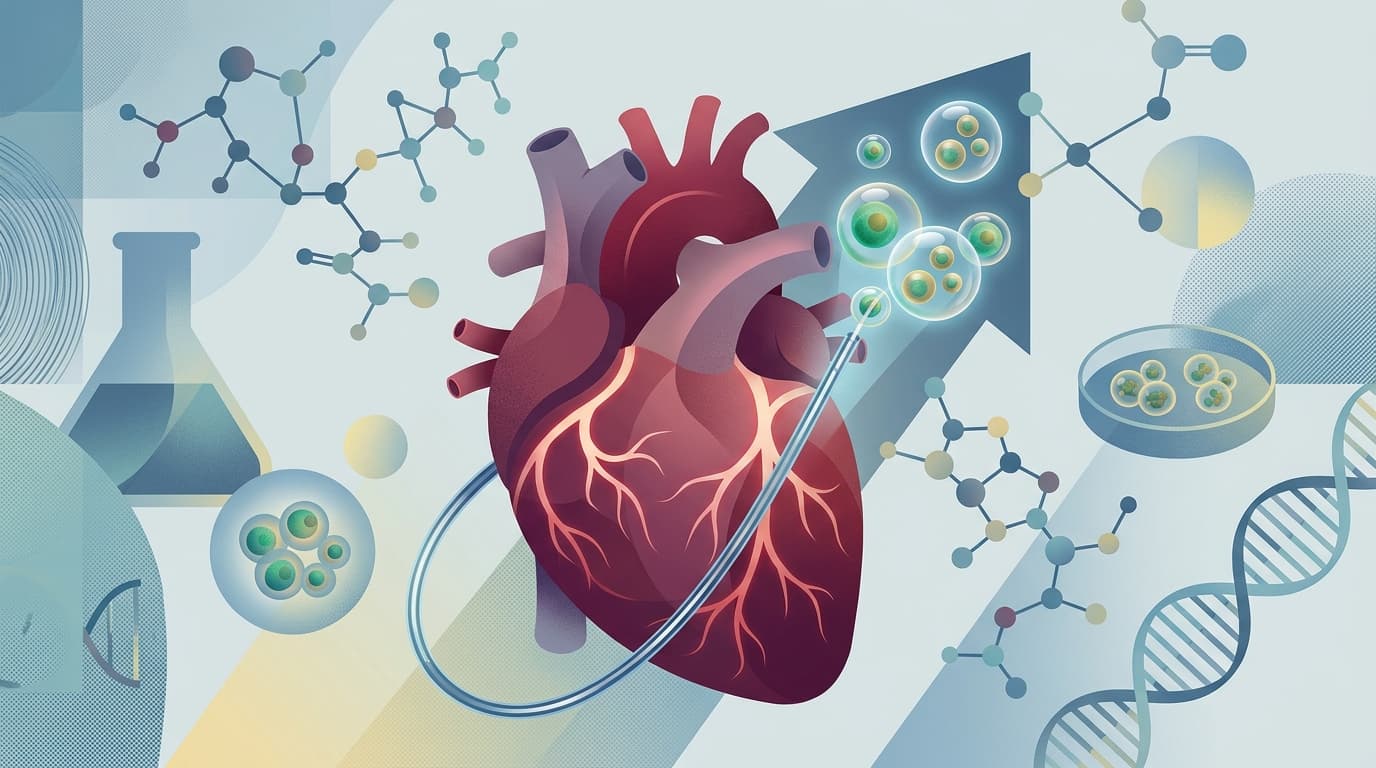
The company behind it, Heartseed Inc., calls the product HS-005. The trial is called EMERALD. And what happened in late March 2026 at Shinshu University Hospital represents the world's first catheter delivery of iPSC-derived cardiomyocyte spheroids for heart failure. That's a mouthful, so let's translate: lab-grown beating heart cells, delivered through a tube in your leg, designed to rebuild a broken heart from the inside out.
If that sounds like science fiction, well, it kind of was until recently.
What Are These Tiny Beating Balls, Exactly?
Heartseed's technology starts with induced pluripotent stem cells (iPSCs), which are adult cells reprogrammed back into a flexible state, like resetting a phone to factory settings. From there, scientists coax them into becoming ventricular cardiomyocytes: the specific type of heart muscle cell that does the heavy lifting of pumping blood.
But here's the clever part. Instead of injecting loose individual cells (which tend to wash away like sand in a river), Heartseed bundles about 1,000 cardiomyocytes into tiny spheroids. Think of them as pre-assembled Lego blocks rather than a pile of loose bricks. These micro-tissues are roughly 0.2 millimeters across and arrive with their internal wiring already partially connected.
The result? In preclinical studies, spheroids showed dramatically better retention and survival compared to single-cell injections. Once engrafted, the transplanted cells can grow to approximately 30 times their original volume over time, essentially building new muscle mass inside a failing heart.
Get tomorrow's biotech intelligence before your competitors.
Join thousands of biotech professionals who start their day with our free, daily briefing.
Why a Catheter Changes Everything
Heartseed already has an earlier product, HS-001, that delivers the same spheroids during open-heart surgery. That trial (called LAPiS) treated 10 patients with ischemic heart failure in Japan, and the results were encouraging: no tumors, no dangerous arrhythmias, and improved ejection fraction (the percentage of blood your heart pumps out with each beat) in most patients. Some returned to near-normal daily activity.
But open-heart surgery is, to put it mildly, a big ask. Many heart failure patients are too frail for it. Requiring a sternotomy just to deliver cells is like needing to tear down a wall every time you want to hang a picture.
HS-005 solves this with a dual-catheter system. The first catheter maps the inside of the heart in 3D using electrical signals, identifying exactly where damaged tissue sits. Through its center, a second catheter threads forward with a needle at the tip and tiny side holes that release spheroids directly into the heart wall. The mapping catheter can even detect when the tip has reached the right depth in the muscle layer.
The practical implications are huge. Catheter procedures mean no general anesthesia, shorter hospital stays, and the ability to repeat treatments if needed. They also mean this therapy could eventually reach the millions of heart failure patients who would never qualify for open-chest surgery.
First Patient: So Far, So Good
The first EMERALD patient received approximately 150 million cardiomyocytes across 15 injection sites. His post-procedure course was described as "largely uneventful." He experienced some ventricular arrhythmias (irregular heartbeats), but these were within the expected range and manageable. He was discharged on schedule.
An independent safety committee reviewed the first four weeks of data and cleared the trial to continue enrolling patients in the dilated cardiomyopathy cohort. With a single patient and no control group, however, it remains far too early for any definitive signal on efficacy.
The EMERALD trial plans to enroll 14 patients total: seven with ischemic heart disease, seven with dilated cardiomyopathy. The primary endpoint is safety over 26 weeks, with cardiac function tracked as an exploratory measure.
A Crowded (But Tiny) Race
Heartseed isn't alone in trying to regrow damaged hearts, but the field is still remarkably small. Repairon GmbH in Germany is testing engineered heart tissue patches that get surgically sewn onto the heart's surface. A Japanese academic consortium linked to Cuorips received conditional approval in March 2026 for an iPSC-cardiomyocyte patch therapy, making it the first iPSC-derived heart cell product to reach market anywhere in the world. In China, HELP Therapeutics has early clinical data on its own iPSC-cardiomyocyte product.
Each competitor has chosen a different bet. Patches require open surgery but deliver cells in a pre-organized sheet. Injections are less invasive but risk cells washing away. Heartseed's spheroid-plus-catheter approach is essentially trying to combine the biological advantages of structured tissue with the clinical convenience of a minimally invasive procedure.
BlueRock Therapeutics (backed by Bayer) lurks in the background with iPSC cardiac programs still in preclinical stages but serious platform muscle.
The Big Questions That Remain
Experts are cautiously optimistic, which in medicine translates to: "This is cool, but don't pop the champagne yet."
The mechanism of action has two parts. First, the transplanted cardiomyocytes are supposed to electrically couple with the patient's existing heart cells, beating in sync and adding contractile force. Second, the graft cells secrete growth factors that promote new blood vessel formation around the injection sites, improving blood flow to the damaged area.
Both of those sound great on paper. But the hard questions remain unanswered. Do these cells stay engrafted for years, or do they fade? Does electrical coupling remain stable, or does it eventually become a source of dangerous arrhythmias? Can you manufacture billions of highly pure ventricular cardiomyocytes at a cost that health systems will actually pay for?
Heartseed is working with Nikon Cell Innovation on manufacturing. Japan's regenerative medicine regulatory framework allows conditional approvals based on limited efficacy data plus strong safety profiles, which means HS-001 could reach the Japanese market as early as 2026 or 2027.
Why This Matters Beyond Cardiology
Heart failure affects over 60 million people worldwide. Current treatments (drugs, devices, transplants) manage the decline but don't reverse it. No approved therapy actually regrows lost heart muscle.
If catheter-delivered iPSC cardiomyocyte spheroids work, it won't just change heart failure treatment. It will validate an entire category of medicine: the idea that you can manufacture replacement human tissue in a factory, load it into a catheter, and rebuild organs without surgery.
That's a massive "if." Fourteen patients in Japan won't answer it. But every revolution in medicine starts with a single patient who volunteers for something that sounds impossible. A man in his 70s in Nagano just did exactly that.
Clinical & Regulatory
5 min read
The FDA Just Declared War on Cheap Ozempic
The FDA just launched its largest-ever coordinated crackdown on compounding pharmacies selling cheap versions of Ozempic and Wegovy, explicitly targeting Hims & Hers in the process. A multibillion-dollar grey market is being dismantled, and the fallout is reshaping telehealth, Big Pharma, and patient access to the most popular drugs in America.